
Sugarcane weevil
Sphenophorus levis
Description
How to identify
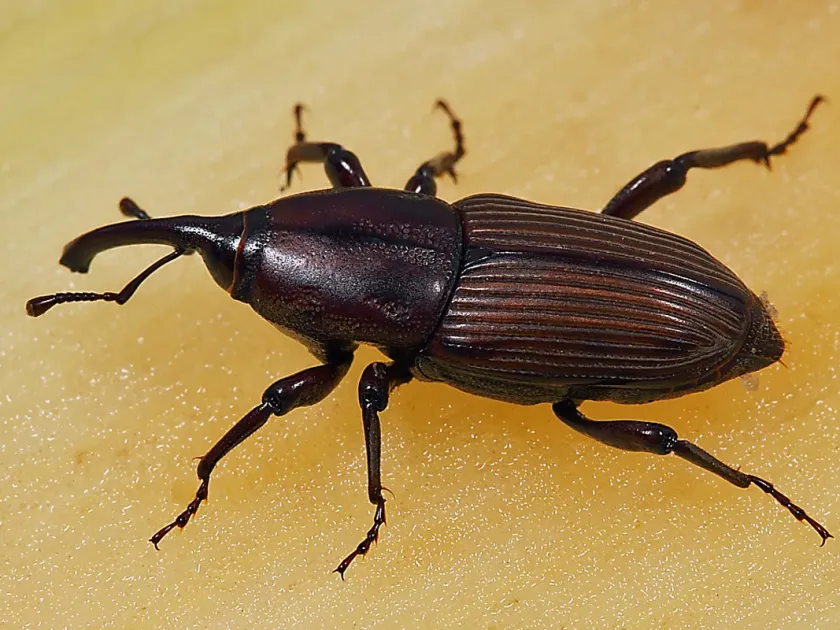
The adult sugarcane weevil is a beetle measuring between 10 and 15 millimeters in length, featuring the characteristic elongated snout of the Curculionidae family. Its body color ranges from dark brown to black, often with a matte or slightly dull appearance.
The larva is a legless, creamy-white grub with a distinct brown head capsule. It spends its entire development period hidden inside the stalks or rhizomes of the host plant, feeding on the internal tissues until it pupates.
Taxonomically, this insect belongs to the order Coleoptera and the family Curculionidae. It is a highly specialized pest that thrives in monoculture environments, particularly in large sugarcane plantations.
The weevil is notoriously cryptic, making it difficult to detect during the early stages of an infestation. Because the life cycle occurs largely within the plant structure, visual inspection of the outer surface often reveals nothing.
Successful identification requires field scouts to look for subtle symptoms, such as wilting or unusual growth patterns. Destructive sampling, involving the cutting of suspect stalks, is often necessary to confirm the presence of larvae.
What it damages
Sugarcane is the primary host for Sphenophorus levis, and the damage it inflicts can lead to severe economic losses. The pest is particularly devastating in regions where sugarcane is grown continuously on the same land.
While sugarcane is the main target, the weevil can also affect other grass species nearby. However, the intensity of damage is highest in managed industrial sugarcane fields, where the density of hosts is ideal for the pest.
Larval feeding activity focuses on the base of the stalk and the root system. By tunneling through these critical areas, the larvae destroy the plant's ability to transport water and essential nutrients from the soil.
As the internal structure of the stalk is consumed, the plant loses its structural integrity. This causes the stalks to become brittle, leading to lodging, where the entire plant falls over even under moderate weather conditions.
Beyond the loss of biomass, the pest significantly reduces the sugar content of the crop. This degradation of quality makes the harvest less profitable for industrial processing, creating a direct impact on sugar yield.
When it appears
The activity of the adult weevil is primarily linked to warm weather conditions, which trigger mating and egg-laying cycles. During these peak periods, the beetles emerge to colonize new parts of the field.
Larval damage is most severe during the intense growth phase of the sugarcane. The destruction of internal tissues at this stage often prevents the plant from recovering, leading to stunted development and eventual death.
The insect typically overwinters in the larval stage, residing safely within the crown or rhizome of the sugarcane. This internal survival strategy allows the population to persist through periods that would otherwise be unfavorable.
Emergence patterns in the spring are often influenced by soil moisture and temperature. Regular rainfall events can stimulate the movement of the weevils, leading to localized population spikes across a plantation.
In tropical and subtropical climates, the life cycle may be continuous, allowing for multiple generations per year. This constant pressure makes the sugarcane weevil an extremely challenging pest to manage effectively.
Signs of infestation
The most common indicator of an infestation is the yellowing and death of the central shoot, a condition known as "dead heart." This occurs when larvae sever the growing point of the sugarcane plant.
Entry holes at the base of the stem are a key sign. These are often surrounded by a buildup of frass—a sawdust-like mixture of plant material and insect excrement—indicating active tunneling activity inside the stalk.
Affected plants exhibit a distinct lack of vigor and uneven stands across the field. When pulled, these stalks often detach easily from the root system, revealing the extensive damage caused by larvae tunneling through the crown.
Longitudinal dissection of a damaged stalk will reveal a maze of tunnels filled with fibrous debris. Finding the larvae or pupae within these tunnels confirms the diagnosis of an active Sphenophorus levis infestation.
In fields with high pest density, patches of dead or severely stunted plants are visible. These patches tend to expand over time as the adult beetles move to neighboring plants to continue their reproductive cycle.
Control measures
The use of clean, certified planting material is the most important defense. Growers must ensure that cane cuttings are free from eggs or larvae before planting to avoid introducing the pest into new areas.
Crop rotation serves as a powerful agronomic tool to manage population levels. By switching to non-host crops for a few seasons, the weevil’s primary food source is removed, leading to a significant drop in its numbers.
Chemical control focuses on applying insecticides either at the time of planting or during peak adult activity. Systemic products that can penetrate the plant tissue are generally more effective against larvae residing inside stalks.
Biological control using entomopathogenic fungi and nematodes offers a sustainable alternative. These biological agents can infect larvae within their concealed habitats, providing long-term population suppression without chemical residue.
Post-harvest management is critical. Destroying crop residues and tilling the soil thoroughly helps to kill overwintering larvae in the rhizomes. Proper sanitation significantly reduces the risk of carry-over infestations for the next season.
Taxonomy
- Latin name
- Sphenophorus levis
- Order
- Coleoptera (beetles)
- Family
- Dryophthoridae
- EPPO code
- SPPHLE
Discussion
No discussions yet — be the first.