
Maize billbug
Sphenophorus cariosus
Description
How to identify
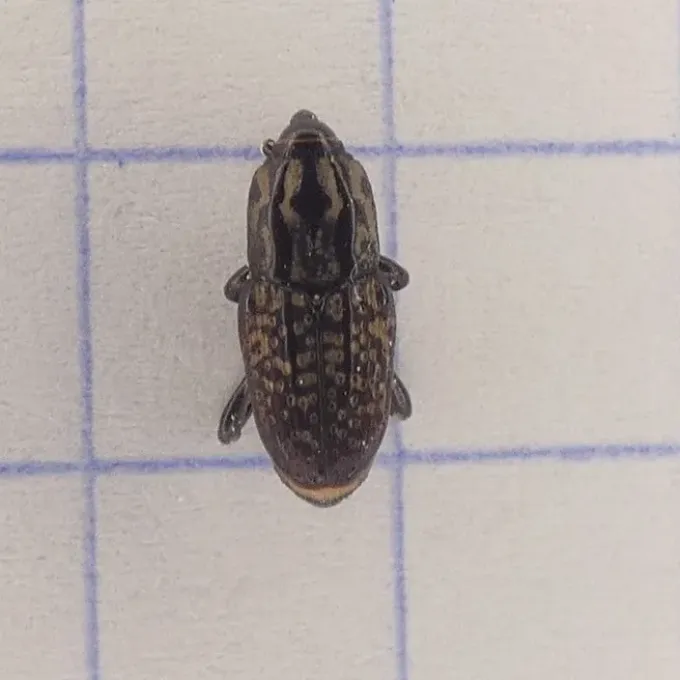
Sphenophorus cariosus, commonly known as the maize billbug, belongs to the family Curculionidae (weevils). It is a significant pest characterized by a distinct elongated snout and a robust, dark, matte-colored body.
Adult beetles measure approximately 10–12 mm in length. Their elytra (wing covers) display a unique texture with fine grooves and pits, which is a key identification feature for this specific species.
The larvae are legless, creamy-white grubs with a well-developed, dark head capsule. They are exclusively internal feeders, spending their entire larval stage inside plant tissues.
Adult billbugs are primarily nocturnal, often mimicking inanimate objects when disturbed, which makes them difficult to spot during routine field inspections.
This species is highly adapted to agricultural environments, surviving in soil residues and feeding on various grasses before moving into cultivated fields.
What it damages
The maize billbug primarily attacks maize (corn), causing significant damage to young plants. Both adults and larvae contribute to yield loss, though they cause damage in different ways.
Adult beetles feed on the stems and leaves of young seedlings, creating characteristic rows of holes that appear as the plant grows and the leaves unfold.
Larvae cause more severe damage by boring into the stalks or roots of the plant, which compromises the vascular system and stunts growth significantly.
Plants infested with larvae often exhibit severe distortion, lodging, or complete wilting, as the internal tissues are consumed and destroyed.
In cases of heavy infestation, the cumulative impact leads to substantial thinning of plant stands, resulting in yield losses that can be difficult to recover from later in the season.
When it appears
Adult billbugs emerge from overwintering sites in the spring, coinciding with the germination and emergence of the corn crop. This is the period of highest risk for seedling survival.
Eggs are typically laid in the soil near the base of the plant or directly into the stem tissue. Larval development occurs over several weeks, depending on soil temperatures and moisture.
The life cycle continues with pupation, which usually occurs in the soil near the host plant, protecting the developing insect from external pressures.
Depending on the region, there may be overlapping generations, with adults potentially being present and active in fields throughout the majority of the summer season.
As the weather cools, the surviving adults migrate toward deeper soil layers or dense crop debris to initiate overwintering, marking the end of the primary feeding season.
Signs of infestation
The most recognizable symptom is the appearance of uniform, repetitive holes across leaf blades. These marks are caused by adult feeding before the leaves have fully expanded from the whorl.
Plants infested with larvae often show signs of stunted growth or chlorosis compared to the surrounding healthy vegetation in the same field.
Base-of-stem damage can be identified by the presence of entry holes accompanied by "frass" (sawdust-like debris) at the site of larval penetration.
In extreme cases, young corn plants may show sudden lodging or collapse at the base because the internal stem tissue has been largely hollowed out by the feeding larvae.
Field scouting at dawn or dusk may reveal adult beetles near the base of damaged plants, providing definitive confirmation of the pest's presence.
Control measures
Cultural practices such as crop rotation are the first line of defense, as billbugs are relatively immobile and struggle to survive if the host crop is absent for an extended period.
Tillage methods that turn the soil effectively disrupt the overwintering habitat and expose the pests to environmental elements and natural predators.
Seed treatments with systemic insecticides are highly recommended as they provide essential protection for seedlings during the early, most vulnerable developmental stages.
In-season foliar applications of systemic insecticides can be utilized to target adult populations before they deposit a significant number of eggs.
- Implementing strict weed control to remove alternative grassy hosts.
- Selecting corn hybrids known for vigorous early-season growth.
- Monitoring field edges and adjacent grassy areas for early warning signs.
- Conducting post-harvest surveys to manage populations for the following season.
Taxonomy
- Latin name
- Sphenophorus cariosus
- Order
- Coleoptera (beetles)
- Family
- Dryophthoridae
- EPPO code
- SPPHCR
Discussion
No discussions yet — be the first.