
Southern corn billbug
Sphenophorus callosus
Description
How to identify
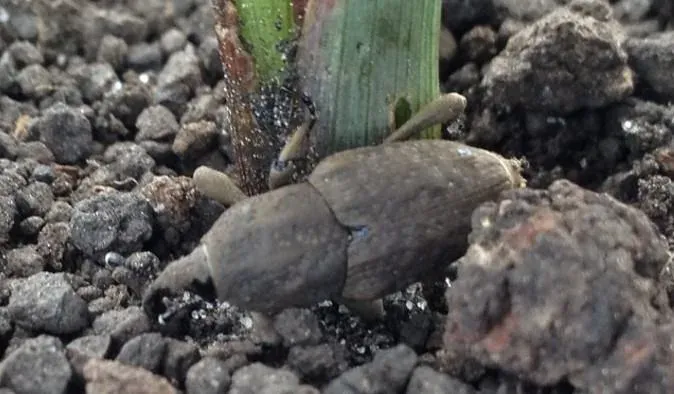
The southern corn billbug, Sphenophorus callosus, belongs to the order Coleoptera and the family Curculionidae (weevils). The adult is a beetle measuring approximately 10–12 mm in length, characterized by a prominent snout.
The insect body has a dark, often nearly black, appearance with a matte or slightly glossy texture. The wing covers (elytra) are marked by deep longitudinal grooves, giving them a distinctively sculptured appearance.
The larvae are legless grubs, typically creamy-white with a distinct brownish-red head capsule. They live primarily within the stem or at the base of the plant, remaining concealed throughout their development.
The pupal stage occurs within the larval feeding galleries in the plant tissue. They are rarely seen in the field without deliberate dissection of the damaged stalks.
This species undergoes complete metamorphosis: egg, larva, pupa, and adult. The adults are equipped with a hardened exoskeleton that provides protection against environmental stress.
What it damages
The primary host for this pest is corn, though it can also infest various wild grasses. Adult beetles feed on foliage and young stems, causing minor initial damage.
The most severe damage is caused by the larvae, which tunnel into the base of the corn stalk. This destruction of the stem tissue disrupts the vascular system of the plant.
Seedlings attacked by the billbug often wilt, yellow, and eventually die. Even if the plants survive the larval stage, their overall growth is significantly stunted, leading to reduced grain yield.
Extensive tunneling at the base of the stalk weakens the plant's structural integrity. This predisposes the crop to lodging, making mechanical harvesting difficult and inefficient.
In areas with high population pressure, the southern corn billbug can cause catastrophic losses. It is particularly problematic in continuous corn cropping systems where the pest has a stable food supply.
When it appears
Overwintered adults emerge from the soil in the spring as temperatures rise, signaling the start of their active season. This timing often aligns with the emergence of corn seedlings.
Peak activity of the adult beetles typically occurs during the early vegetative stages of corn, which is when the crop is most vulnerable to economic damage.
Females deposit eggs in individual cavities created in the stem near the soil line. This oviposition process occurs over several weeks, leading to overlapping life stages in the field.
Larval development takes several weeks depending on the temperature and moisture conditions. Multiple generations may occur in warmer climates throughout the growing season.
As fall approaches, the new generation of adults seeks shelter in the soil or crop debris to overwinter. Identifying the specific emergence window is critical for effective chemical intervention.
Signs of infestation
One of the earliest diagnostic signs of billbug activity is the appearance of rows of symmetrical, transverse holes on the leaves, which become visible as the leaves unfurl.
Wilt of the central leaf, often referred to as "dead heart," is a clear indicator of larval feeding within the stem. The damaged leaf often pulls away easily from the whorl.
Deformation of the stalk, including swelling or inward curvature at the base, is a hallmark sign of larval infestation. Dissecting the stem reveals internal cavities and frass.
Field patches with uneven growth or missing stands often indicate localized infestations. Plants in these areas are frequently stunted or have a yellowish, sickly appearance.
- Symmetrical leaf holes in unfolded leaves.
- Wilting of the central whorl ("dead heart").
- Stunting and basal distortion of the corn stalk.
- Increased lodging due to weakened stem bases.
- Presence of sawdust-like frass inside the stalk.
Control measures
Cultural control remains a primary strategy, with crop rotation being the most effective method to disrupt the pest's life cycle. Avoiding corn-on-corn planting is highly recommended.
Sanitation practices, such as the destruction of crop residues and effective weed control, reduce the overwintering success of the beetles. Early-season tillage can also disturb populations.
Seed treatments with systemic insecticides are currently the most reliable way to protect young corn seedlings from early larval damage. This ensures protection during the most vulnerable growth phase.
Foliar insecticide applications may be necessary if adult beetle populations exceed economic thresholds. Timing is critical, and scouts should be used to monitor emergence.
Integrated Pest Management (IPM) programs emphasize monitoring and combining different tactics, such as choosing hybrid varieties with better vigor and avoiding high-risk, poorly drained fields.
Taxonomy
- Latin name
- Sphenophorus callosus
- Order
- Coleoptera (beetles)
- Family
- Dryophthoridae
- EPPO code
- SPPHCA
Discussion
No discussions yet — be the first.