

Pest · Lepidoptera (butterflies) · affects Tomato, Winter wheat, Soybean
Especially harmful
Silver Y
Autographa gamma
Description
How to identify
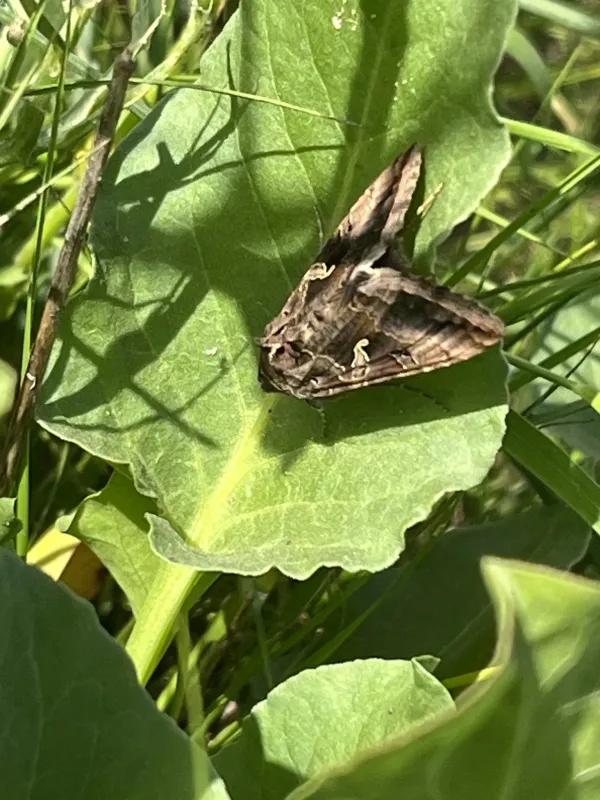
The Silver Y moth (Autographa gamma) is a migratory insect belonging to the family Noctuidae. The adult moth has a wingspan of 35–48 mm and is named for the distinctive silver mark on its forewings that resembles the Greek letter gamma.
The larvae, or caterpillars, are typically bright green with white or yellowish longitudinal lines. They have a characteristic looping movement due to having only three pairs of prolegs, which distinguishes them from other noctuid larvae.
Pupation occurs within a white, loose silk cocoon, often hidden inside folded leaves or among plant debris. The pupa darkens from green to a dark brown as it matures toward the emergence of the adult moth.
As a highly mobile species, the Silver Y moth can migrate over thousands of kilometers. This migration capability allows the species to colonize new areas rapidly and adapt to changing seasonal conditions across different latitudes.
The total lifespan and the number of generations depend heavily on climate, with warmer regions supporting multiple overlapping generations per year, while cooler areas may only see one or two significant flights.
What it damages
The Silver Y moth is a polyphagous pest, meaning it feeds on a vast array of host plants. It poses a significant threat to agriculture, specifically damaging sugar beets, potatoes, sunflowers, peas, and various leafy vegetables.
Young larvae initially graze on the epidermis of leaves, causing skeletal damage. As they grow, they move on to consuming the entire leaf tissue, leaving only the primary veins, which significantly impairs the plant's ability to photosynthesize.
Severe infestations can lead to complete defoliation of crops. In addition to direct biomass loss, the damage weakens the plants, making them more susceptible to secondary pathogens, including bacteria and fungi that cause root or stem rot.
The economic impact is highest when larvae attack during critical growth stages, such as seedling emergence or pod filling. Reduced leaf surface area leads to lower accumulation of storage compounds, negatively impacting yield quality.
In greenhouses and open fields alike, the rapid feeding rate of large populations can result in catastrophic crop losses within a very short period, necessitating constant monitoring and timely intervention.
When it appears
Adult moths typically arrive in temperate regions during late spring or early summer, depending on wind patterns and temperature. These migrations mark the beginning of the local breeding cycle.
Egg-laying begins shortly after the arrival of the adults. The subsequent larval stages are most active during the peak summer months, coinciding with the most vigorous growth phase of many agricultural crops.
A second, often larger, generation typically peaks in late summer and early autumn. This generation poses the most serious risk to late-harvested vegetables and fodder crops.
As temperatures begin to drop, the final generation may attempt to overwinter in the soil as larvae or pupae. Successful overwintering is highly dependent on soil temperature and the presence of vegetative cover.
Monitoring using pheromone traps is essential for detecting the arrival of adult moths, allowing farmers to predict potential larval outbreaks and prepare necessary pest management strategies.
Signs of infestation
The earliest signs of infestation include irregular holes in the leaves, known as shot-holing. This is caused by first-instar larvae feeding on the leaf surface without completely perforating it.
The presence of frass (caterpillar excrement) on leaves or on the ground beneath the plants is a reliable indicator of larval activity. Heavy deposits are usually found in the central whorl or underside of leaves.
Larvae often use fine silken webbing to join leaves together, creating a protective enclosure. Finding these "tents" or rolled leaves is a definitive sign of active infestation by the Silver Y moth.
Visible wilting or yellowing of foliage despite adequate watering may indicate that larvae are feeding on the plant's vascular tissue or have caused enough structural damage to interrupt nutrient transport.
A visual inspection of the underside of leaves and stems, especially in the early morning or at dusk, will often reveal the larvae, as they are often photophobic and hide from direct sunlight.
Control measures
Integrated Pest Management (IPM) is the most effective approach for controlling the Silver Y moth, emphasizing a combination of cultural, biological, and chemical methods.
- Deep tillage (plowing) after harvest to bury and destroy overwintering pupae.
- Rigorous weed control in and around fields to eliminate alternative host plants and nectar sources.
- Application of microbial insecticides, such as Bacillus thuringiensis, which is specific to caterpillars.
- Release of biological control agents like Trichogramma wasps that parasitize the moth's eggs.
- Targeted chemical application using selective insecticides when larval densities exceed economic thresholds.
Crop rotation is a critical cultural practice. By alternating host plants with non-host crops, growers can break the lifecycle of the moth and significantly reduce the overall population pressure in the soil.
Chemical control should be timed to match the most vulnerable larval stages, usually early instars. Evening applications are preferred to maximize contact since the larvae are more active and exposed at night.
Regular field scouting and data from pheromone traps ensure that interventions are applied only when necessary, minimizing cost and reducing the impact on beneficial insects and the environment.
Content graph
Connections · Silver Y
Most often together:
Marketplace
Products · 2

Biology
Taxonomy
- Latin name
- Autographa gamma
- Order
- Lepidoptera (butterflies)
- Family
- Noctuidae
- EPPO code
- PYTOGA
Community
Discussion
No discussions yet — be the first.