
Brown-tail moth
Somena similis
Description
How to identify
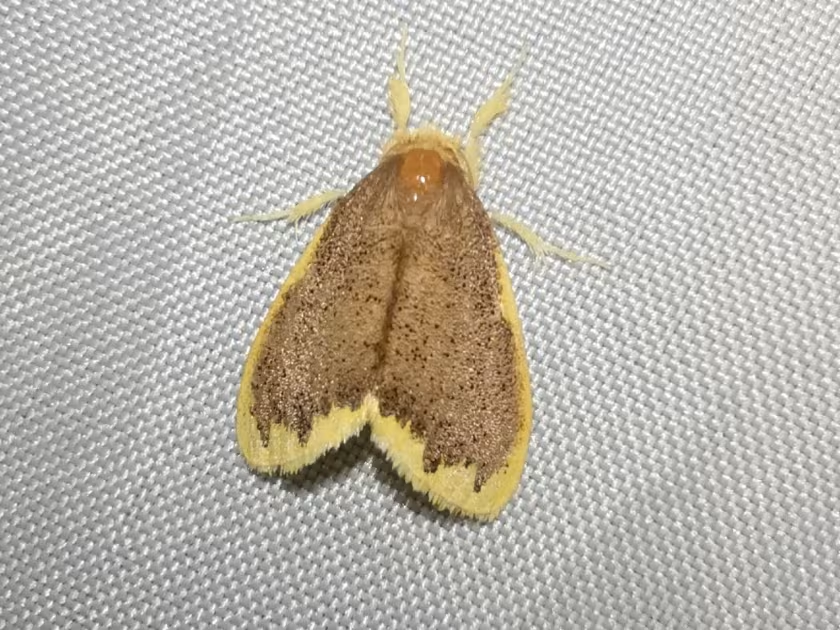
The Brown-tail moth (scientific name Somena similis, formerly Euproctis chrysorrhoea) is a destructive species of moth in the family Erebidae.
Adult moths are recognizable by their bright white wings and a distinctive tuft of golden-brown hairs located at the tip of the abdomen.
Caterpillars are dark brown to black, featuring two reddish-orange lines along the back and are densely covered with urticating (stinging) hairs.
Pupation occurs within brownish cocoons, which are constructed from spun silk and leaf remnants, usually hidden in the tree canopy.
The moth lays eggs in small, neat batches on the underside of leaves, covering them with the golden hairs from its abdomen for protection against weather.
What it damages
The Brown-tail moth is a highly polyphagous insect that attacks a wide variety of broad-leaved trees and shrubs in orchards and gardens.
Preferred hosts include fruit trees such as apple, pear, plum, and cherry, causing significant defoliation and reduction in fruit yields.
Broad-leaved forest trees like oak, hawthorn, and elm are also frequently infested, which can weaken the trees and make them susceptible to secondary diseases.
Damage is cumulative, as caterpillars feed in late summer and then again in the spring after emerging from their overwintering nests.
Severe infestations can lead to total loss of foliage in early spring, causing significant stress to the host tree and potentially affecting its long-term health.
When it appears
The lifecycle of this moth is univoltine, meaning there is one generation per year, with the species overwintering as second or third-instar larvae.
During the winter, larvae congregate in communal nests formed by silk webbing wrapped around several leaves at the tips of branches.
Larval emergence occurs in early spring as temperatures rise, coinciding with the opening of tree buds, where the larvae begin intensive feeding.
Pupation occurs in late spring or early summer, and the adult moths emerge to mate and lay eggs during the months of July and August.
The newly hatched larvae spend the late summer feeding on leaves before constructing their winter nests to prepare for the cold season.
Signs of infestation
The most visible sign of an infestation is the presence of silk-webbed "winter nests" found on the tips of branches throughout the dormant season.
In spring, skeletonized leaves and the presence of webbing within the canopy are clear indicators of caterpillar feeding activity.
The caterpillars themselves are often observed during the day, though humans should avoid direct contact due to the irritating nature of their hairs.
Golden, felt-like egg batches on the undersides of leaves in late summer provide evidence that the next generation is already established.
Presence of larvae can also be noted by their shed skins and frass (droppings) which accumulate on the branches and leaves below the feeding sites.
Control measures
The most reliable control method is to prune out and destroy winter nests by burning them, which significantly reduces the local population before spring.
For large infestations, targeted application of contact insecticides or stomach poisons is effective during the early larval stage in spring.
Biological control using Bacillus thuringiensis sprays is highly effective against young caterpillars while remaining relatively safe for beneficial insects.
Because the hairs of the caterpillars are toxic and cause skin irritation, appropriate protective clothing must be worn during any manual removal efforts.
- Regularly monitor trees for silk nests during winter.
- Prune and incinerate infested branches.
- Use biological control agents early in the season.
Taxonomy
- Latin name
- Somena similis
- Order
- Lepidoptera (butterflies)
- Family
- Erebidae
- EPPO code
- PORTSS
Discussion
No discussions yet — be the first.