
Emeralds
Somatochlora
Description
How to identify
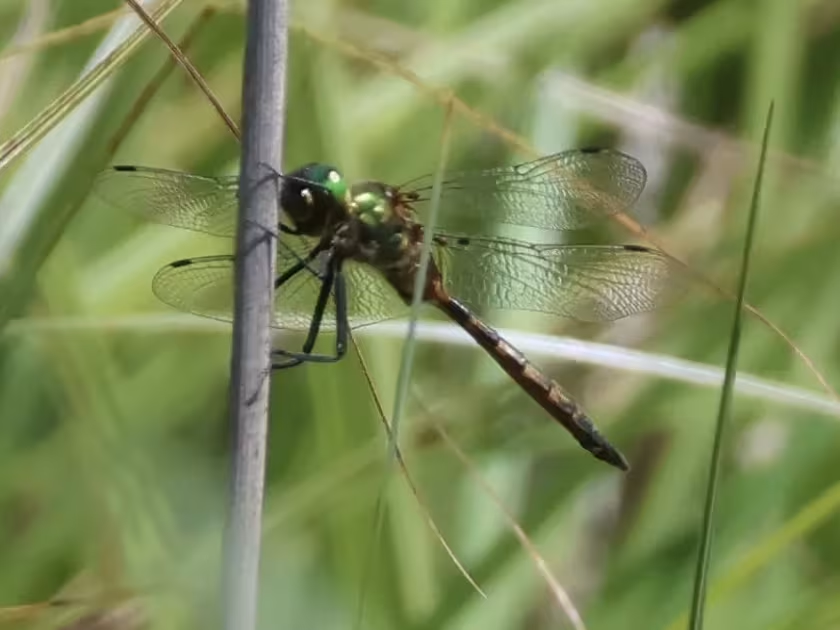
Emerald dragonflies (genus Somatochlora) are large, striking dragonflies belonging to the Corduliidae family. They are known for their brilliant metallic green to bronze body coloration and bright emerald-green eyes.
Adults typically have a wingspan ranging from 7 to 9 centimeters. Their bodies are streamlined and robust, enabling them to be powerful and highly agile fliers.
The larvae, also known as nymphs, are aquatic and dwell at the bottom of ponds or slow-moving streams. They have a stout, hairy body that often collects silt and detritus, providing excellent camouflage.
Their head features a large, extensible labium (mask) equipped with sharp hooks, used for capturing prey efficiently in underwater environments.
The lifecycle of these insects is deeply dependent on clean freshwater habitats, where they complete their long larval development.
What it damages
Dragonflies of the genus Somatochlora are not agricultural pests. In fact, they are considered beneficial predators that help manage insect populations in and around fields.
The only potential conflict arises in aquaculture, specifically in fish hatcheries, where the predatory nymphs can prey on young fish fry, potentially reducing yields.
In standard crop production, these dragonflies are allies to farmers, as they actively consume dipterans, including mosquitoes and various flies that can be nuisance pests.
No damage to agricultural crops (such as chewing, sucking, or mining tissues) has ever been reported for this genus.
Any negative perception is usually due to misconceptions or confusion with actual crop-destroying pests in the same environment.
When it appears
Adult emeralds are primarily active during the warm summer months, typically appearing between June and August depending on the local climate.
The larval stage is much longer, lasting 2 to 3 years, which means they are a permanent feature of the aquatic ecosystems in irrigation canals and ponds.
Adult activity peaks during bright, sunny daylight hours when they patrol their territories and hunt for smaller flying insects.
Oviposition occurs as females deposit their eggs directly into the water or into the stems of submerged and emergent aquatic vegetation.
Metamorphosis concludes when the nymph crawls out of the water onto terrestrial vegetation to undergo its final molt into an adult.
Signs of infestation
The presence of emeralds is easily detected by observing their distinct metallic appearance while they fly low over water surfaces.
In aquaculture, a noticeable decline in the survival rate of young fish in shallow, vegetated areas can indicate high nymph activity.
Finding cast-off nymph skins (exuviae) clinging to reeds or stems near the water's edge is a clear indicator that a local population is breeding successfully.
Their characteristic hovering flight patterns over fields and water bodies serve as a visual sign of their presence.
An abundance of these dragonflies often correlates with the presence of other small aquatic insects, indicating a balanced, healthy water source.
Control measures
Active control measures are rarely needed or recommended, as emerald dragonflies provide valuable ecosystem services by predating on insect pests.
In environments where they may be problematic, such as fish hatcheries, managing the water vegetation and periodic cleaning of pond bottoms can reduce the availability of hiding spots for nymphs.
Regulating water levels in irrigation systems can effectively help limit the larval population without resorting to chemicals.
The use of broad-spectrum insecticides in surrounding fields should be minimized to protect these important natural predators.
- Maintaining clean water channels.
- Strategic removal of excessive aquatic vegetation.
- Avoiding unnecessary insecticide application to preserve biodiversity.
Taxonomy
- Latin name
- Somatochlora
- Family
- Corduliidae
- EPPO code
- ZOMCSP
Discussion
No discussions yet — be the first.