
Orange-spotted emerald
Oxygastra curtisii
Description
How to identify
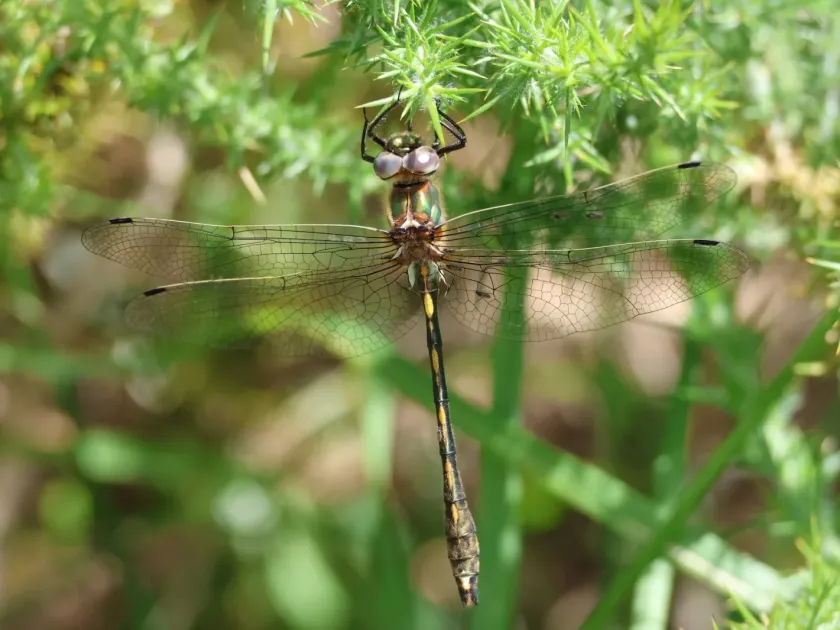
The Orange-spotted emerald (Oxygastra curtisii) is a rare species of dragonfly belonging to the Corduliidae family.
Adults are easily recognized by their metallic body color and distinct orange-yellow spots along the abdomen.
The wings are clear, showing a delicate network of dark veins, with a wingspan of approximately 60–70 mm.
Larvae, known as naiads, live in clean, slow-flowing water bodies, camouflaging themselves in the silt and mud.
Taxonomically, the species is classified under the order Odonata, demonstrating significant evolutionary adaptation to aquatic life.
What it damages
This species is strictly a predator and is not classified as an agricultural or garden pest.
It does not feed on plant tissues, meaning it causes zero damage to agricultural crops or ornamental plants.
The larvae feed on small aquatic invertebrates, while adults hunt for mosquitoes and other flying insects.
By consuming harmful flying insects, Oxygastra curtisii provides a form of natural biological control in its habitat.
Farmers and gardeners do not need to worry about this species, as it poses no threat to the harvest.
When it appears
The flight period for the adult dragonfly occurs typically between June and August.
The aquatic larval stage is complex and may last for two to three years before the final metamorphosis.
The emergence of adults depends on water temperatures and the availability of suitable vegetation.
Mating occurs near small, clean rivers or ponds, where females lay their eggs on submerged objects.
Temperature fluctuations influence the activity levels and the duration of the larval development.
Control measures
There are no control measures required, as the species is entirely beneficial to the ecosystem.
Oxygastra curtisii is protected in many regions due to its rarity and declining population trends.
Agrochemical run-off from fields can negatively impact the water quality, which is fatal to the larvae.
Best practices include maintaining buffer zones around water bodies to prevent chemical contamination.
Protecting the natural habitats of this dragonfly is encouraged as part of sustainable agricultural management.
Taxonomy
- Latin name
- Oxygastra curtisii
- Family
- Corduliidae
- EPPO code
- OXYGCU
Discussion
No discussions yet — be the first.