
Downy emerald
Cordulia
Description
How to identify
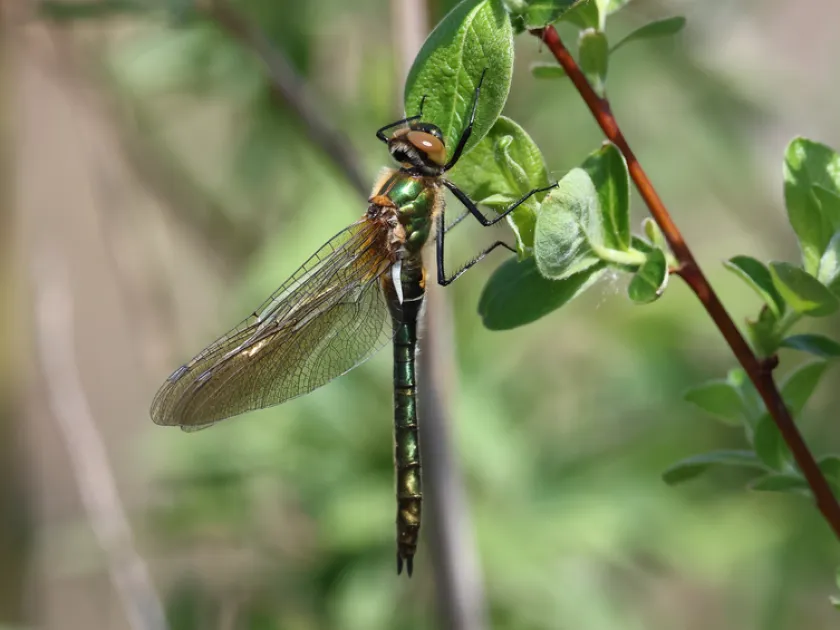
The Downy emerald, scientifically known as Cordulia aenea, is a dragonfly belonging to the Corduliidae family. It is easily identified by its distinct metallic green or bronze-green body.
Adults possess brilliant emerald-green eyes, which are a characteristic feature of this species. The body length ranges from 50 to 55 mm, with a wingspan of up to 80 mm.
The nymphs, or larvae, are strictly aquatic. They exhibit a robust, broad, and somewhat flattened body shape, usually covered in fine hairs that help collect debris for camouflage.
The larvae are typically found in well-vegetated still or slow-flowing waters, where they remain buried or hidden among aquatic plants.
This species is widely distributed across temperate regions and is often observed patrolling the edges of ponds and lakes.
What it damages
The Downy emerald is not an agricultural pest. It does not feed on crops, vegetables, or any parts of plants, and it causes no economic damage to agricultural production.
In fact, this dragonfly is highly beneficial as an apex predator in its niche. It helps control the populations of midges, mosquitoes, and other flying insects.
The aquatic larvae serve as predators of other small aquatic invertebrates and mosquito larvae, significantly reducing the density of these nuisance insects in stagnant water.
No crop protection measures are directed against this species, as it contributes positively to the biological balance within an agricultural ecosystem.
The presence of these dragonflies is often a positive indicator of water quality and the overall health of the farm ecosystem.
When it appears
Adult emergence typically occurs from late spring through the summer months, with the peak flight period ranging from May to August.
The life cycle of the Downy emerald is long, with the larval stage lasting two to three years in the aquatic environment before metamorphosis.
Mating and egg-laying activities are concentrated in the summer, when environmental temperatures are high enough to support rapid development.
Adults are highly active on sunny days, patrolling water bodies and hunting for insect prey within the immediate vicinity of their habitat.
The lifecycle is naturally completed after the adults lay eggs, with the next generation continuing its development underwater until the following season.
Control measures
Since the Downy emerald is a beneficial insect, no control or extermination measures should ever be applied to these dragonflies.
If insect activity near water bodies must be managed, it is essential to avoid the use of broad-spectrum pesticides that could harm dragonflies and other beneficial predatory insects.
Maintaining the integrity of riparian zones and natural vegetation around farm ponds encourages the presence of dragonflies, aiding in natural pest suppression.
Agricultural practices should prioritize ecological safety to ensure the survival of such natural predators, which act as a free biological control agent.
- Avoid chemical sprays near water sources.
- Preserve diverse wetland vegetation on the farm.
- Promote biodiversity to support beneficial predators.
Taxonomy
- Latin name
- Cordulia
- Family
- Corduliidae
- EPPO code
- CRDUSP
Discussion
No discussions yet — be the first.