
Silvanoprus
Silvanoprus
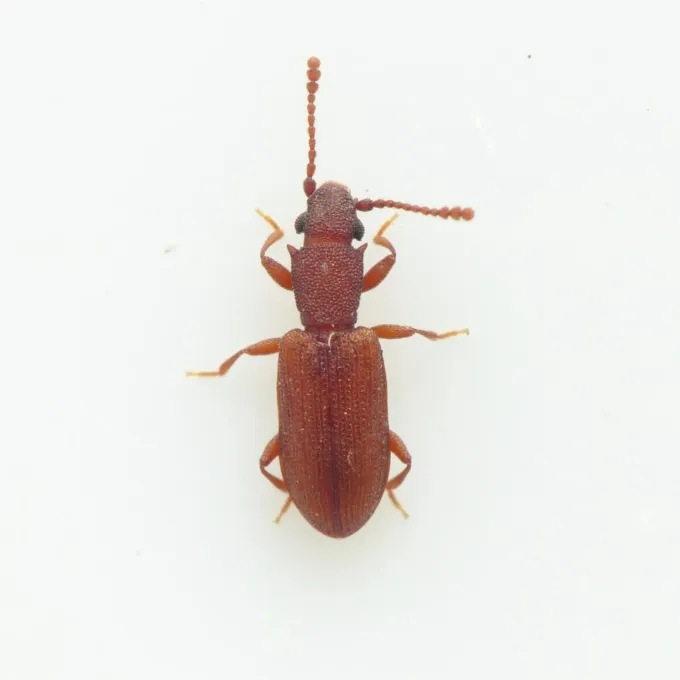
Description
How to identify
Silvanoprus is a genus belonging to the Silvanidae family within the order Coleoptera. These are small insects morphologically similar to the sawtoothed grain beetle, but they possess specific characteristics in the structure of the pronotum and antennae.
The adult beetle body is typically elongated and slightly flattened, with coloration ranging from light brown to dark brown. The adult size is approximately 2–3 millimeters in length.
Silvanoprus larvae exhibit typical morphology for the family: they are mobile, possess three pairs of thoracic legs, and have a lightly chitinized body of a pale shade.
Beetles are characterized by their secretive lifestyle, preferring dark and poorly ventilated areas of warehouses or plant debris where they can camouflage themselves effectively.
Identification is difficult due to their small size, so specialists use binocular microscopes to examine genitalia and the structure of the elytra for precise species determination.
What it damages
This pest primarily infests dry products of plant origin, including cereal and legume grains, as well as their processed forms like flour or cereals.
While Silvanoprus can be found in field plant debris, it poses the greatest economic threat as a stored product pest in closed facilities and warehouses.
The insect is capable of damaging grain with high moisture content, penetrating the kernel or feeding on the germ, which drastically reduces the viability of seed material.
Beyond direct consumption, the pest contaminates products with excrement, larval skins, and metabolic waste, rendering the entire mass unfit for consumption or processing.
In elevator and storage conditions, the proliferation of Silvanoprus triggers localized self-heating of the grain mass, which creates favorable conditions for mold development and other pests.
When it appears
In storage facilities, the pest's development occurs continuously throughout the year, as warehouse temperatures are generally sufficient for insect life cycles.
Optimal conditions for an active development cycle include a temperature range of 25–30 degrees Celsius and relative air humidity above 60 percent.
When temperatures drop below 15 degrees, life processes slow down, though the beetles are capable of maintaining viability in a state of diapause for long periods.
In spring and summer, when pests enter storage facilities via containers or contaminated transport, there is a peak in their reproduction and spread throughout the grain mass.
The full life cycle from egg to adult is highly dependent on the microclimate of the specific warehouse and can take between 30 and 60 days.
Signs of infestation
Visual signs of infestation include the presence of live beetles, larvae, and specific grain dust created during the insects' feeding process within the grain mass.
A characteristic symptom is the emergence of an unpleasant musty odor emanating from the stored batch, indicating microbial growth spurred by pest activity.
Careful inspection of grain samples may reveal characteristic chewed areas, often around the germ, which leads to reduced seed germination rates.
The presence of significant webbing or clumped flour and grain particles in warehouse corners or on equipment also indirectly indicates the presence of a Silvanoprus population.
Detecting the pest via monitoring traps or during standard sample collection is a critical signal to initiate disinfestation measures.
Control measures
The primary focus in controlling Silvanoprus is prevention: maintaining optimal storage conditions that exclude grain moisture and temperature fluctuations.
Regular mechanical cleaning of storage facilities is recommended, including hard-to-reach areas where old harvest residues, which serve as pest reservoirs, tend to accumulate.
If infestation hotspots are detected, fumigation of grain masses using authorized phosphine-based products or other fumigant insecticides is applied.
For empty warehouse disinfestation, wet surface treatment with broad-spectrum contact insecticides is highly effective.
- Control of grain moisture content (below 14%).
- Use of airtight storage containers.
- Regular monitoring using pheromone or sticky traps.
- Adherence to storage temperature regimes (grain cooling).
Taxonomy
- Latin name
- Silvanoprus
- Order
- Coleoptera (beetles)
- Family
- Silvanidae
- EPPO code
- SILVSP
Discussion
No discussions yet — be the first.