
Grape leaf mite
Shevtchenkella obtusa
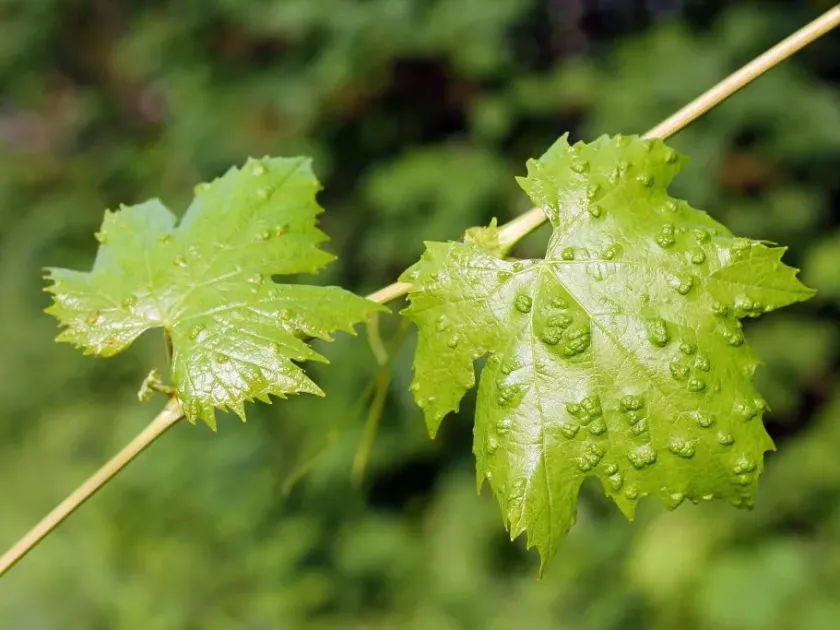
Description
How to identify
The Grape leaf mite, scientifically known as Shevtchenkella obtusa, belongs to the Eriophyidae family. It is a microscopic organism, measuring approximately 0.15 to 0.2 mm, making it invisible to the naked eye.
These mites possess a worm-like body, which is highly adapted for navigating the crevices of grapevine bark and the tight spaces between leaf veins.
They are characterized by having only two pairs of legs situated at the anterior end of their body, distinguishing them from other mite species found on grapevines.
The coloration of these mites is typically pale yellow or white, allowing them to blend perfectly with the plant tissues they inhabit.
They are primarily found on the underside of grape leaves, where they congregate in colonies to feed and reproduce throughout the growing season.
What it damages
This pest targets cultivated grapes, causing significant physiological stress by feeding on the sap of young leaves and flower clusters.
As the mite feeds, it injects saliva containing enzymes that interfere with normal plant growth, often leading to structural deformation of the leaf tissue.
The impact of the feeding can manifest as curling or crinkling of leaves, which reduces the total leaf area available for photosynthesis.
In severe cases, the mite can cause necrosis of the leaf cells and damage to the flower buds, directly leading to lower grape yields.
Continued infestation weakens the vine plant, making it more susceptible to environmental stress and secondary fungal infections.
When it appears
The life cycle begins in spring when overwintering females emerge from their shelters in the bark crevices and bud scales as temperatures rise.
The period of maximum activity coincides with the rapid growth phase of the vine, providing the mite with abundant food sources.
Several generations of the mite occur throughout the summer, with the rate of development being strongly influenced by ambient temperature and humidity.
By late autumn, triggered by shorter days and cooler temperatures, the mites migrate to protected areas on the vine to undergo overwintering.
The duration of a single generation can be as short as 10 days during warm summer months, allowing populations to explode if left unchecked.
Signs of infestation
Early symptoms of an infestation include the appearance of mottled or discolored patches on the young leaves at the shoot tips.
Leaves often exhibit an abnormal curvature or a stunted growth pattern, which is a classic indicator of mite-related feeding damage.
In some grape varieties, the damaged areas may turn reddish or brownish, which can be misidentified as a nutrient deficiency or disease.
- Leaf curling and deformation on shoot tips.
- Reduced vigor of the vine and slow canopy development.
- Abnormal fruit set with small or poorly developed berries.
Detailed examination with a hand lens can reveal the tiny white colonies of mites along the veins on the underside of the leaves.
Control measures
Effective control requires a combination of chemical and cultural practices, focusing on early intervention during the green-tip stage of the vine.
Using authorized acaricides that specifically target Eriophyid mites is crucial, and alternating chemical classes helps prevent resistance development.
Cultural methods such as pruning out infested canes during winter help reduce the overwintering population density of the pest.
Maintaining a healthy, well-ventilated vineyard through proper canopy management is essential to discourage the build-up of mite populations.
Integrated Pest Management (IPM) strategies, including the promotion of beneficial predatory mites, can offer long-term suppression of the pest without constant chemical usage.
Taxonomy
- Latin name
- Shevtchenkella obtusa
- Order
- Mites
- Family
- Eriophyidae
- EPPO code
- SHEVOB
Discussion
No discussions yet — be the first.