
Poplar hornet moth
Sesia melanocephala
Description
How to identify
The poplar hornet moth (Sesia melanocephala) is a clearwing moth belonging to the family Sesiidae, known for its striking mimicry of hornets and wasps.
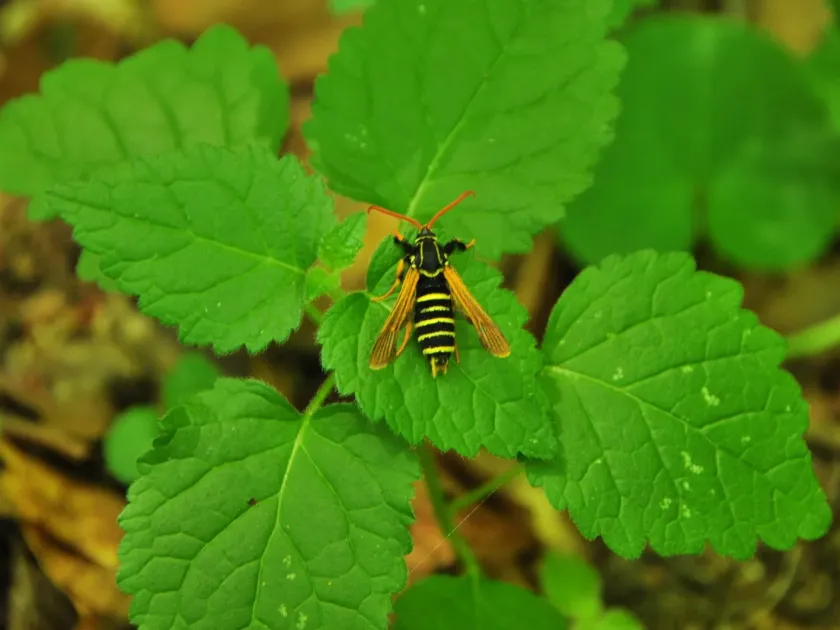
Adult moths possess transparent wings with dark margins and veins, while their body color is mostly black with distinct yellow bands, enhancing their hornet-like appearance.
The wingspan of this species typically ranges from 25 to 30 millimeters, making them relatively small but noticeable due to their unique flight behavior.
The larvae are creamy-white, fleshy caterpillars with a dark, hardened head capsule that allows them to chew through tough woody tissues.
As part of the clearwing family, they spend most of their life cycle inside the host tree, making them difficult to detect until significant damage has occurred.
What it damages
This pest primarily targets trees within the Populus genus, with a strong preference for aspen and black poplar species in temperate regions.
The larvae bore tunnels beneath the bark and deep into the sapwood, causing severe structural damage to the tree's vascular system.
Disruption of the cambium layer hinders the transport of water and nutrients, which often leads to branch dieback or total tree decline.
Young trees are especially vulnerable; their trunks can become so weakened by extensive boring that they may snap during strong winds.
Furthermore, the galleries created by the larvae serve as entry points for pathogens, fungi, and secondary wood-boring insects, further endangering the tree.
When it appears
Adult moths are typically active during the warm summer months, with the peak flight period usually occurring from June through August.
Female moths deposit their eggs individually, often selecting sites with rough bark, existing wounds, or previous damage as optimal locations.
Upon hatching, the larvae quickly bore into the bark, establishing galleries where they feed and remain through the winter months.
The larvae overwinter in various stages of development within the wood, resuming their feeding activity as temperatures rise in the spring.
Pupation occurs in late spring or early summer within the larval galleries, with the pupae partially emerging from the bark before adult eclosion.
Signs of infestation
The most reliable sign of an infestation is the presence of frass (a mixture of excrement and wood particles) pushed out of small holes in the bark.
Over time, the affected areas of the bark may become sunken, cracked, or show signs of sap flow due to the larval activity underneath.
Following the adult moth's emergence, empty pupal exuviae can often be found protruding from exit holes along the trunk or main branches.
Early symptoms may include the yellowing of foliage in specific sections of the tree canopy, followed by the wilting of affected branches.
- Accumulation of wood shavings at the base of the trunk.
- Visible round emergence holes in the bark.
- Discolored or sunken patches of bark on the main stem.
- Premature leaf drop or sparse crown development.
Control measures
Cultural control is paramount; maintaining tree vigor through proper irrigation and avoiding mechanical wounding of the trunk helps deter egg-laying.
Sanitation is a critical step, requiring the removal and destruction of heavily infested trees to prevent the spread of the population to healthy individuals.
Insecticide treatments, if applied precisely during the egg-laying period, can provide a protective barrier for the trunks of high-value trees.
Encouraging the presence of natural predators, such as parasitoid wasps and woodpeckers, can assist in keeping the pest population below economic thresholds.
For ornamental or high-value specimens, regular inspection and localized treatment of larval entry points can help salvage the tree before damage becomes systemic.
Taxonomy
- Latin name
- Sesia melanocephala
- Order
- Lepidoptera (butterflies)
- Family
- Sesiidae
- EPPO code
- AEGEME
Discussion
No discussions yet — be the first.