
Hornet moth
Sesia apiformis
Description
How to identify
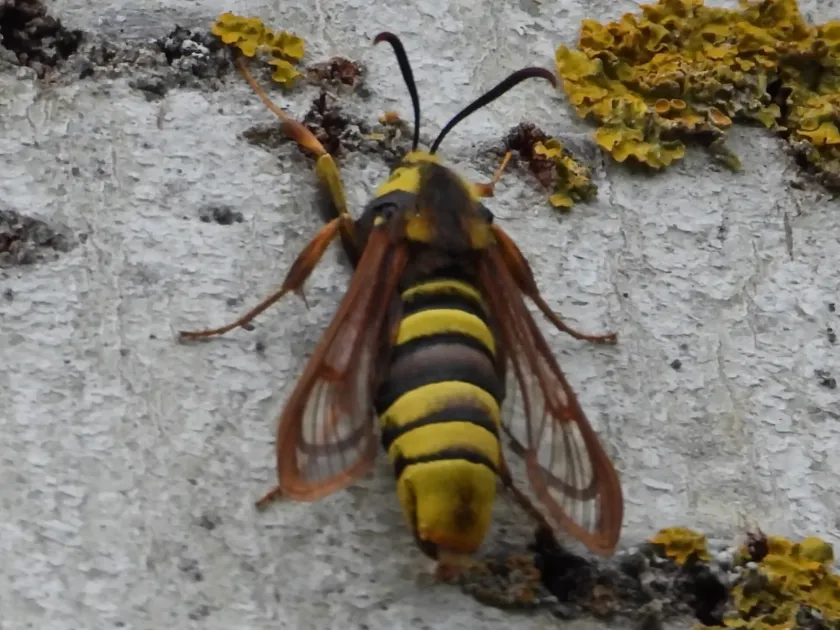
The Hornet moth (Sesia apiformis) is a large clearwing moth from the family Sesiidae that remarkably mimics a hornet in appearance. Its body features characteristic yellow and black banding, and its wings are almost entirely transparent, except for the edges and veins.
Adults reach a wingspan of up to 45 millimeters. This visual resemblance to Hymenoptera is a form of mimicry that protects the moth from predators, but it poses a significant threat to trees.
Systematically, this species belongs to the order Lepidoptera. Despite its outward appearance similar to wasps, the moth lacks a stinger and the pronounced "wasp waist" common to many Hymenoptera species.
Hornet moth larvae have a whitish body with a brown head, reaching up to 50 millimeters in length by the end of their development. They lead a cryptic lifestyle, boring tunnels deep into the trunks and root systems of host trees.
The species can be distinguished by its specific two-year life cycle, which allows the pest to remain safely hidden within the wood for almost its entire development period.
What it damages
The primary food sources for this pest are poplar and willow trees. The Hornet moth prefers stressed or young trees, though it often infests healthy specimens in urban landscapes.
Larvae excavate deep tunnels in the lower trunk and root crown. This disrupts the sap flow and the overall nutrient transport system of the plant, making it highly susceptible to secondary pathogens.
Mechanical damage to the cambium layer is a serious concern. In areas where tunnels are bored, the wood begins to decay, and severe infestations can lead to the death of young saplings within two to three years.
The pest is frequently found in forest belts, parks, and industrial poplar plantations. Compromising the integrity of the trunk leads to a loss of timber quality and makes the tree prone to breakage during high winds.
Mass reproduction of the Hornet moth can significantly reduce biomass growth across entire plantations, creating infection foci from which the insects spread to neighboring healthy areas.
When it appears
The flight of adult moths begins in late spring and lasts until mid-summer, typically occurring in June and July. Insects are active primarily during daylight hours, when they lay eggs in bark crevices.
Egg development lasts about two weeks, after which newly hatched larvae immediately bore into the bark. The first winter is spent in the larval stage inside the trunk, where they continue to feed actively on the wood.
In the second year of life, the larva completes its development and, before pupation, bores an exit hole, sealing it with a plug of wood shavings. Pupation takes place directly within the tunnels or in the soil at the base of the trunk.
The emergence of the imago from the pupa depends on specific weather conditions, linking the reproductive cycle closely to climatic zones. The transformation process takes about 3-4 weeks during the summer period.
The total generation time is two years, which makes population monitoring a complex task, as most of the life cycle remains hidden from the agronomist's view inside the woody tissue.
Signs of infestation
The primary sign of infestation is the presence of multiple exit holes, approximately 5-8 millimeters in diameter, in the lower part of the trunk near the root collar.
At the base of the trees, one can find characteristic piles of brown wood dust (frass) ejected by the larvae during tunneling. This is a clear indicator of active pest activity.
Often, sap discharge from the trunk is observed at the sites of larval entry, indicating a breach in the tree's vascular system. The bark in these areas may darken and peel away.
When inspecting plantations, pay attention to canopy thinning and premature yellowing of leaves, which often points to damage to the root system or the base of the trunk.
Empty pupal casings left protruding from the bark after the moth's emergence serve as final confirmation that the tree has been or remains infested by the Hornet moth.
Control measures
- Ensure optimal water and mineral regimes to maintain tree vitality and resilience.
- Perform mechanical cleaning of bark and remove heavily infested specimens from plantations.
- Use pheromone traps to disrupt mating behavior and monitor population density.
- Apply insecticide injections directly into the trunk during the period of young larval activity.
- Encourage natural predators, such as birds, that feed on the insects during the moth's flight period.
Taxonomy
- Latin name
- Sesia apiformis
- Order
- Lepidoptera (butterflies)
- Family
- Sesiidae
- EPPO code
- AEGEAP
Discussion
No discussions yet — be the first.