
Clearwing moth
Sesia
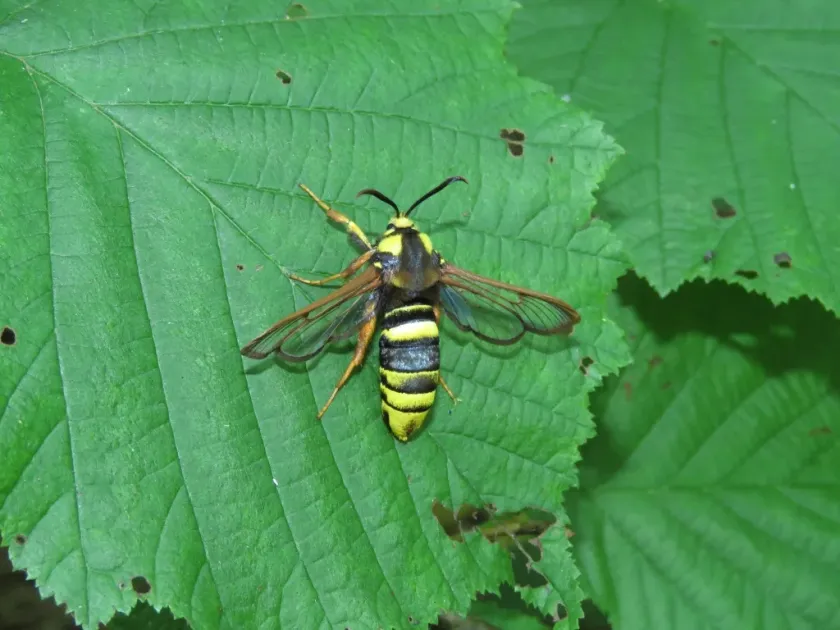
Description
How to identify
Clearwing moths (family Sesiidae) are a distinct group of insects known for their transparent wings and body mimicry, which makes them look strikingly like wasps or hornets.
They are active during the day, which is unusual for most moths, and they often visit flowers, making them easily mistaken for Hymenoptera by casual observers.
The larvae are typically whitish with a brown head and are specialized borers that feed within the stems, trunks, or roots of various woody plants.
Because they spend most of their life cycle hidden inside plant tissues, adults are rarely seen in large numbers unless specialized pheromone traps are used.
Their morphological adaptations, including the lack of scales on their wings, serve as a defensive mechanism to avoid avian predators in their natural environment.
What it damages
The currant clearwing (Synanthedon tipuliformis) is a significant pest that targets currants and gooseberries, causing severe structural damage to the stems.
Larvae feed on the pith of the branches, creating tunnels that disrupt the transport of nutrients and water from the roots to the foliage and fruits.
Infested branches often exhibit reduced vigor, yellowing leaves, and reduced fruit yields, eventually leading to the death of the specific branch.
Over time, a heavy infestation can compromise the structural integrity of the entire shrub, causing it to become stunted or completely non-productive.
Various species within the Sesiidae family can also affect timber trees, fruit orchards, and ornamental trees, often leading to secondary infections by fungi or bacteria.
When it appears
Adult moths typically emerge in late spring or early summer, coinciding with the flowering period of their host plants, providing optimal conditions for mating.
Females deposit eggs on the bark, specifically near buds, wounds, or pruning cuts, where the neonate larvae can easily gain entry into the plant tissue.
Once inside the stem, the larvae feed throughout the season and overwinter within the galleries they have created inside the wood or pith.
The life cycle is often biennial, meaning the pest spends two full years developing before reaching the adult stage to complete the cycle.
Environmental factors, such as spring temperatures and rainfall, significantly influence the timing of emergence and the success rate of larval establishment.
Signs of infestation
The primary symptom of infestation is the premature wilting and sudden dieback of stems that appear otherwise healthy but show internal hollowing.
Upon pruning or splitting the affected wood, one can clearly observe the frass-filled galleries and the tunnel running through the center of the stem.
Branches infested with clearwing larvae are often weaker than healthy ones and may snap easily under wind pressure or during standard gardening activities.
The presence of tiny entrance holes on the bark, although often difficult to detect, serves as an indicator of recent larval entry into the plant.
Persistent decline of specific parts of a shrub or tree despite adequate irrigation and fertilization is a hallmark sign of wood-boring pest activity.
Control measures
The most effective strategy involves rigorous sanitary pruning, which requires removing and destroying infested stems before the adults emerge.
Proper maintenance of host plants, such as avoiding unnecessary mechanical injuries to the bark, is essential for reducing the risk of infestation.
- Deploying pheromone-based monitoring traps to time interventions.
- Applying biological insecticides (e.g., nematodes or Bt) when larvae are young.
- Sealing pruning wounds with wound dressings to prevent egg-laying.
- Encouraging natural predators and parasitoids in the garden ecosystem.
- Using systemic insecticides at the start of the season in high-risk areas.
Chemical control is challenging because larvae are protected inside the wood, making timing based on the egg-hatching phase absolutely critical for success.
Integrated Pest Management (IPM) practices, emphasizing cultural control over chemical reliance, are recommended for long-term suppression of clearwing populations.
Taxonomy
- Latin name
- Sesia
- Order
- Lepidoptera (butterflies)
- Family
- Sesiidae
- EPPO code
- SESISP
Discussion
No discussions yet — be the first.