
Common acorn barnacle
Semibalanus balanoides
Description
How to identify
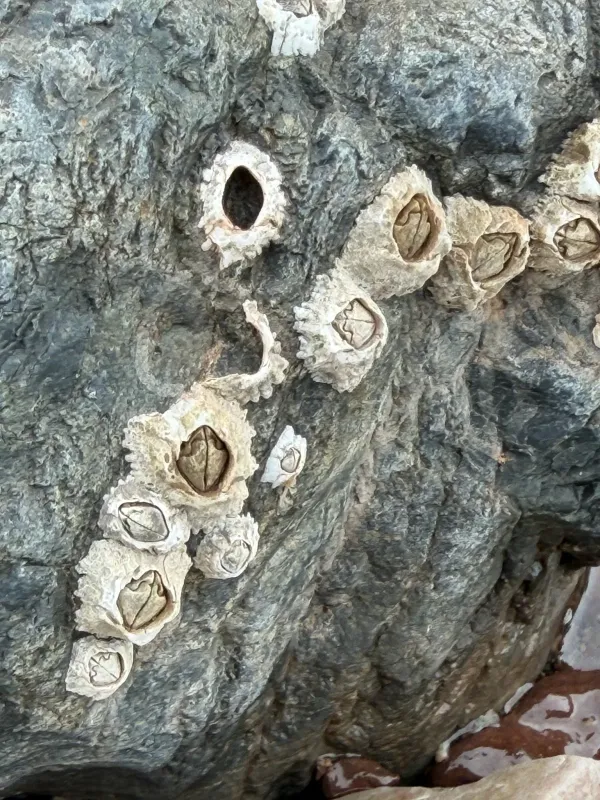
The common acorn barnacle (Semibalanus balanoides) is a sessile crustacean belonging to the Cirripedia order, family Balanidae. Its body is encased in a rigid, conical shell consisting of six calcareous plates.
Adult individuals look like small, cone-shaped structures firmly cemented to hard surfaces. They typically range from 1 to 2 centimeters in diameter and have a whitish or grayish appearance.
The life cycle involves planktonic larval stages (nauplius and cyprid). After drifting, the cyprid larva finds a suitable hard substrate, attaches itself permanently, and undergoes metamorphosis into a sessile adult.
These organisms are highly adaptable, capable of surviving in various salinity and temperature conditions, which allows them to colonize almost any submerged hard surface.
Their rapid growth and firm attachment make them a significant challenge for industrial and agricultural infrastructure in coastal areas.
What it damages
The primary damage caused by acorn barnacles is the severe fouling of hydraulic systems used in aquaculture, such as seaweed or shellfish farms.
They infest the interior of water supply pipelines, intake pumps, and filter systems, forming dense colonies that drastically reduce the effective pipe diameter.
This constriction causes pressure drops, pump overheating, and premature equipment failure, leading to significant maintenance costs and operational downtime.
The accumulation of calcified shells inside tanks and pipes promotes the buildup of debris and organic matter, creating unsanitary conditions for farmed stocks.
Furthermore, the increased friction caused by barnacle encrustation leads to higher electricity consumption for water circulation and irrigation systems.
When it appears
Breeding and mass settlement of larvae generally occur during the spring months as water temperatures begin to rise.
In temperate zones, mass release of larvae into the water column usually begins in March or April, marking the most critical period for protection measures.
The settlement phase can continue throughout the summer, with the rate of individual growth being directly dependent on water temperature and food availability.
While development slows down in the autumn, already established colonies remain a persistent threat to the operational capacity of industrial equipment.
Observations indicate that areas with moderate water flow are the most susceptible to colonization as they provide a constant supply of nutrients to the barnacles.
Signs of infestation
A primary indicator of infestation is a noticeable decline in water flow rates and loss of hydraulic efficiency in the supply network.
Visual inspection of submerged equipment often reveals small, rough, calcified patches that grow into larger, rigid mounds over time.
Unusual vibrations or grinding sounds emanating from pumps often signify that fragments of barnacle shells have detached and entered the internal mechanisms.
Frequent clogging of pre-filters and intake screens with gritty, white shell fragments is a clear sign of an active colonization process.
A persistent, foul smell coming from the water system may indicate the decay of dead barnacles trapped within closed pipeline loops.
Control measures
Effective control requires a multi-faceted approach, including the application of anti-fouling coatings containing copper or silicone to inhibit larval settlement.
Regular mechanical removal using high-pressure sprayers or mechanical scrapers is essential for maintaining equipment cleanliness during the off-season.
The installation of multi-stage filtration systems at water intakes helps capture larvae before they can establish colonies within the plumbing.
Routine inspection of pump impellers and pipeline bends is necessary to identify and remove early-stage settlements before they become calcified and entrenched.
UV-C sterilization systems can be used in some setups to disable larval stages, effectively preventing them from successfully attaching to equipment surfaces.
Taxonomy
- Latin name
- Semibalanus balanoides
- Family
- Balanidae
- EPPO code
- BALSBA
Discussion
No discussions yet — be the first.