
Semibalanus
Semibalanus
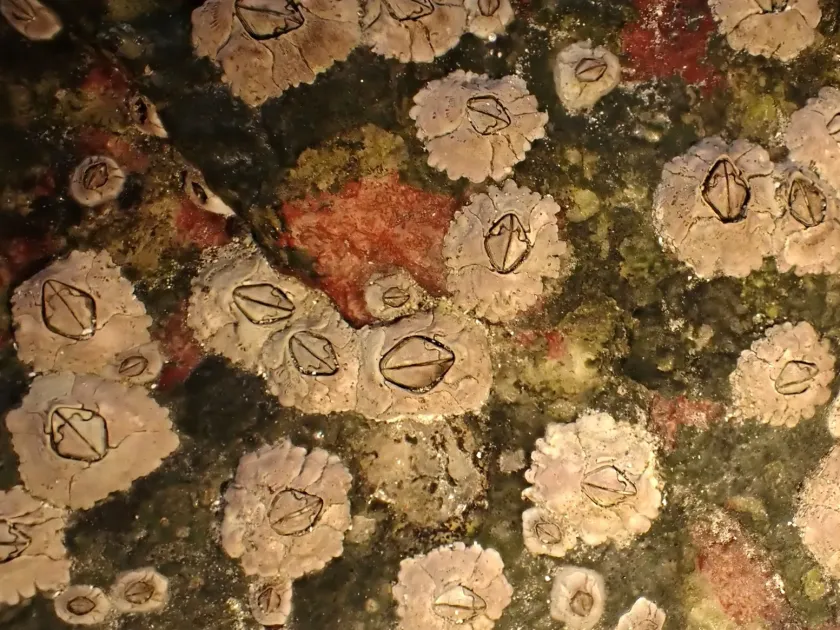
Description
How to identify
Semibalanus (Semibalanus balanoides) is a member of the subphylum Crustacea, order Cirripedia, and family Archaeobalanidae. Commonly known as the acorn barnacle, it is a sessile marine organism.
It is characterized by a conical shell made of six movable calcareous plates. Adult specimens typically measure between 1 and 2 centimeters in diameter.
The organism's body is enclosed within this protective shell, with an upper opening covered by two pairs of movable opercular valves. It uses specialized appendages called cirri to filter feed plankton from the water.
Barnacles are hermaphroditic, allowing for successful reproduction even at low population densities through cross-fertilization. Their reproductive cycle is often synchronized with phytoplankton blooms.
The life cycle begins with planktonic larval stages (nauplius and cyprid), which eventually settle onto a hard substrate to undergo metamorphosis into the adult sedentary form.
##damage##While not a plant pest in the terrestrial sense, Semibalanus is a major threat to aquaculture facilities and maritime infrastructure. It colonizes fish cages, water intake pipes, and vessel hulls.
Heavy fouling on aquaculture netting severely restricts water flow, leading to oxygen depletion for farmed species and an accumulation of metabolic waste products.
Water intake systems are often clogged by barnacle calcification, reducing pipe capacity and causing frequent mechanical failures in pumps.
The organisms contribute to structural bio-corrosion in maritime facilities, significantly increasing hydrodynamic drag and maintenance costs for floating structures.
On seaweed farms, barnacles compete for space and nutrients, while their sharp shells cause physical damage to the delicate algal fronds.
Signs of infestation
The first sign of infestation is the appearance of rough, white, cone-shaped calcareous deposits on any submerged hard surface.
A tactile check of nets, ropes, or pipe surfaces will reveal a sharp, abrasive texture, which indicates that barnacles have successfully settled and matured.
Reduced water flow efficiency in aquaculture systems and stunted growth in livestock are strong indicators of significant barnacle colonization on infrastructure.
The presence of numerous free-swimming larvae in the water column during the spring serves as a biological warning of imminent settlement on artificial structures.
The observation of empty or dead shell casings on equipment suggests that the colony has been established for a prolonged period, requiring immediate intervention.
Control measures
The primary control measure involves the application of antifouling coatings containing biocides that prevent larval adhesion to submerged surfaces.
Mechanical removal through pressure washing or specialized scraping tools is essential, especially if performed before the barnacles mature and harden their shells.
- Utilizing ultrasonic transducers to deter larval settlement.
- Employing nets coated with non-stick polymers to discourage colonization.
- Conducting regular site monitoring during peak reproductive seasons.
- Using thermal treatment (hot water flushing) for intake pipes.
Selecting durable, non-porous materials for underwater construction remains one of the most effective long-term strategies for minimizing barnacle impact.
Taxonomy
- Latin name
- Semibalanus
- Family
- Balanidae
- EPPO code
- SBALSP
Discussion
No discussions yet — be the first.