
Barnacle
Balanus
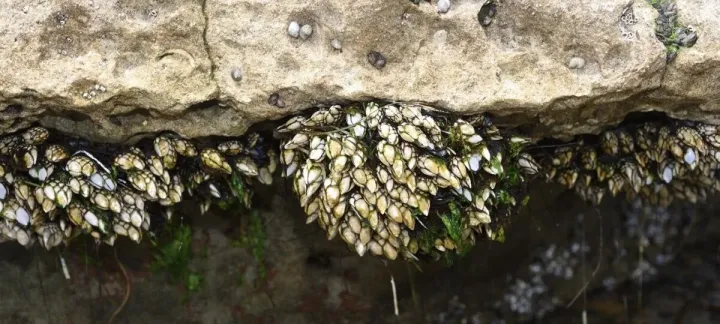
Description
How to identify
Barnacles belong to the order Sessilia (family Balanidae) and are highly specialized crustaceans that live attached to hard surfaces in marine environments.
The adult form is enclosed in a hard calcareous shell composed of several plates, which serves as a defensive barrier against predators and desiccation.
Inside this shell, the organism remains immobile, using feathery appendages called cirri to filter microscopic food particles from the surrounding water.
Their external color ranges from white to grey or brownish tones, allowing them to blend in with natural substrates like rocks, pilings, or shells.
Sizes vary significantly, typically ranging from one to five centimeters in diameter, though they often form dense clusters that completely cover surfaces.
What it damages
Barnacles are considered major pests in aquaculture, as they aggressively compete for space on substrates used to grow kelp, mussels, and oysters.
Their presence on farming equipment, such as netting, ropes, and submerged pipes, significantly restricts water flow and blocks essential nutrients for crops.
In coastal areas, barnacles can colonize the roots and stems of mangroves or other marine plants, causing physical stress and hindering their growth.
The heavy accumulation of shells on marine structures leads to increased drag and structural weight, often resulting in equipment failure or maintenance issues.
By overgrowing crops, barnacles effectively starve them of light and space, causing significant mortality rates and economic losses in the aquaculture industry.
When it appears
The reproduction cycle of barnacles is highly dependent on water temperature, with peak larval activity occurring during spring and summer months.
The life cycle begins with a planktonic larval stage known as a nauplius, which drifts with ocean currents for several weeks before metamorphosing.
This is followed by the cyprid larval stage, which is the final mobile phase that actively seeks a suitable hard surface to settle upon for the rest of its life.
Large-scale settlement of larvae on farm infrastructure usually occurs in waves, creating sudden and intense pressure on marine farming systems.
Once settled, the barnacle undergoes a permanent transformation into its adult sessile form, firmly anchoring itself to the substrate to mature.
Signs of infestation
The initial signs of an infestation include the appearance of tiny, pinhead-sized white spots on equipment, shells, or the base of aquatic plants.
These spots rapidly grow into characteristic conical structures with sharp, stony edges that feel very abrasive and rough to the touch.
Structural damage is often signaled by a noticeable increase in the weight of submerged gear, leading to sagging nets or broken anchor lines.
Plants affected by barnacles often appear stunted, discolored, or brittle due to the mechanical stress imposed by the heavy encrustations on their surfaces.
A heavily infested area will appear covered in a thick, stony layer that obscures the original material and inhibits the normal growth of cultured organisms.
Control measures
Anti-fouling coatings containing specific biocides are the most common industrial method to prevent barnacle larvae from attaching to surfaces.
Regular manual cleaning of nets, ropes, and submerged installations using pressure washers or brushes is essential for maintaining operational efficiency.
Biological control methods include encouraging natural predators or timing the installation of equipment to avoid peak larval settlement periods.
Ultrasonic antifouling systems can also be employed to deter larvae from settling on sensitive underwater equipment without the use of chemical agents.
- Periodic inspection of all underwater structures.
- Use of smooth, non-toxic surface coatings.
- Scheduled harvesting to minimize contact time with larvae.
Taxonomy
- Latin name
- Balanus
- Family
- Balanidae
- EPPO code
- BALSSP
Discussion
No discussions yet — be the first.