
Balanus improvisus
Balanus improvisus
Description
How to identify
Balanus improvisus, commonly known as the bay barnacle, is a crustacean belonging to the order Cirripedia and the family Balanidae, adapted to live in various salinity levels.
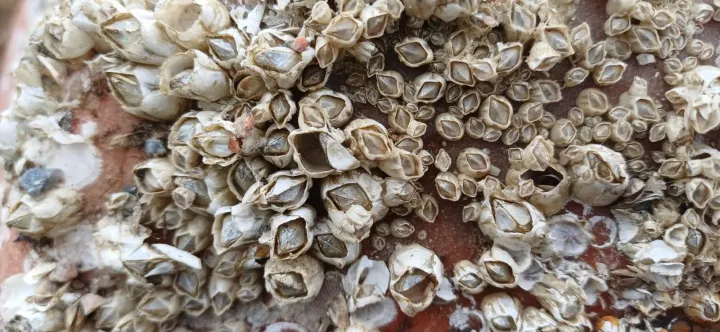
The adult organism is protected by a rigid shell composed of several calcareous plates, which forms a cone-like shape firmly attached to hard substrates.
They typically grow in dense clusters, covering available surfaces in layers that can significantly alter the internal diameter of water transport systems.
The larval stages, including the nauplius and cyprid phases, are planktonic, allowing them to travel through agricultural water networks with ease.
Once the cyprid larva finds a suitable surface, it undergoes metamorphosis into a sedentary adult, establishing a permanent and resilient colony.
What it damages
The primary economic impact of Balanus improvisus in agriculture is the biofouling of irrigation infrastructure, including pump stations and pipelines.
By settling inside water pipes, these barnacles decrease the cross-sectional area, leading to significant friction losses and reduced flow velocity.
This obstruction puts excessive strain on pump motors, causing increased energy consumption, potential overheating, and premature mechanical failure.
The calcified shells are extremely hard and abrasive; if they detach, they can damage downstream components or clog precise irrigation nozzles and drip tapes.
In cases of severe infestation, the irrigation system may become entirely blocked, causing major disruptions in water delivery to essential crops.
When it appears
The reproductive cycle of the bay barnacle is highly dependent on water temperature, with active settlement occurring during warmer months.
The peak season for larval dispersal generally aligns with the active irrigation period, making infrastructure vulnerable to new infestations.
Development rates increase significantly between +10 and +25 degrees Celsius, allowing for rapid colonization of cleaned surfaces during the summer.
While cold temperatures reduce activity, the established, calcified colonies persist year-round, requiring physical removal to restore system functionality.
Multiple generations can settle within a single season, leading to a cumulative increase in the thickness of biofouling layers if left unmanaged.
Signs of infestation
An early indication of an infestation is a noticeable drop in water pressure throughout the irrigation lines despite normal pump operation.
Visual inspection of intake screens and valve housings often reveals hard, sharp, and whitish-grey crusts characteristic of barnacle colonies.
Increased operational noise or vibrations from water pumps can indicate that barnacles are fouling the suction ports or internal impellers.
The presence of fine white shell debris appearing in filters or at the end of drip irrigation lines is a clear sign of internal fouling.
Uneven water distribution across agricultural plots may indicate partial blockage of the piping network due to the growth of these organisms.
Control measures
Mechanical removal using high-pressure water jets, brushes, or specialized scrapers is the most common method for cleaning infested pipes.
Installing fine-mesh filtration systems at the water source is essential to intercept larvae before they can settle inside the irrigation network.
Applying anti-fouling coatings to internal surfaces can prevent larvae from successfully attaching and growing into mature colonies.
Chemical treatments that temporarily adjust the water environment to be unsuitable for barnacle larvae can be used in some irrigation systems.
Regular maintenance and routine inspections at the start of each irrigation season are critical to preventing catastrophic pipe clogs.
Taxonomy
- Latin name
- Balanus improvisus
- Family
- Balanidae
- EPPO code
- BALSIM
Discussion
No discussions yet — be the first.