
Australian whistling spider
Selenotypus plumipes
Description
How to identify
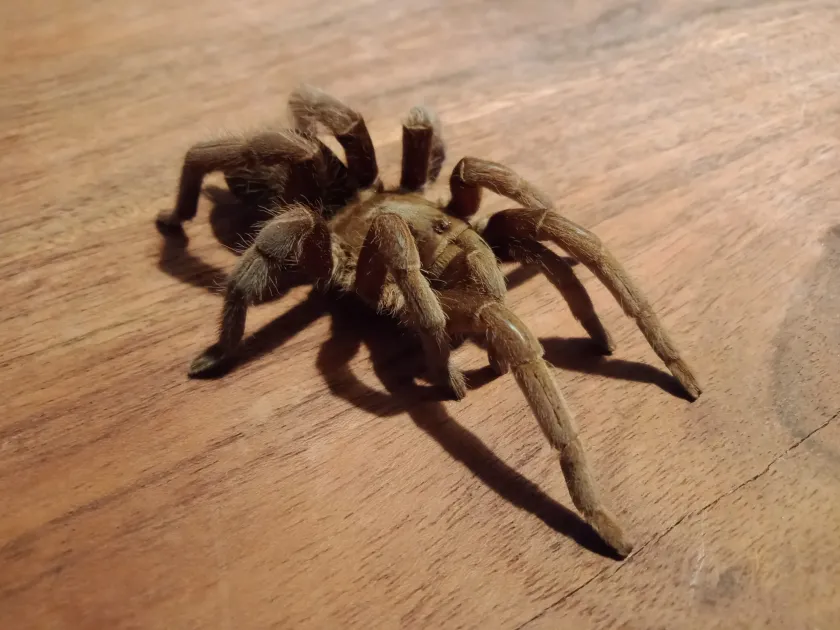
The Australian whistling spider (Selenotypus plumipes) is a prominent member of the Theraphosidae family, well-known for its size and burrowing behavior.
These spiders possess a robust, hairy body that helps regulate temperature and moisture, allowing them to survive in diverse Australian soil environments.
Their coloration typically ranges from dark brown to reddish-tan, which provides excellent camouflage against the soil surface during their nocturnal hunting activities.
A distinctive feature of S. plumipes is the presence of specialized tibial spurs in males and scopulate pads on their legs, aiding movement in tunnels.
As a burrowing species, they spend most of their life cycle underground, coming to the surface primarily at night to capture prey or find mates.
What it damages
The Australian whistling spider is not a herbivore and does not consume plant tissue; therefore, it does not feed on agricultural crops directly.
However, the agricultural impact arises from their extensive burrowing behavior, which can cause significant mechanical disruption to the soil profile.
When high population densities occur in cultivated fields, the digging of deep, permanent burrows can disturb the root systems of young or sensitive plants.
This soil displacement can lead to increased root exposure to air and reduced moisture retention, potentially hindering the early growth stages of a crop.
Furthermore, in mechanized farming, the presence of numerous deep holes can slightly impede the uniformity of soil surface preparations and cultivation equipment.
When it appears
The activity of Selenotypus plumipes is highly influenced by seasonal changes in temperature and rainfall, which dictate their metabolic rates.
Peak activity generally occurs during the warmer, wetter months when both the spiders and their prey base are most active and visible on the surface.
In contrast, during extreme droughts or cold winter periods, the spiders retreat deep into their burrows to maintain a stable microclimate and lower their activity levels.
The reproductive season often triggers a surge in male movement across the surface, increasing the frequency of sightings in agricultural areas during those months.
Monitoring seasonal rainfall patterns can help agriculturalists anticipate potential increases in spider activity and plan soil management accordingly.
Signs of infestation
The most visible sign of an infestation is the presence of vertical burrow entrances, which are sometimes rimmed with silk webbing to prevent debris from falling in.
Exuviae (cast skins) or remains of insects around the burrow entrance are common indicators that a spider is successfully hunting in the vicinity.
Minor mounds of excavated soil or cleaned debris near the hole entrance often reveal the most recent burrow maintenance activities of the spider.
In areas where burrow density is high, one might notice localized stress in crop seedlings due to the mechanical root disturbance caused by tunnel formation.
Nocturnal visual inspections using a flashlight during peak activity seasons can confirm the presence of these spiders at the mouths of their burrows.
Control measures
Since the Australian whistling spider is generally not considered a major agricultural pest, heavy chemical intervention is rarely recommended or necessary.
Deep tillage and soil cultivation remain the most effective methods to disrupt burrow stability and discourage permanent settlement in agricultural fields.
Managing the local insect population, which serves as the spider's primary food source, can make the area less attractive for colonization.
In small-scale or high-value crops, manual inspection and disturbance of burrow entrances during soil preparation can help mitigate potential root damage.
- Regular soil tilling to destroy burrow integrity.
- Monitoring pest insect populations to reduce the spiders' food supply.
- Using appropriate irrigation to ensure healthy, resilient root growth.
- Mechanical levelling of soil surfaces to remove burrow clusters.
Taxonomy
- Latin name
- Selenotypus plumipes
- Family
- Theraphosidae
- EPPO code
- SETYPL
Discussion
No discussions yet — be the first.