
Sisal weevil
Scyphophorus acupunctatus
Description
How to identify
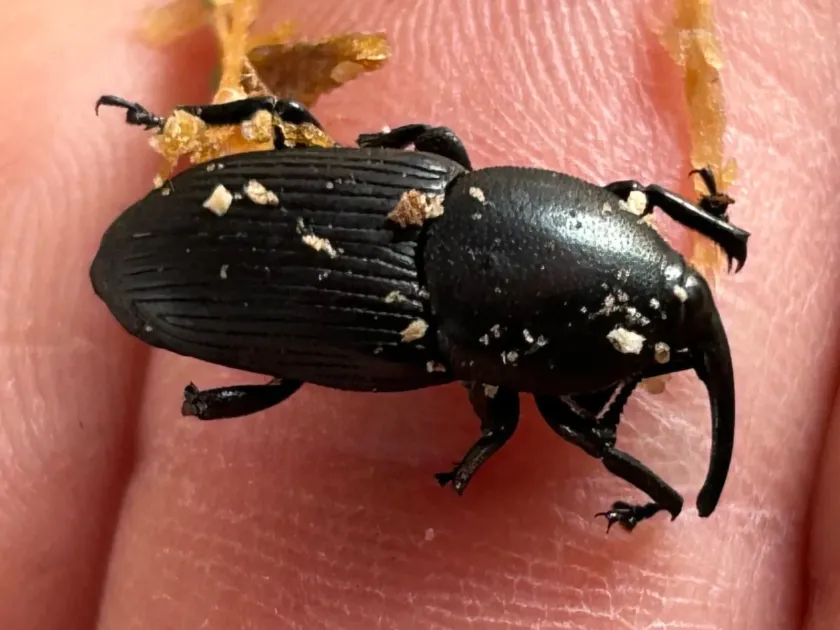
The sisal weevil (Scyphophorus acupunctatus) is a member of the Curculionidae family within the order Coleoptera. Adults are large, robust beetles measuring between 10 and 19 mm in length, possessing a prominent, elongated rostrum.
The body is typically matte black or dark brown, with a smooth, hard exoskeleton that provides significant protection against environmental stressors and predators.
Larvae are legless, fleshy, and creamy-white, featuring a distinct, hardened brown head capsule. They spend their entire developmental phase feeding inside the tissues of the host plant.
Adult beetles are highly mobile and capable of flying long distances, allowing them to rapidly colonize new host plants and expand their territory across plantations.
While historically associated with Agave species, the weevil has demonstrated an ability to adapt to various succulent ornamental plants, increasing its significance as a global pest.
What it damages
This weevil primarily infests members of the Agave genus, particularly sisal, as well as a wide range of ornamental cacti and succulent species.
Damage is caused by both adults, which feed on plant tissues, and larvae, which tunnel through the stem and base of the leaves to consume the succulent core.
In large-scale commercial plantations, severe infestations can lead to the death of entire crops within a single season, causing significant economic losses.
The internal tunneling activity of the larvae disrupts the plant's vascular system, compromising its structural integrity and inhibiting the transport of water and nutrients.
Compromised plants often succumb to secondary bacterial and fungal infections that thrive within the tunnels created by the weevil, leading to total tissue decay.
When it appears
The life cycle of the sisal weevil is heavily influenced by temperature and humidity, with peak reproductive activity occurring during warm, wet seasons.
In tropical and subtropical regions, adult beetles remain active year-round, as they do not require a winter diapause provided temperatures remain within their developmental threshold.
Activity intensifies during the active growing season of the host plant, when the plants are most succulent and offer optimal nutritional conditions for larval development.
Females insert their eggs directly into the plant tissues, using their rostrum to drill entry holes, ensuring the larvae have an immediate food source upon hatching.
Under optimal conditions, multiple generations can occur annually, which necessitates continuous monitoring and proactive management strategies throughout the growing cycle.
Signs of infestation
Early-stage infestations are notoriously difficult to detect because the weevils spend most of their life cycle hidden deep within the plant structure.
- Presence of small, circular entry holes in the leaf bases or stems.
- Yellowing and wilting of the central leaves, which may easily pull out from the crown.
- A distinct, pungent odor of rotting plant material emitted from the crown.
- Accumulation of dark, frass-like material around the base of the plant.
- Total collapse of the stem base and detachment from the root system due to internal structural destruction.
Control measures
Effective management of the sisal weevil requires an integrated pest management approach that combines cultural, mechanical, and chemical control methods.
Sanitation is the most critical practice; infected plants should be promptly removed and destroyed away from the field to eliminate breeding sites.
The use of synthetic aggregation pheromone traps is highly effective for monitoring and suppressing adult beetle populations before they can lay eggs.
Systemic insecticides are the preferred chemical treatment, as they are absorbed by the plant and target the larvae feeding within the hidden internal tissues.
Minimizing physical damage during cultivation is essential, as any wounds or cuts on the stem serve as attractants and entry points for the adult weevils.
Taxonomy
- Latin name
- Scyphophorus acupunctatus
- Order
- Coleoptera (beetles)
- Family
- Dryophthoridae
- EPPO code
- SCYPIN
Discussion
No discussions yet — be the first.