
Goosefoot moth
Scrobipalpa atriplicella
Description
How to identify
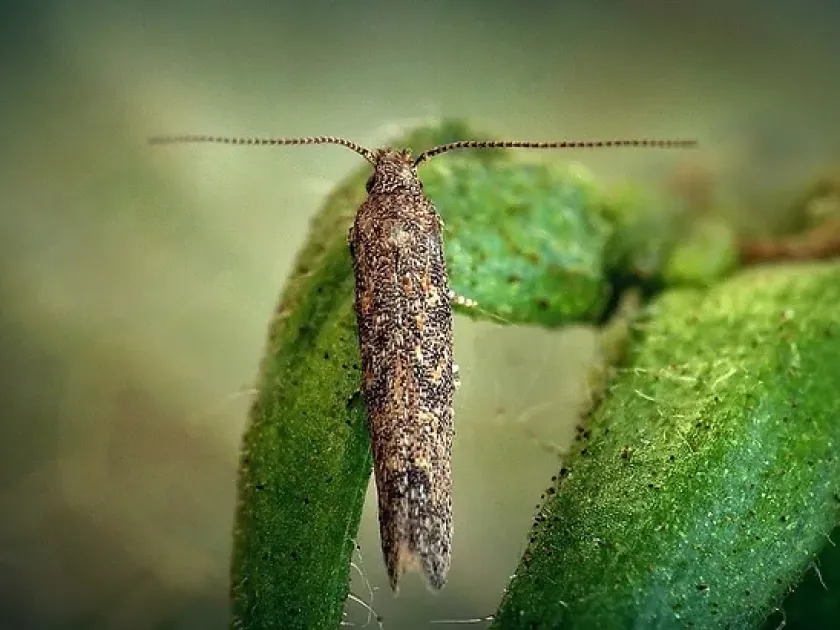
The Goosefoot moth (Scrobipalpa atriplicella) belongs to the order Lepidoptera and the family Gelechiidae. The adult moth has a wingspan of approximately 12–16 mm.
The forewings have a greyish-brown color with a distinct pattern of dark spots and stripes. The hindwings are paler with long fringes along the edges.
The larvae reach a length of 10–12 mm. Their body is yellowish-green or brownish with a darker head and characteristic longitudinal stripes on the dorsal side.
The pupa is dark brown and typically develops inside a silken cocoon constructed by the larva either in its feeding site or in the topsoil layer.
Eggs are extremely small, oval-shaped, and usually laid individually or in small clusters on the underside of the leaves of host plants.
What it damages
The primary hosts of the Goosefoot moth are plants of the Amaranthaceae family, particularly species in the Atriplex (orache) and Chenopodium (goosefoot) genera.
In commercial agriculture, this pest poses a significant risk to sugar beets, table beets, and fodder beets, as these crops are closely related to common weeds.
The larvae feed on both foliage and reproductive organs, including seed stalks, which can lead to substantial reductions in seed yield.
Damage to the crop occurs through skeletonization or by boring tunnels into the leaf parenchyma, which severely impairs the plant's photosynthetic capacity.
Infestation by this pest weakens the crop, making it more susceptible to various secondary fungal and viral diseases that enter through damaged tissues.
When it appears
The life cycle of the Goosefoot moth includes several generations per growing season, with the number of cycles depending on the local climatic conditions.
The insect typically overwinters in the pupal stage or as a mature larva within plant debris or in the upper layers of the soil.
The first generation of moths usually emerges in late spring or early summer, coinciding with the onset of stable warm temperatures required for their activity.
Peak larval density occurs during the second half of summer, as subsequent generations develop and are capable of causing maximum damage to fields.
During the autumn, development slows down, and the pest prepares for diapause by seeking shelter among weed vegetation or crop residues.
Signs of infestation
The first sign of the Goosefoot moth's presence is the appearance of small, light-colored spots on the leaves, which eventually turn into brown, dry, irregular patches.
Larvae frequently weave leaves together with silk to form nests or fold a leaf into a tube, providing themselves with shelter from predators and excessive sunlight.
Monitoring the fields often reveals characteristic larval frass, appearing as small dark pellets on the surface of the affected leaves or inside the silk webbings.
When seed stalks are attacked, symptoms include premature wilting of flowers and stunted development of fruits, which is easily identifiable during field surveys.
- Yellowing of specific leaf areas.
- Presence of silk webbing in folded leaves.
- Development of holes and tunnels (mines) in leaf tissues.
Control measures
The most important control measure is the diligent management of weeds, specifically orache and goosefoot species, which act as reservoirs for the pest early in the season.
Effective agrotechnical practices, such as deep autumn plowing, are crucial for destroying overwintering pupae in the soil, thus reducing population levels for the following year.
Implementing crop rotation, which excludes beet cultivation on fields heavily infested with Amaranthaceae weeds, significantly minimizes the risk of massive outbreaks.
In cases of high infestation levels, insecticides with contact and stomach action, labeled for use on beets, should be applied according to pre-harvest intervals.
Biological control strategies involve the use of beneficial entomophagous insects and microbial agents, which effectively regulate larval populations without harming the environment.
Taxonomy
- Latin name
- Scrobipalpa atriplicella
- Order
- Lepidoptera (butterflies)
- Family
- Gelechiidae
- EPPO code
- PHTOAT
Discussion
No discussions yet — be the first.