
Peach tree borer
Sanninoidea exitiosa
Description
How to identify
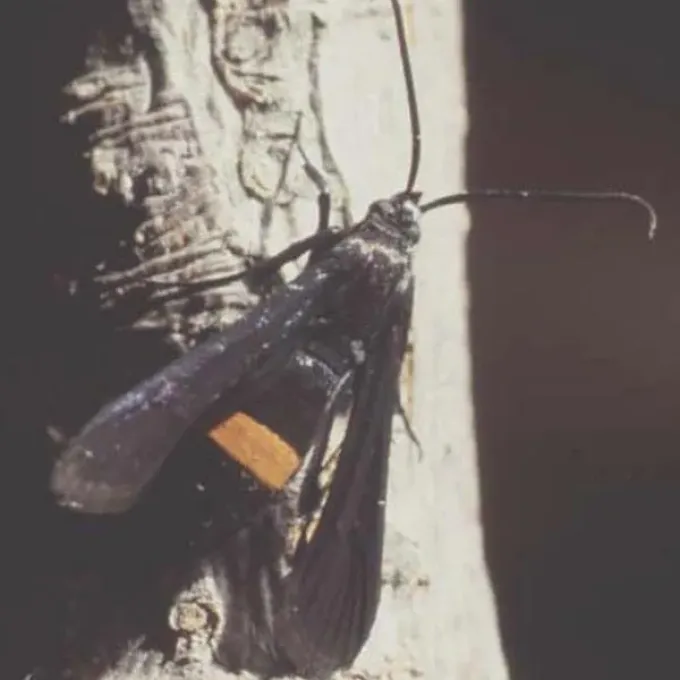
The peach tree borer (Sanninoidea exitiosa) belongs to the Sesiidae family of moths, which are well-known for their mimicry. They look remarkably like wasps, which helps them avoid some predators.
Adult females are dark, metallic blue with a distinct orange band across the abdomen. Males are more slender and have more transparent areas on their wings, resembling narrow-waisted wasps.
The larvae, or caterpillars, are creamy-white with a brown head capsule. They grow up to 30 mm in length and spend almost their entire lives boring into the wood of the host tree.
The life cycle is generally completed in one year, though it can vary based on local climate. Larvae overwinter in burrows beneath the bark, resuming activity as soon as the weather warms.
Pupation occurs in the spring inside a silken cocoon covered with frass and bark pieces. Once the transformation is complete, the adult moth emerges through a hole in the bark.
What it damages
This pest targets stone fruits, including peaches, nectarines, apricots, cherries, and plums. It is considered one of the most destructive pests for trees in this category.
Larvae feed primarily in the crown area or near the base of the trunk. They create winding tunnels in the cambium layer, effectively girdling the tree and cutting off nutrient flow.
Infested trees show signs of decline, including stunted growth and sparse foliage. A heavy infestation can cause the complete death of the tree within a few seasons.
Secondary infections, such as pathogens or fungal diseases, often enter through the wounds caused by the borers, further weakening the tree's immune system and vitality.
Young nursery trees are particularly susceptible. If the base of the trunk is significantly damaged, the tree will lose its structural integrity and may snap during high winds.
When it appears
Adult moths emerge in early summer, typically starting in June, with activity continuing through August. The exact timing depends on the regional climate and seasonal temperatures.
Mated females lay eggs on the trunk of the host tree, usually near the soil line or around the base of major roots. A single female can produce hundreds of eggs during her lifespan.
After hatching, the neonate larvae quickly move to find a crack in the bark or a wound to enter the tree. Once they are beneath the surface, they are protected from environmental factors.
Feeding activity is most intense during the spring when the tree starts its growth cycle and nutrients are abundant in the cambium, fueling the larvae's rapid development.
By late spring, the larvae finish feeding and construct their pupal cells. Monitoring the timing of adult emergence is crucial for effective orchard management and control.
Signs of infestation
The most visible indicator of an infestation is the presence of large amounts of gummy sap mixed with frass (insect excrement) at the base of the trunk.
Piles of sawdust-like frass on the soil around the base of the tree are clear indicators that larvae are currently active inside the wood of the host plant.
Bark near the base may appear loose, soggy, or cracked. If inspected closely, one might see small exit holes where the moths have previously emerged.
- Yellowing of leaves in mid-summer.
- Wilting or dieback of individual branches.
- Overall lack of new terminal growth.
- Premature leaf drop in early autumn.
In advanced cases, the tree may show signs of severe stress, and dead bark patches become prominent as the cambium layer is destroyed by the boring insects.
Control measures
Good orchard sanitation is essential. Avoid injuring the base of the trunk with lawnmowers or string trimmers, as these wounds provide perfect entry points for larvae.
Pheromone traps are highly effective for monitoring adult moth populations and identifying the exact time frame for applying control measures in a given season.
Manual removal of larvae, where possible, or cleaning the infested areas and applying a protective dressing can help, though it is only viable for smaller infestations.
Chemical control usually involves targeting the base of the trunk with residual insecticides just before or during the period when newly hatched larvae are seeking entry.
Maintaining strong tree vigor through proper irrigation and balanced fertilization helps trees withstand minor attacks and promotes faster healing of damaged tissues.
Taxonomy
- Latin name
- Sanninoidea exitiosa
- Order
- Lepidoptera (butterflies)
- Family
- Sesiidae
- EPPO code
- SANNEG
Discussion
No discussions yet — be the first.