
Persimmon borer
Sannina uroceriformis
Description
How to identify
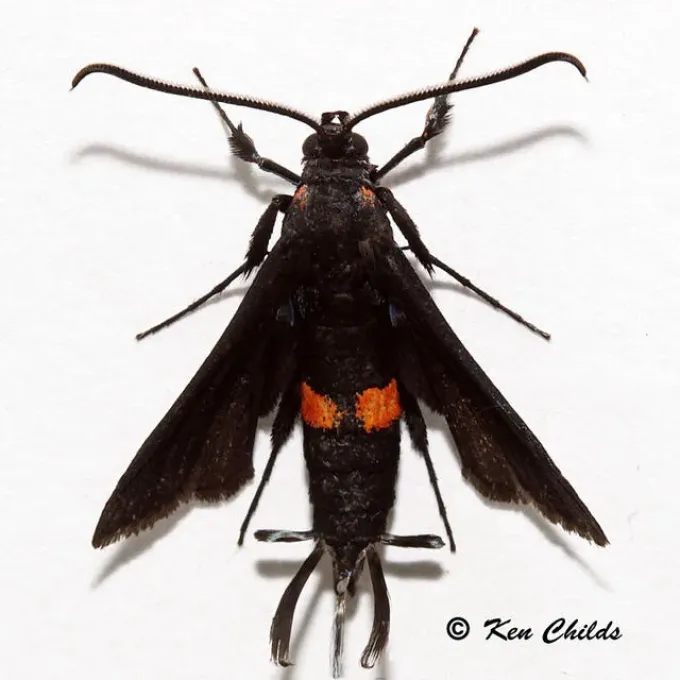
The persimmon borer (Sannina uroceriformis) is a member of the clearwing moth family (Sesiidae), order Lepidoptera. Adults exhibit Batesian mimicry, resembling wasps to avoid predation.
The moth has a dark body with distinctive yellow or orange bands on the abdomen. Its wingspan typically ranges from 30 to 40 mm, with mostly transparent wings marked by dark edges.
Larvae are cream-colored with dark head capsules. They spend their entire developmental period inside the trunk or root system of the host tree, making them difficult to spot.
Pupae are equipped with backward-pointing spines that allow them to move within the galleries created by the larvae before the adult moth emerges from the bark.
The life cycle is typically univoltine, meaning one generation per year, though environmental factors may occasionally extend development across two seasons.
What it damages
The primary host for this pest is the persimmon tree (Diospyros species). Damage is inflicted by the larvae, which bore into the wood and conductive tissues of the tree.
Larvae focus their feeding on the lower trunk and the crown area of the root system, which are critical for the plant's overall vascular health.
Tunneling activity disrupts the flow of nutrients and water throughout the tree, leading to gradual decline, reduced yield, and weakened vigor.
Severe infestations can result in the girdling of young trees, causing stunted growth, limb dieback, and eventually the death of the entire plant.
Damaged trunks become entry points for secondary pathogens and fungal infections, which further accelerate the deterioration of the tree's internal structure.
Signs of infestation
The most reliable sign of an infestation is the presence of brown frass (larval waste) mixed with wood shavings piled up at the base of the tree trunk.
Bark surfaces may display exit holes, sometimes accompanied by sap or gum oozing from the entry sites as the tree attempts to seal the wounds.
Foliage on infested branches often yellows prematurely and drops, and new vegetative growth appears significantly reduced compared to uninfested parts of the orchard.
During the flight period, empty pupal casings can be found protruding from the bark, confirming the successful emergence of adult clearwing moths.
In cases of chronic infestation, the bark may show signs of splitting, thinning, or loose detachment in the areas where the larvae have been feeding.
Control measures
Management of the persimmon borer begins with proactive orchard hygiene, including the removal of dead or heavily infested wood to reduce breeding sites.
Farming practices should prioritize tree health, ensuring proper irrigation and fertilization, as vigorous trees are more capable of resisting initial larval attacks.
Pheromone traps are highly effective for monitoring adult moth populations, allowing growers to time insecticide applications accurately during the peak flight season.
- Regular inspection of lower trunks for frass.
- Pruning and destroying heavily infested branches.
- Application of systemic insecticides during egg-laying.
- Protecting the tree base from mechanical injury.
In integrated pest management programs, natural predators and parasitic wasps should be encouraged, as they play a significant role in reducing borer populations.
Taxonomy
- Latin name
- Sannina uroceriformis
- Order
- Lepidoptera (butterflies)
- Family
- Sesiidae
- EPPO code
- SANIUR
Discussion
No discussions yet — be the first.