
Black scale
Saissetia oleae
Description
How to identify
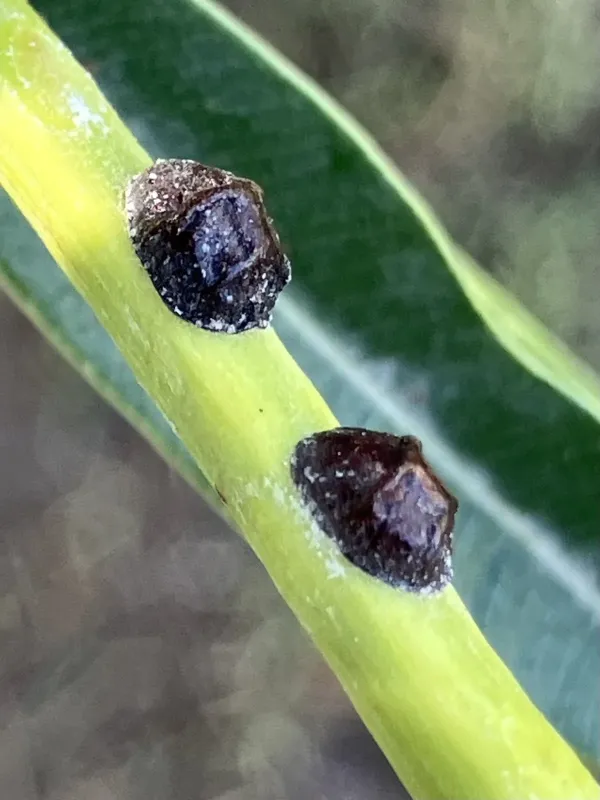
The black scale (Saissetia oleae) is a prominent pest belonging to the Coccidae family. The adult female is easily recognized by its hemispherical, dark brown or black body with a distinct "H"-shaped ridge on its dorsal surface.
Adult females are sessile, meaning they remain fixed in one spot on the bark or leaves of the host plant throughout their reproductive life. They are protected by a thick, waxy cuticle that makes them highly resistant to standard contact insecticides.
The lifecycle involves a nymph stage known as "crawlers." These crawlers are the only mobile phase of the insect, characterized by a pale yellow color and small size, allowing them to disperse via wind or by crawling to new plant parts.
Reproduction is primarily parthenogenetic, with females producing up to 2,000 eggs hidden beneath their protective scale. This high fecundity allows the population to expand rapidly under favorable environmental conditions.
Males of the species are rarely observed and do not significantly contribute to the population growth. Consequently, the pest population consists almost exclusively of females and their offspring.
What it damages
Black scale is a polyphagous pest that attacks a wide range of economically important plants. Its primary hosts include olive trees, citrus species, figs, oleanders, and various ornamental plants in greenhouses.
Damage is caused by both adults and nymphs piercing plant tissues to extract sap. This continuous feeding leads to the depletion of nutrients, reduced plant vigor, stunted growth, and potential dieback of twigs and branches.
A significant indirect effect of black scale infestation is the excretion of honeydew. This sticky substance covers the leaves and serves as a substrate for sooty mold, a type of fungus that turns foliage black.
The accumulation of sooty mold physically blocks sunlight, severely hindering photosynthesis. This disruption results in lower yields, poor fruit quality, and weakened overall tree health.
Heavy infestations can lead to premature leaf drop and the death of young saplings. In agricultural settings, the presence of these scales significantly degrades the market value of the harvested fruit.
When it appears
The seasonal development of black scale is heavily influenced by regional climate patterns. In tropical and subtropical areas, it can complete multiple generations per year, creating a continuous pressure on crops.
The peak period for crawler emergence is typically during the warmer months. This is the critical window when the pest is most vulnerable to chemical treatments, as the newly emerged crawlers have not yet developed their protective waxy cover.
During the cooler seasons, the development slows down significantly. The pest typically overwinters as second or third-stage nymphs or as young adults, waiting for the return of warmer temperatures to resume activity.
In greenhouses and indoor environments, development can proceed year-round without a distinct seasonal break. This requires constant vigilance and a preventative management strategy to protect sensitive crops.
Temperature fluctuations and humidity play key roles in determining the survival rate of the crawlers. Consistent warmth generally favors rapid population growth and successive generation cycles.
Signs of infestation
The primary sign of infestation is the presence of hard, bumpy, dark-colored scales on stems and leaves. These are the fixed bodies of the adult females and are resistant to manual removal.
Sticky, shiny surfaces on the foliage are a classic indication of honeydew secretions. This substance is often accompanied by the presence of ants, which visit the scales to feed on the sweet honeydew.
The development of a black, powdery coating on the leaves is a clear symptom of secondary sooty mold growth. This indicates that the scale population has been present for a significant period.
Plant distress is visible through yellowing leaves, chlorosis, and the general loss of leaf luster. In severe cases, the branches may begin to dry out, and the tree may appear prematurely defoliated.
Observing colonies in the crotches of twigs or along the midribs of leaves is a common diagnostic method. Finding these clusters confirms an active infestation that requires immediate management intervention.
Control measures
Successful management of black scale requires an integrated pest management (IPM) approach. This involves combining cultural practices with biological controls and targeted chemical applications.
Cultural methods include regular pruning to remove heavily infested branches and improve the overall airflow within the canopy. A thinner canopy creates a less suitable microclimate for the pest to thrive.
Chemical control is most effective when applied against the crawler stage. Systemic insecticides are preferred as they penetrate the plant tissues, making them effective even against insects that may have begun to form their shields.
Biological control, utilizing beneficial insects like parasitic wasps or ladybird beetles, can be very effective in reducing populations. Conserving these natural predators is essential for long-term ecological balance.
- Monitor crops regularly, especially during the peak crawler emergence phase.
- Use mineral or horticultural oils to suffocate the insects by blocking their breathing pores.
- Manage ant populations, as they protect scale insects from natural predators.
- Ensure proper fertilization to help the plant recover from the stress of the infestation.
- Clean equipment thoroughly when moving between orchards to prevent the spread of crawlers.
Taxonomy
- Latin name
- Saissetia oleae
- Order
- Hemiptera (bugs, aphids, leafhoppers)
- Family
- Coccidae
- EPPO code
- SAISOL
Discussion
No discussions yet — be the first.