
South American palm weevil
Rhynchophorus palmarum
Description
How to identify
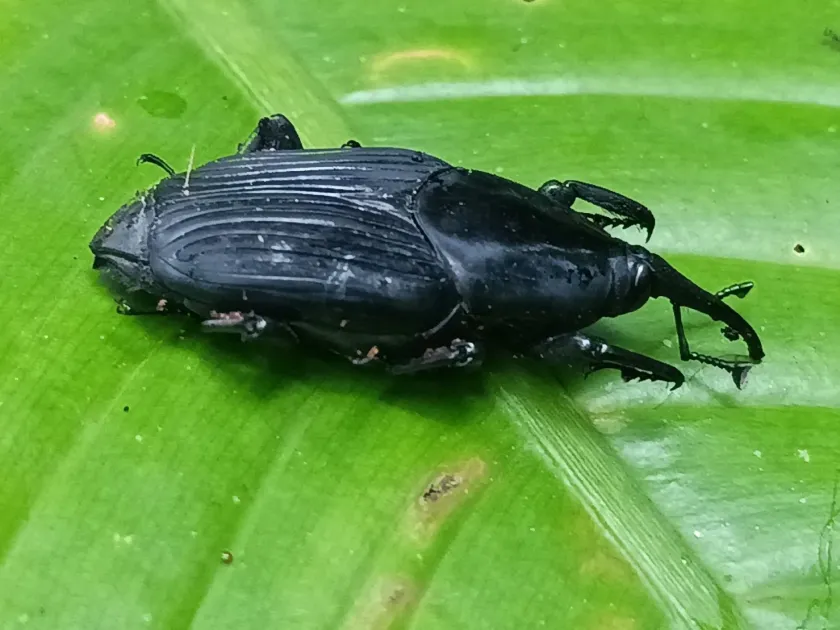
The South American palm weevil (Rhynchophorus palmarum) is a significant pest belonging to the Curculionidae family within the order Coleoptera. Adult weevils are large, typically reaching 4 to 5 centimeters in length, and possess a long, distinct snout used for feeding and egg-laying.
The coloration of the adult beetle ranges from deep brown to solid black. They have a relatively smooth surface on their elytra, which allows them to navigate within the fibrous tissues of their host plants efficiently.
The larvae are fleshy, legless grubs with a creamy-white or yellowish body and a hard, dark brown head capsule. They are the primary damaging stage, spending their entire development tunneling through the host tree.
Pupation occurs inside a fibrous, oval-shaped cocoon constructed by the mature larva using plant fibers. These cocoons are highly resilient and are often found within the galleries created by the larvae.
The complete life cycle depends heavily on the local climate. In tropical regions, breeding can occur continuously, allowing for multiple overlapping generations throughout the year.
What it damages
This pest primarily attacks various palm species, such as coconut, oil, and date palms. It also poses a threat to sugarcane and banana plantations, making it a significant economic concern in agriculture.
Beyond direct physical damage, the weevil is the primary vector for the nematode Bursaphelenchus cocophilus. This pathogen causes "red ring disease," which is rapidly fatal to palm trees.
Larvae consume the internal tissues, especially the apical bud (the growth point). Extensive tunneling destroys the plant's vascular system, preventing water and nutrients from reaching the crown.
Infested trees often suffer from structural failure. As the larvae hollow out the central trunk, the structural integrity of the palm is compromised, often leading to total collapse during high winds.
The presence of tunneling also invites secondary infections from fungi and bacteria, which accelerate the decomposition of the plant tissues and hasten the death of the tree.
Signs of infestation
The most common early symptom is the yellowing and drooping of the central fronds. This indicates that the internal vascular system has been compromised, hindering the palm's development.
External signs include the presence of small entry holes on the trunk or base of the leaves, accompanied by oozing sap. This fluid often mixes with frass (insect excrement) and wood fibers to form a sticky mass.
In quiet environments, it is sometimes possible to hear the audible chewing sounds of the larvae working inside the trunk, which is a telltale sign of a severe infestation.
As the damage progresses, the palm crown may collapse entirely. The foliage turns brown and shrivels rapidly, leaving a clear visual sign of significant internal degradation.
The appearance of fallen, fibrous cocoons around the base of the tree or within the leaf axils is a clear indicator that the lifecycle of the weevil has been successfully completed in that host.
Control measures
Integrated Pest Management (IPM) for this species heavily relies on the use of pheromone traps. These traps are highly effective at capturing adult weevils, thereby reducing the breeding population.
Sanitation is critical; all heavily infested trees must be cut down and destroyed, ideally by burning, to eliminate the reservoir of larvae and pupae within the trunks.
For high-value trees, systemic insecticide injections directly into the trunk are recommended. This method ensures the chemical reaches the larval galleries, providing better protection than topical sprays.
Preventative care involves minimizing mechanical damage to the trunk, as fresh wounds release chemicals (kairomones) that actively attract adult weevils to the site for egg-laying.
- Deployment of pheromone-baited traps to monitor and reduce populations.
- Prompt removal and destruction of infested palm material.
- Trunk injections of systemic insecticides for targeted protection.
- Biological control using pathogenic fungi like Beauveria bassiana.
- Avoiding unnecessary pruning or wounding to reduce plant attractiveness.
Taxonomy
- Latin name
- Rhynchophorus palmarum
- Order
- Coleoptera (beetles)
- Family
- Dryophthoridae
- EPPO code
- RHYCPA
Discussion
No discussions yet — be the first.