
Red palm weevil
Rhynchophorus ferrugineus
Description
How to identify
The red palm weevil (Rhynchophorus ferrugineus) is a destructive pest of palms belonging to the family Curculionidae of the order Coleoptera.
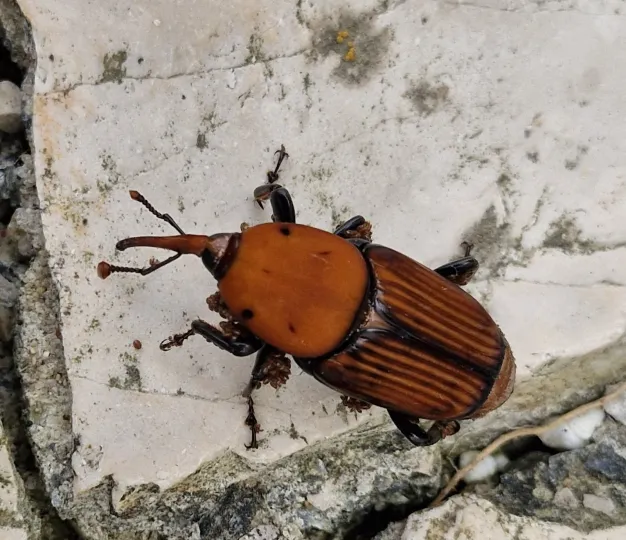
The adult weevil is roughly 35 mm in length, easily identified by its rusty red coloration and several small black spots on the dorsal side of the thorax.
It possesses a long, curved snout, which is a characteristic feature of its family, and well-developed wings that facilitate long-distance dispersal.
The life cycle encompasses eggs, larvae, pupae, and adults, with the larvae being the primary stage responsible for the extensive damage to host plants.
Larvae are legless, creamy-white in color, and possess a heavily sclerotized brown head capsule equipped with powerful mandibles for boring through palm tissue.
What it damages
This pest affects a wide range of palm species, most notably the date palm, canary island date palm, and the oil palm, causing devastating losses in agriculture.
Beyond palms, the red palm weevil has been reported to infest other monocotyledonous crops such as sugarcane, bananas, and ornamental agaves.
The larvae tunnel deep into the apical growth zone and internal trunk tissues, consuming the soft fibers and ultimately destroying the plant's vascular system.
Heavy infestation leads to the collapse of the palm's crown and its eventual death, as the structural integrity of the trunk is completely compromised by internal tunnels.
The economic impact is profound, as the loss of mature palms entails significant replacement costs, environmental degradation, and long-term control expenses.
Signs of infestation
Early symptoms include the wilting and yellowing of the central leaves, often appearing as a collapsed "flag" at the top of the palm tree canopy.
Visual inspection often reveals exit holes on the trunk or base, from which thick, dark-colored fluid oozes, frequently accompanied by a sour fermentation odor.
The presence of fibrous debris, resembling sawdust, around the base of the tree or at the points of leaf attachment is a definitive sign of active larval boring.
Auditory detection is possible; using a stethoscope or electronic sensor, one can often hear the larvae chewing inside the trunk of a heavily infested palm.
In advanced stages, the entire crown may topple over, revealing a hollowed-out interior filled with cocoon casings and decaying plant fibers.
Control measures
Integrated Pest Management (IPM) is essential, starting with constant monitoring using pheromone traps to capture adult weevils and estimate population density.
Chemical control involving systemic insecticides is commonly applied via trunk injection or soil drenching to ensure the toxin reaches the larvae hidden within the trunk.
Cultural practices include strictly avoiding pruning during the active flight season and immediately sterilizing any wounds caused by maintenance work.
Strict phytosanitary protocols are necessary for the disposal of infested palms, which must be shredded and burnt to prevent further spread to healthy plants.
Biological control agents, including specific entomopathogenic fungi such as Beauveria bassiana, are increasingly used to suppress populations in an eco-friendly manner.
Taxonomy
- Latin name
- Rhynchophorus ferrugineus
- Order
- Coleoptera (beetles)
- Family
- Dryophthoridae
- EPPO code
- RHYCFE
Discussion
No discussions yet — be the first.