
Giant palm weevil
Rhynchophorus colossus
Description
How to identify
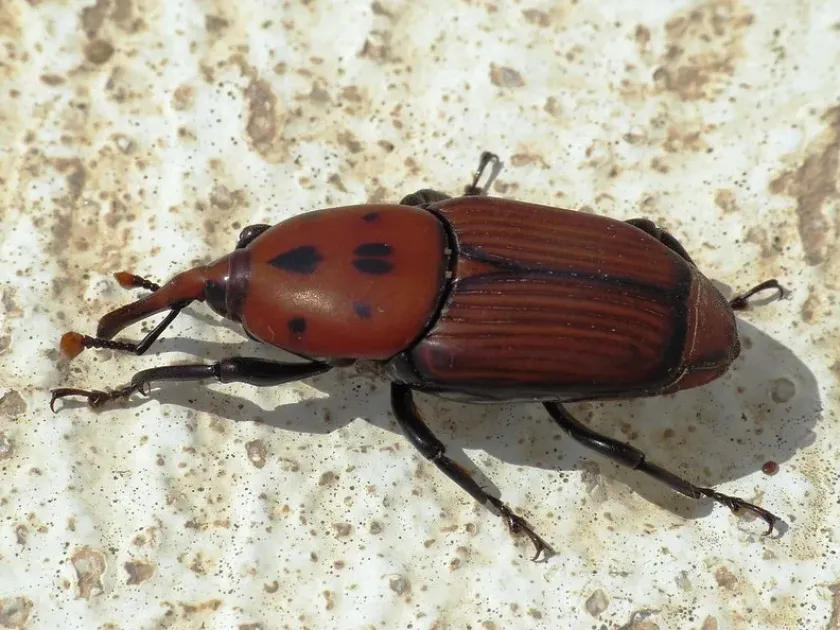
The giant palm weevil (Rhynchophorus colossus) belongs to the order Coleoptera and the family Curculionidae. It is a large insect with a robust exoskeleton, typically measuring between 30 and 45 millimeters in length.
The adult weevils are dark brown to black in color. A distinguishing feature is the long, curved snout (rostrum), which is more robust and covered with short, stiff hairs in males, while the female's snout is smoother and more slender.
The larvae are legless, reaching up to 50 millimeters, with a fleshy, creamy-white body and a hard, brown head capsule. They possess powerful mandibles capable of easily chewing through the fibrous tissues of palm trunks.
Pupation occurs within a specialized, oval-shaped cocoon constructed from processed palm fibers. This cocoon provides essential protection for the developing insect during the metamorphosis process before emergence.
Adults are highly mobile and equipped with strong flight wings, allowing them to navigate vast areas. They utilize specific olfactory signals to locate suitable host trees, particularly those showing signs of stress or wounding.
What it damages
The giant palm weevil is a significant pest of various palm species, most notably date palms, coconut palms, and several ornamental palm varieties used in landscaping and park management.
The larvae are the primary cause of damage. Upon hatching, they bore into the soft tissues of the crown and the heart of the palm, creating deep, extensive tunnels that destroy the plant's vital vascular system.
By consuming the growing point (apical meristem), the larvae effectively prevent the tree from producing new foliage, which is fatal to the plant. Heavy infestations can lead to hundreds of larvae feeding simultaneously within a single trunk.
Ornamental palms are often severely impacted, as the pest can remain hidden for weeks before external symptoms appear, making early diagnosis exceptionally difficult for arborists and gardeners.
Economic damage is substantial, as infested trees often cannot be salvaged once the growing point is destroyed. This necessitates the removal and destruction of the trees to stop the spread to nearby healthy palms.
When it appears
In tropical and subtropical regions, the giant palm weevil is active throughout the year. Development is continuous, as the warm climate supports year-round reproduction without the need for a winter dormancy period.
The life cycle, covering egg, larval, pupal, and adult stages, typically lasts between three and four months, contingent upon ambient temperature, humidity levels, and the nutritional state of the host tree.
Peak dispersal activity for adult weevils usually occurs following rainy seasons or periods of high humidity. These conditions are ideal for egg survival and larval establishment within the succulent parts of the host plant.
Females deposit eggs in cavities they excavate within the petiole bases or any existing wounds on the palm's trunk. A single female can produce several hundred eggs during her lifespan, ensuring rapid population growth.
Because generations often overlap, it is common to find multiple developmental stages within a single palm trunk simultaneously, which complicates the timing of pesticide application and integrated pest management efforts.
Signs of infestation
An early warning sign is the thinning or yellowing of the central leaves (the spear leaf). This indicates that the larvae are disrupting the nutrient flow or damaging the growth point at the top of the trunk.
Infected trees may exhibit weeping wounds on the trunk where eggs were laid. These spots often leak a brownish, viscous fluid with a characteristic sour, fermenting odor that attracts other weevils.
A telltale auditory sign is the internal chewing noise produced by a large population of larvae feeding inside the trunk. In quiet settings, this sound can be detected using sensitive acoustic devices.
As the damage progresses, the entire crown of the palm may collapse or lean, creating a "parasol" effect. This structural failure occurs because the internal tissues have been completely hollowed out by the larvae.
Accumulation of "frass" (a mixture of chewed wood fibers and excrement) at the base of the trunk or in leaf axils is a clear visual indicator that the interior of the tree is being actively destroyed.
Control measures
Effective management of the giant palm weevil relies on an integrated approach, as larvae are largely protected from external contact insecticides while residing within the palm trunk.
- Installation of pheromone traps to monitor and reduce adult weevil populations.
- Prophylactic trunk injections of systemic insecticides to kill larvae before they cause terminal damage.
- Proper sanitary pruning practices, ensuring all cuts are treated with protective fungicides or sealants.
- Removal and immediate destruction (chipping/burning) of heavily infested trees to prevent further spread.
- Deployment of biological control agents, such as entomopathogenic nematodes, to target larvae in the tunnels.
Public awareness and strict quarantine regulations regarding the transport of palm nursery stock are essential to prevent the accidental introduction of this pest into non-infested geographic regions.
Maintaining palm health through optimal irrigation and balanced fertilization helps trees recover from minor stress, thereby reducing the chemical signals that attract foraging adults.
Ongoing monitoring of all palm plantings, especially in urban landscapes, is critical for identifying potential infestation hotspots early, which significantly increases the chances of successful tree rescue.
Taxonomy
- Latin name
- Rhynchophorus colossus
- Order
- Coleoptera (beetles)
- Family
- Dryophthoridae
- EPPO code
- RHYCCO
Discussion
No discussions yet — be the first.