
Red palm weevil
Rhynchophorus
Description
How to identify
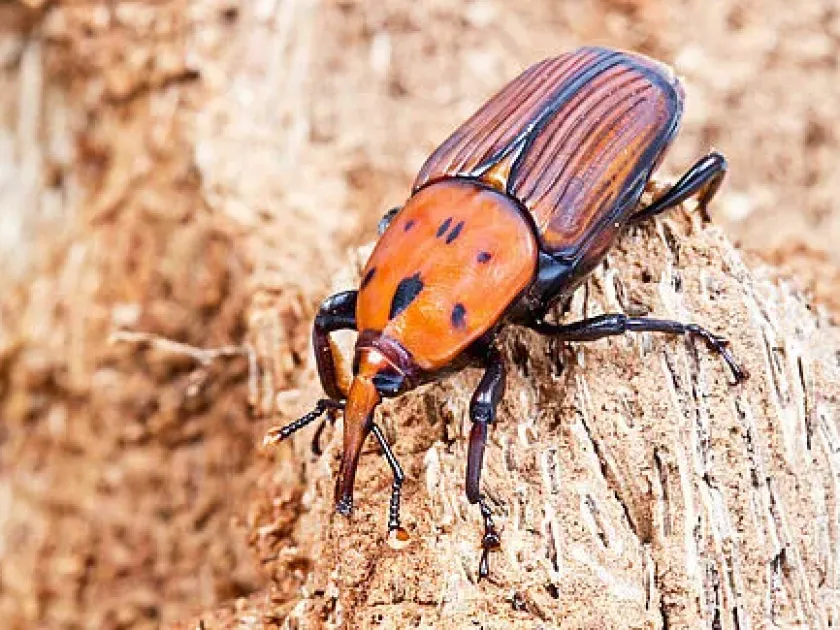
The red palm weevil (Rhynchophorus ferrugineus) is a member of the weevil family (Curculionidae) and is considered one of the most destructive pests of palm trees worldwide. Adults are characterized by their rust-red or reddish-brown color, a long snout, and distinct black spots on the thorax, measuring roughly 30-40 mm in length.
The life cycle consists of four stages: egg, larva, pupa, and adult. The female lays several hundred eggs in small holes or crevices in the palm tissue, usually near the crown or fresh wounds. The larvae are legless, creamy-white grubs with a brown head, capable of boring deeply into the tree.
Development from egg to adult occurs entirely within the palm's interior, making the pest extremely difficult to detect in the early stages. The pupal stage is protected by a fibrous cocoon made from the host plant's internal material.
Adults are strong fliers and can travel long distances, allowing the pest to colonize new areas rapidly. Their ability to reproduce continuously in tropical and subtropical environments contributes to their status as a major agricultural and ornamental threat.
Understanding their behavior is critical for management, as they are attracted to damaged or stressed palms, often using chemical cues to locate suitable hosts for egg-laying and feeding.
What it damages
Red palm weevils primarily infest a wide range of palm species, including the date palm, coconut palm, and various ornamental varieties such as Canary Island date palms. The damage is caused by the larvae feeding on the succulent, internal tissues of the stem.
As the larvae bore through the crown and trunk, they disrupt the vascular system, preventing the tree from transporting water and nutrients. This interference with the palm's internal structure often leads to the collapse of the crown and the eventual death of the tree.
Infested palms often show signs of secondary infection, as the damaged plant tissue becomes highly susceptible to various fungal and bacterial pathogens. These infections frequently accelerate the decline of the plant.
In cases of severe infestation, the interior of the trunk may be completely hollowed out, leaving the tree structurally unstable and prone to snapping during wind events. This poses significant risks to urban environments and public safety.
Economic damage is substantial, particularly in date palm orchards, where a single infestation can lead to the loss of a productive tree. Due to the cryptic nature of the pest, entire plantations can be decimated before the threat is fully recognized.
Signs of infestation
Early symptoms include the presence of holes in the trunk or base of the leaves, accompanied by the oozing of a thick, brownish fluid. Frass, which looks like wet sawdust, is often found near these entry points.
Yellowing and wilting of the younger, central fronds are key indicators of significant internal damage. As the vascular system fails, the entire crown may eventually droop, tilt, or fall over due to the destruction of the apical meristem.
During the night or in very quiet conditions, one may hear the distinct crunching or chewing sound of the larvae as they tunnel through the trunk. This sound is a clear indication of a heavy infestation.
A foul, putrid odor often emanates from the plant, signaling tissue decay and secondary decomposition. This smell is usually associated with the final stages of the infestation, making saving the tree unlikely.
The use of pheromone-based traps is the standard method for early detection. By monitoring adult beetle counts, arborists can determine if the pest is present in the area and initiate control measures before trees begin to die.
Control measures
Managing the red palm weevil requires an integrated pest management (IPM) strategy that combines physical, chemical, and biological methods. Prevention is the most effective approach to minimize tree losses.
Good horticultural practice is essential; this includes regular pruning but ensuring that cuts are minimal and immediately sealed with antiseptic pastes. Preventing tree stress and physical injury is vital to make the palms less attractive to the weevils.
Systemic insecticides, applied either via trunk injection or soil drenching, are effective in protecting palms from initial attacks. Regular treatment cycles are necessary during the active flying seasons of the beetle.
Biological control, including the use of entomopathogenic nematodes, has proven effective in targeting larvae deep within the palm's tissue. These natural enemies can be introduced into the galleries to kill the developing grubs.
- Regular inspection of palms for early symptoms or frass.
- Strategic deployment of pheromone traps to disrupt mating and monitor populations.
- Prompt removal and destruction of heavily infested palms to reduce the total beetle population.
Taxonomy
- Latin name
- Rhynchophorus
- Order
- Coleoptera (beetles)
- Family
- Dryophthoridae
- EPPO code
- RHYCSP
Discussion
No discussions yet — be the first.