
Rhodobaenus weevil
Rhodobaenus
Description
How to identify
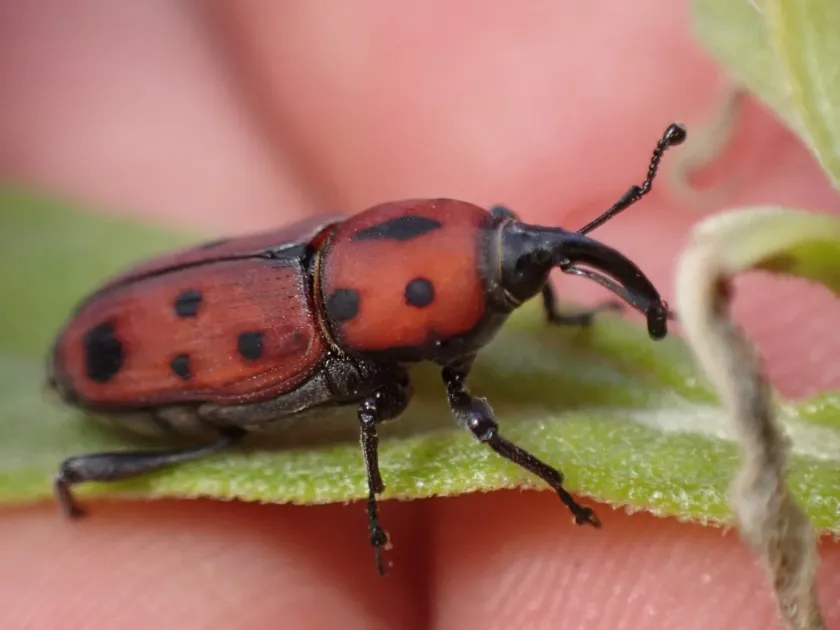
The genus Rhodobaenus belongs to the Curculionidae family, which are commonly known as true weevils. These insects are distinguished by their vibrant, often high-contrast color patterns, frequently featuring black with red or orange markings on the elytra.
Adult weevils possess a characteristic rostrum or snout, which is an elongated part of the head used for feeding and during the egg-laying process in host plants.
The larvae are typically legless and plump, with a cream-white body and a hardened, dark head capsule, adapted for their specialized life within the stems of host plants.
Rhodobaenus species undergo complete metamorphosis, which includes the stages of egg, larva, pupa, and adult, with each stage occurring in or on the host plant.
The pupal stage is often spent within a protective chamber constructed by the larva inside the host stem, ensuring safety while the insect undergoes transformation into an adult.
What it damages
These weevils primarily target plants in the Asteraceae and Poaceae families, with major crops like sunflower, corn, and sorghum often suffering the most severe impacts.
Wild plants such as thistles or ragweed often serve as the primary hosts, allowing the pest population to establish itself before migrating to neighboring cultivated fields.
Larval feeding activity involves tunneling through the internal tissues of the stem, which effectively severs the vascular system responsible for nutrient and water distribution.
Structural damage caused by internal tunneling significantly weakens the host plant, leading to lodging, which complicates harvesting and results in substantial yield loss.
Besides structural failure, infested plants often show poor grain filling and reduced vigor, as the plant's energy is diverted from growth to surviving the internal infestation.
Signs of infestation
The most prominent sign of an infestation is the presence of small, circular exit holes on the exterior of the plant stems, created by adults emerging from the plant.
Plants may exhibit signs of premature wilting or yellowing, which often occurs unexpectedly as the internal damage reaches a threshold that limits systemic transport.
Deformed or swollen stem bases are clear indicators of internal feeding, as the plant attempts to react to the presence of larvae tunneling through its core.
Lodging or stems breaking at the base, especially during windy conditions, is a late-stage sign that the core of the plant has been extensively damaged and hollowed out.
Dissecting an infested stem reveals extensive tunneling and accumulations of frass, which confirm that the plant is serving as a host for Rhodobaenus larvae.
Control measures
Cultural control is the most effective approach, focusing on the destruction of crop residues immediately after harvest to eliminate overwintering sites for the larvae.
Maintaining clean field borders by managing weeds is crucial, as these areas often provide the primary refuge and breeding ground for the weevils throughout the season.
Implementing a diverse crop rotation helps to break the pest's life cycle, preventing the buildup of local populations that can occur in continuous monoculture systems.
Chemical control with systemic insecticides can be utilized during the peak adult activity period, though timing is difficult due to the cryptic nature of the larvae.
Choosing vigorous, well-adapted hybrids can help plants withstand mild infestations and ensure that the impact of the pest on total yield remains at an economic minimum.
Taxonomy
- Latin name
- Rhodobaenus
- Order
- Coleoptera (beetles)
- Family
- Dryophthoridae
- EPPO code
- RHOOSP
Discussion
No discussions yet — be the first.