
Palm weevil
Rhinostomus barbirostris
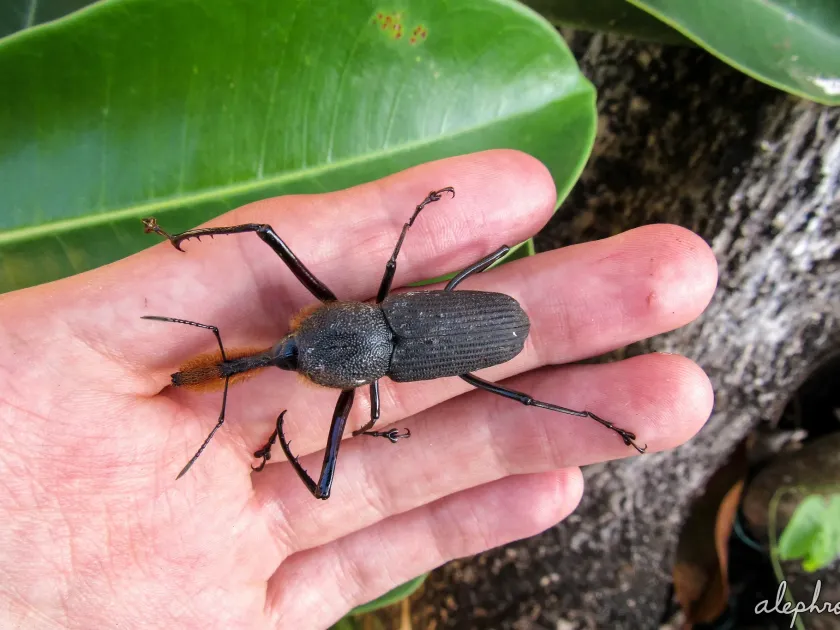
Description
How to identify
The palm weevil Rhinostomus barbirostris belongs to the order Coleoptera and the family Curculionidae. Adult beetles are large, characterized by a prominent rostrum which the female uses to drill holes into plant tissue for oviposition.
The coloration of the adult beetle ranges from deep dark brown to black. Due to their significant size, they are considered one of the most prominent species within the Dryophthorinae subfamily in their native regions.
The larvae are typically legless, cream or white in color, and possess a heavily sclerotized head capsule. They spend their entire developmental cycle hidden inside the palm’s interior tissues.
Development involves a complete metamorphosis: egg, larva, pupa, and adult. Before pupation, the mature larva constructs a protective chamber or cocoon made of dense plant fibers.
These weevils are primarily adapted to tropical and subtropical climates, allowing for multiple overlapping generations throughout the year where conditions remain favorable.
What it damages
Primary hosts for Rhinostomus barbirostris include various palm species, most notably coconut palms and several ornamental palm varieties. The pest is also known to occasionally attack other tropical fruit trees, causing agricultural concern.
The larvae are the most destructive stage, creating extensive tunnels within trunks and leaf stalks. This feeding activity disrupts the vascular system and nutrient transport of the palm.
Severe infestations weaken the tree significantly, leading to reduced fruit production and loss of ornamental value. In advanced stages, the internal structural integrity of the trunk is compromised, often leading to tree collapse.
Physical damage caused by larvae serves as entry points for secondary pathogens, including bacteria and fungi, which trigger rot and accelerate the decline of the palm.
Economic impact is significant, encompassing the loss of yield, the costs of tree removal, and the necessity for rigorous and repeated pest management programs on plantations.
Signs of infestation
The earliest visible signs often include holes in the trunk or leaf bases, accompanied by the exudation of viscous sap or gum, which is a plant stress response to the larval feeding.
Yellowing, wilting, and drooping of the central fronds are critical indicators that the larvae have reached and damaged the terminal bud (the growing point of the palm).
Frass—a mixture of sawdust and wood fibers produced by the feeding larvae—often accumulates near the base of the tree or at the entry points of the tunnels.
In cases of high infestation, the trunk may exhibit noticeable structural deformities or cracks, and the crown may collapse under its own weight due to internal hollowing.
Specialized equipment, such as acoustic sensors or stethoscopes, can sometimes detect the specific sounds of larvae feeding deep within the trunk, aiding in early detection.
Control measures
Monitoring using pheromone-based traps is the primary strategy for managing populations. These traps attract adults, providing data on pest density and timing for control interventions.
Sanitation is crucial; heavily infested trees should be removed promptly and destroyed by burning or deep burial to prevent the emergence of new adult beetles and further infestation.
Chemical control measures typically involve the application of systemic insecticides via trunk injections or soil drenching, allowing the chemical to be translocated through the plant's vascular system.
- Regular grooming of palm trunks to remove dead leaf bases that serve as oviposition sites.
- Use of biological control agents, including entomopathogenic fungi and nematodes.
- Enforcement of quarantine protocols to restrict the movement of infested palm nursery stock.
Preventative care through optimal irrigation and fertilization strengthens the tree's health, making it less susceptible to the initial establishment of weevil populations.
Taxonomy
- Latin name
- Rhinostomus barbirostris
- Order
- Coleoptera (beetles)
- Family
- Dryophthoridae
- EPPO code
- RHINBA
Discussion
No discussions yet — be the first.