
Palm weevil (Rhinostomus)
Rhinostomus
Description
How to identify
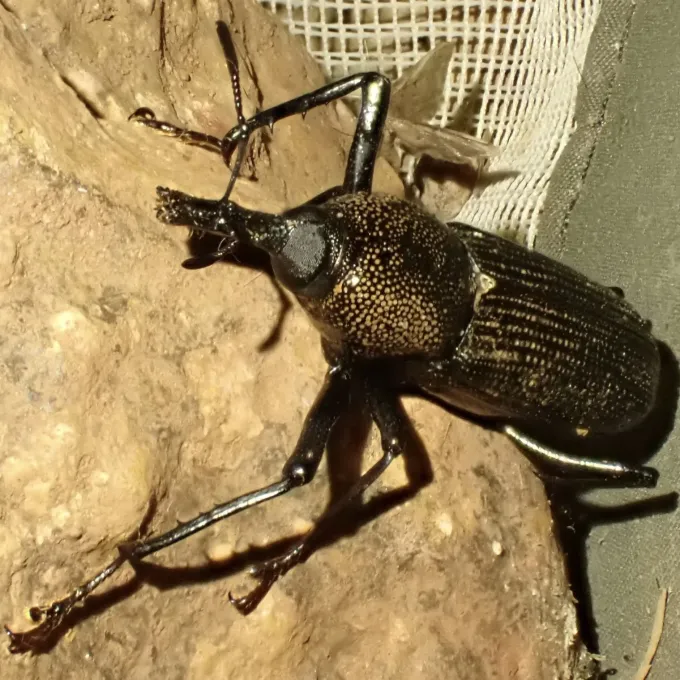
The palm weevil (Rhinostomus barbirostris) belongs to the order Coleoptera and the family Curculionidae. It is a large beetle distinguished by a long rostrum, which the female uses to drill holes into the plant tissue for oviposition.
Adult beetles have a dark, usually black or brownish coloration and can reach a body length of 2-3 centimeters. The larvae are legless, fleshy grubs with a creamy-white color and a strong, dark head, featuring powerful mouthparts designed for boring into wood.
The insect undergoes complete metamorphosis, including egg, larva, pupa, and adult stages. Adult weevils are active flyers, capable of covering significant distances to find suitable host plants, which facilitates rapid spread across plantations.
Females prefer to deposit eggs in weakened or wounded areas of the palm, taking advantage of mechanical injuries or natural fissures in the bark. Once hatched, the larvae penetrate deep into the soft tissues of the trunk or the base of the fronds.
Pupation occurs within the galleries created by the larvae. To survive environmental challenges and predators, the larva constructs a sturdy cocoon made of plant fibers, making the pupal stage highly resistant to external control measures.
What it damages
This pest specifically targets various palm species. Coconut palms, oil palms, and ornamental palms used in tropical landscaping suffer the most significant economic damage due to the activity of this insect.
The primary damage is caused by the larvae, which bore extensive tunnels through the trunk and the growing point of the palm. This destruction disrupts the vascular system, preventing water and nutrients from reaching the crown.
Damage to the growing point is catastrophic, as it halts the palm's development and leads to its eventual death. Structural integrity is often compromised, leading to trunk bending or snapping where larval activity is most intense.
Mass infestations can decimate large areas of plantations within a single or two seasons, classifying this weevil as a severe quarantine pest that poses a major threat to agricultural productivity.
Furthermore, the larval tunnels create an entry point for secondary infections, including fungal and bacterial pathogens, which drastically accelerate the decay and ultimate collapse of the palm tree.
Signs of infestation
Early symptoms of an infestation include the appearance of holes in the trunk or leaf bases, often accompanied by leaking sap. Accumulations of larval frass, which resembles sawdust, are frequently observed near these entry holes.
The crown of the tree starts to display visible stress: leaves turn yellow, lose turgor, and gradually dry out, beginning with the central young fronds. This indicates that the growing point has been compromised.
Upon examination, one may find areas where the bark feels soft or compressible to the touch. In advanced cases, a distinctive crunching or grinding sound can be heard coming from within the trunk due to larval feeding.
A foul, putrid odor emanating from the palm is a strong indicator of internal tissue decay, providing a favorable environment for secondary microbial colonization and accelerating the plant's decline.
The collapse or deformation of the crown serves as a critical sign that the internal structure of the trunk has been extensively hollowed out, meaning the palm is beyond the point of recovery.
Control measures
Control strategies rely heavily on strict quarantine regulations regarding the movement of plant material and regular monitoring of plantations. Pheromone traps are essential for tracking adult activity and determining the timing for pesticide application.
Chemical control involves the injection of systemic insecticides directly into the palm trunk. This method ensures the chemical travels through the vascular system, reaching the larvae hidden deep within the wood.
Sanitation practices, such as the prompt removal and destruction of heavily infested trees, are vital to prevent the spread of the population. Plant debris must never be left on-site as it acts as a reservoir for future generations.
Maintaining optimal palm health through proper agronomic practices helps increase resistance. It is crucial to minimize mechanical injuries during routine maintenance, as fresh wounds serve as highly attractive sites for female egg-laying.
Biological control methods, including the use of entomopathogenic nematodes or fungal-based biopesticides, can be applied to larval entry sites. These methods provide an environmentally friendly alternative for suppressing pest populations when detected early.
Taxonomy
- Latin name
- Rhinostomus
- Order
- Coleoptera (beetles)
- Family
- Dryophthoridae
- EPPO code
- RHINSP
Discussion
No discussions yet — be the first.