
European rhinoceros beetle
Rhinoceros
Description
How to identify
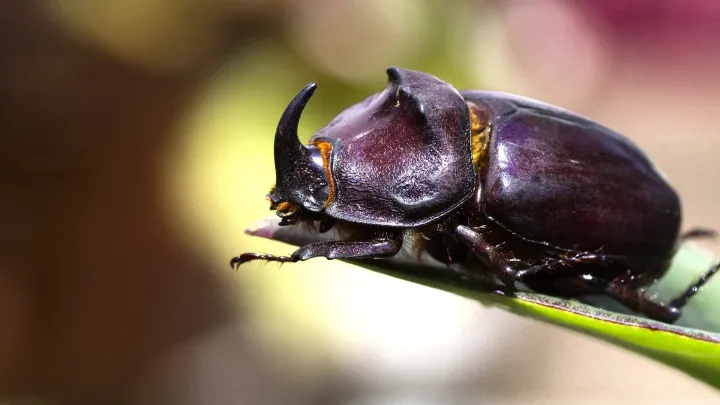
The European rhinoceros beetle (Oryctes nasicornis) is a member of the Scarabaeidae family. It is a large, stout beetle, measuring between 25 and 40 mm in length.
Males are easily recognized by their prominent, curved horn extending from the head, which gives the species its name. Females lack this horn and have a much flatter head profile.
The body is covered in a hard, glossy, dark brown or mahogany-colored exoskeleton, providing protection against mechanical damage and some environmental stresses.
The larvae are typical of the scarab beetle family: they have a C-shaped, creamy-white body with a brown head and three pairs of legs, growing up to 80 mm.
The life cycle is long, ranging from 3 to 5 years, which involves complete metamorphosis including the egg, three larval stages, pupation, and the final adult stage.
What it damages
Larvae primarily feed on decaying organic matter, such as dead wood, compost, manure, and rotting sawdust, making them essential decomposers in natural forests.
However, in horticultural settings, they can become pests when their natural food sources are depleted and they begin consuming the roots of live nursery stock.
Young trees, ornamental saplings, and greenhouse crops are particularly susceptible, as larval feeding can destroy the root system, causing plant wilting and stunted growth.
Adult beetles have vestigial mouthparts and do not feed significantly; however, they may occasionally cause mechanical damage to the bark of trees when emerging or landing.
While often considered harmless in the wild, in dense agricultural or home garden settings, their presence requires careful monitoring to prevent localized economic damage.
When it appears
Adult beetles typically emerge in late spring, specifically in May and June, seeking out suitable egg-laying sites based on warmth and high organic content.
The egg-laying period lasts throughout the summer, with the larvae developing slowly within the substrate over several seasons.
Activity levels of the larvae remain relatively consistent throughout the warm months, as they feed steadily on the decaying materials provided in their environment.
Overwintering occurs primarily in the larval stage, deep within the soil or inside decaying wooden structures where they are insulated from extreme freezing temperatures.
Pupation occurs in the spring, once the larva has reached its final instar, marking the beginning of the transition into the mature adult form.
Signs of infestation
The most common sign of a rhinoceros beetle infestation is finding large, white, C-shaped larvae in your compost pile or in mulched garden beds.
Sudden wilting of young container plants or saplings can indicate root damage caused by larvae tunneling through the root zone.
Holes in old stumps, rotting logs, or piles of wood chips indicate that the beetles have used these materials as breeding or shelter sites.
Observing adult beetles near artificial light sources during warm summer evenings confirms that a population is breeding in the immediate vicinity.
Excrement piles or loose, friable soil in compost areas often betray the presence of high-density larval colonies beneath the surface.
Control measures
Effective management begins with sanitation: remove potential breeding grounds, such as rotting logs, stumps, and neglected wood piles, from the garden area.
Regularly turning over compost piles in the autumn exposes the larvae to cold temperatures and predators, which significantly reduces the surviving population.
For high-value nurseries, using protective barriers like fine mesh or thick gravel layers around the base of young plants can prevent females from laying eggs.
Biological control using entomopathogenic nematodes or specialized fungi can be applied to the soil or substrate to specifically target and kill the larvae.
- Remove rotting wood and debris from the garden.
- Turn compost heaps frequently to disrupt larval life cycles.
- Use light traps during the peak adult flight period to reduce local numbers.
Taxonomy
- Latin name
- Rhinoceros
- Family
- Rhinocerotidae
- EPPO code
- RHNOSP
Discussion
No discussions yet — be the first.