
Walnut husk fly
Rhagoletis suavis
Description
How to identify
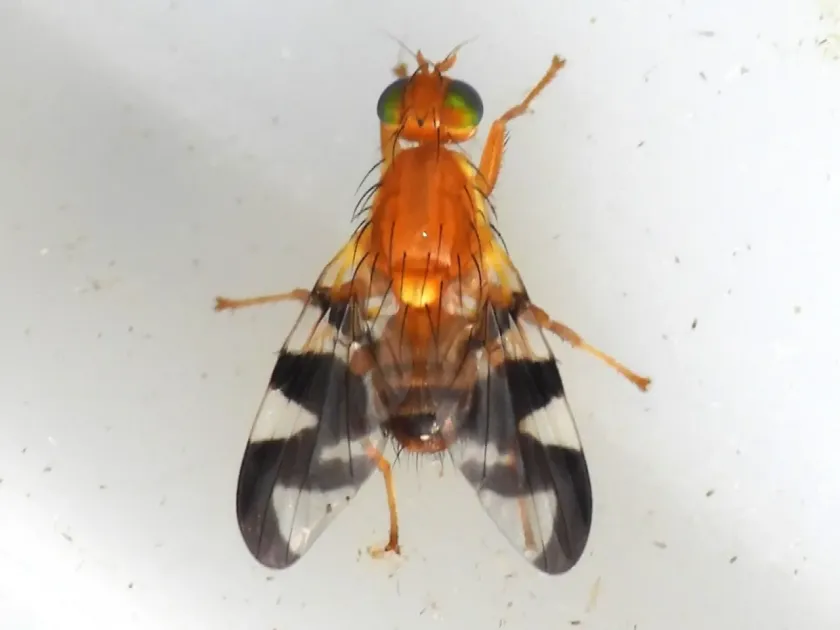
The walnut husk fly (Rhagoletis suavis) is a member of the Tephritidae family within the order Diptera. These adult flies are small, measuring approximately 5–8 mm in length, and are easily recognized by the distinct banded patterns on their wings.
The adult fly body is generally dark brown or black, often with light-colored markings on the scutellum. Their eyes exhibit a shimmering, greenish-golden hue, which serves as a key diagnostic feature for identification in the field.
The larvae are cream-colored, legless maggots that typically grow to about 10 mm in length. They spend their entire feeding stage confined within the husk (the green outer layer) of the walnut fruit.
Pupae survive the winter in a puparium stage buried in the soil beneath the host tree. They are barrel-shaped, dark brown, and highly resistant to environmental stressors until they emerge as adults.
Reproduction involves the female using her ovipositor to insert eggs into the soft tissues of the developing walnut husk. A single female can deposit hundreds of eggs over her lifespan, targeting multiple fruits.
What it damages
This pest specifically targets walnuts and several related species, focusing its damage on the green outer husk. The larvae tunnel and feed within this tissue, effectively destroying the husk integrity.
Feeding by the larvae causes the husk to turn black, soft, and mushy, leading to premature drop of the fruit. This process not only ruins the fruit's outer appearance but also negatively affects its commercial value.
Secondary infections, such as fungi or bacteria, frequently invade the damaged husks. The resulting fluids and decay can penetrate the shell, staining the nut meat and causing it to taste bitter or become moldy.
Even when fruit remains on the tree, the infestation often results in shell staining and reduced quality of the kernel. This significantly decreases the marketability of the harvest for both fresh consumption and processing.
In high-pressure years, the walnut husk fly can lead to substantial crop losses, sometimes exceeding 50% of the total yield. Proper management is essential to prevent these economic impacts.
When it appears
Adult emergence typically begins in mid-summer, coinciding with the development of the walnut husk. This period generally spans from July to late August, depending on the local climate and temperature trends.
The emergence window is prolonged, necessitating a sustained monitoring effort throughout the summer months. During this time, adults feed on sugars and honeydew on the tree foliage before egg-laying starts.
Mating and oviposition occur throughout the late summer period. The window for successful infestation closes once the walnut husks begin to harden, making them difficult for the female to penetrate.
Larval development inside the husk lasts between 3 to 5 weeks. Once mature, the larvae exit the nut, drop to the ground, and burrow into the top layer of soil to pupate and overwinter.
The species generally completes only one generation per year. Understanding this univoltine lifecycle allows growers to implement targeted control measures during the critical period of adult activity.
Signs of infestation
The earliest sign of infestation is the presence of small, dark, puncture-like marks on the husk, indicating where the female has deposited her eggs. These spots eventually expand and darken.
As the infestation progresses, the husk becomes entirely black or dark brown. Affected nuts often appear to mature or decay prematurely, showing signs of severe darkening on the surface.
Cutting into a damaged husk will reveal the larvae actively feeding on the internal tissues. The husk interior is often reduced to a dark, pulpy, and malodorous mess due to the larval activity.
Premature nut drop is a clear indicator of a significant infestation. Finding a large number of walnuts on the ground before they have naturally matured is a strong signal of pest pressure.
Yellow sticky traps baited with lures are highly effective for detecting the first arrivals of adult flies. Monitoring these traps is crucial for timing any necessary chemical or biological interventions.
Control measures
Yellow sticky traps serve as both a monitoring tool and a direct control method by trapping adult flies, which helps reduce the total population in smaller orchards.
Insecticide applications are most effective when timed to target adults before they lay eggs. Treatments should be repeated based on the activity levels captured by the traps to ensure coverage.
Cultural practices, such as the prompt removal of fallen nuts (culls), are essential to prevent larvae from completing their lifecycle in the soil. This significantly reduces the overwintering population.
Tilling the soil under the tree canopy in late autumn can help disrupt the pupae's overwintering sites, making them more vulnerable to predators and environmental exposure.
- Regular monitoring with pheromone or bait-baited yellow traps.
- Strict sanitation by removing and destroying fallen infested walnuts.
- Proper timing of insecticide applications to hit the adult flight window.
- Using biological control agents such as nematodes to treat the soil.
Taxonomy
- Latin name
- Rhagoletis suavis
- Order
- Diptera (flies)
- Family
- Tephritidae
- EPPO code
- RHAGSU
Discussion
No discussions yet — be the first.