
Blueberry maggot
Rhagoletis mendax
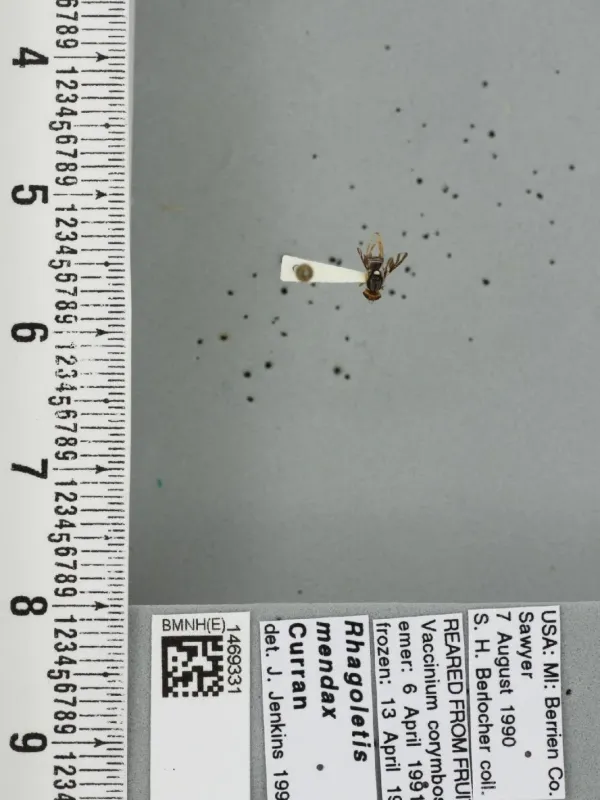
Description
How to identify
The blueberry maggot Rhagoletis mendax is a species of fruit fly belonging to the Tephritidae family, order Diptera. Adults are small, roughly 3-4 mm long, making them difficult to spot without close inspection.
Adult flies are characterized by distinctive dark bands on their wings, forming a specific pattern that helps in identification. The body is generally black with a prominent yellow scutellum on the thorax.
The larvae are small, legless maggots, creamy-white in color, reaching about 5 mm in length. They develop through three larval instars while feeding inside the host fruit.
The pupae are brown and barrel-shaped, typically overwintering in the soil beneath the host plants. This life stage is particularly important for integrated pest management.
Females are equipped with a sharp ovipositor, which they use to pierce the skin of the berry to lay a single egg inside, providing a secure environment for the developing larvae.
What it damages
The primary hosts for this pest are members of the Ericaceae family, particularly highbush blueberries (Vaccinium corymbosum) and wild blueberries. It is a major economic pest in commercial berry production.
The larvae feed on the pulp of ripening berries, consuming the inside of the fruit. This process leads to softened, watery berries that are prone to premature dropping.
Infested berries are unmarketable because they lose their firm texture and aesthetic appeal. The presence of larvae inside the fruit makes them unsuitable for fresh market sale or processing.
Damage caused by the blueberry maggot often facilitates secondary fungal infections, such as anthracnose or grey mold, which further degrade the quality of the harvested fruit.
High infestation rates can lead to significant yield losses, as entire clusters of berries may become infested within a short period if control measures are not implemented.
When it appears
The life cycle of the blueberry maggot is tightly linked to the phenological development of the blueberry crop. Adult flies usually emerge from the soil as berries begin to change color.
The emergence of adults is often spread over several weeks, necessitating a continuous monitoring program using sticky traps throughout the ripening season.
Following mating, females begin laying eggs. The eggs hatch within a week, and the larvae immediately begin feeding on the fruit tissue for a period of 15 to 20 days.
Once the larvae reach maturity, they exit the fruit and drop to the ground to pupate in the soil. They remain in the soil until the next season, or sometimes longer.
In most regions, there is one generation per year. However, some individuals can remain in pupal diapause for two or more years, which complicates control efforts in infested areas.
Signs of infestation
Initial signs of infestation are difficult to detect as they consist of microscopic puncture marks on the skin of the berries made by the female ovipositor.
As the larvae feed, the berries lose their firmness and become soft or mushy to the touch. Infested berries often appear duller and may exhibit uneven ripening.
An internal inspection of a suspicious berry will reveal the creamy-white maggot feeding on the deteriorating pulp, often accompanied by discoloration of the fruit interior.
Yellow sticky traps baited with lures are the most reliable indicator of adult fly presence in the field, allowing growers to track activity before egg-laying becomes widespread.
Premature fruit drop, where berries fall from the bush before they are fully mature, is a late-stage indicator that the infestation has reached a critical level.
Control measures
Integrated Pest Management (IPM) is the most effective approach. The use of yellow sticky traps is essential for monitoring and timing the application of control measures.
Insecticide treatments should be applied when adult flies are active but before they have the chance to lay eggs inside the berries, as larvae are protected once inside.
- Harvest blueberries frequently to prevent fruit from becoming overripe.
- Collect and destroy all fallen berries to remove the potential habitat for the next generation.
- Use landscape fabrics or mulch under bushes to prevent emerging adults from leaving the soil.
- Implement strict quarantine measures for incoming planting stock to prevent introduction.
- Use biological control agents or insect-pathogenic fungi to target pupae in the soil.
Cultural practices, such as maintaining weed-free rows and proper pruning, can create an environment less favorable for the fly and facilitate more effective monitoring.
Regular communication with local extension services is advised to stay informed about regional thresholds and specific timing for management actions in your area.
Taxonomy
- Latin name
- Rhagoletis mendax
- Order
- Diptera (flies)
- Family
- Tephritidae
- EPPO code
- RHAGME
Discussion
No discussions yet — be the first.