
Walnut husk fly
Rhagoletis completa
Description
How to identify
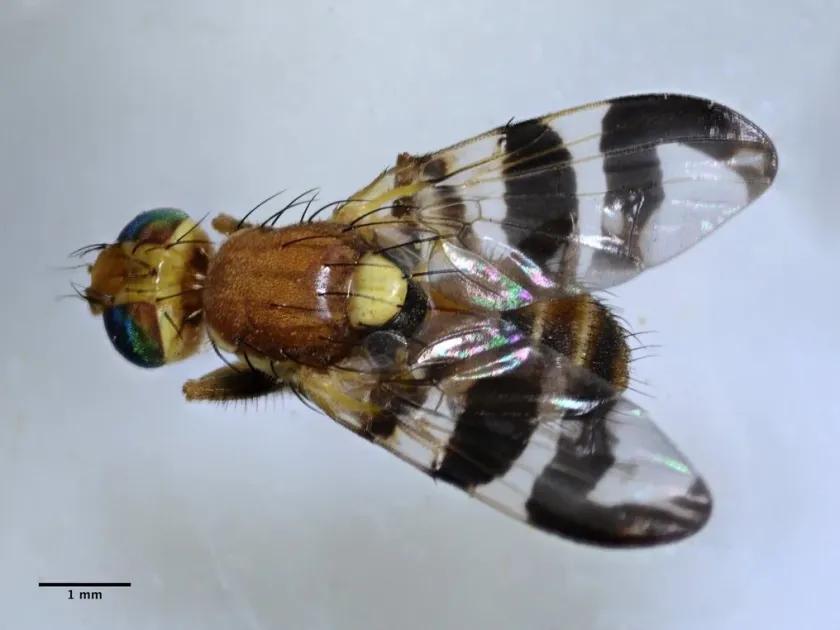
The Walnut husk fly (Rhagoletis completa) is a member of the Tephritidae family, order Diptera. Adult flies are approximately 4–5 mm long, with a yellow-brown body and transparent wings bearing characteristic dark bands.
The eyes of the adult fly exhibit a distinct golden-green sheen. Females possess a sharp, prominent ovipositor, which they use to penetrate the green hull of the walnut to deposit eggs.
The larvae are legless, white to cream-colored maggots reaching up to 8 mm in length. As they feed, they often take on a yellowish hue, distinguishing them from other dipteran larvae.
Pupae overwinter in the soil beneath the host tree canopy. They are barrel-shaped, dark brown, and protected by a robust casing that ensures survival throughout the winter months.
Development is highly synchronized with temperature fluctuations, which dictates the timing of the emergence of adults and subsequent infestation cycles in the orchard.
What it damages
The primary host for this pest is the English walnut (Juglans regia). If left unmanaged, the infestation can lead to the loss of a significant portion of the harvest.
The adult fly causes minor damage through oviposition punctures, but the primary destruction is caused by the larvae feeding within the fleshy hull of the walnut.
The feeding activity of the larvae triggers the decay of the husk, which turns black and mushy. This process stains the walnut shell, reducing the market value of the nut significantly.
In addition to cosmetic damage, the larvae cause the hull to adhere tightly to the shell, making mechanical cleaning very difficult and causing the nut to appear unmarketable.
The feeding activity also facilitates the entry of secondary pathogens, leading to the darkening of the nut meat, a bitter taste, and a reduction in overall nutritional quality.
When it appears
Emergence typically occurs in early summer, triggered by soil temperatures warming to approximately 18–20 degrees Celsius, often coinciding with nut development.
Adult flies are active for several weeks, with peak mating and egg-laying occurring during the mid-summer months as the walnuts begin to mature.
Each female can deposit hundreds of eggs over her lifespan, placing clusters into the husk of developing nuts. The eggs hatch within a week under favorable conditions.
Larvae feed for about 3–5 weeks before exiting the fruit to drop into the soil for pupation. Most pupae enter a diapause state to survive until the following season.
Because the emergence period can be protracted, managing the fly throughout the entire summer is crucial to preventing successive waves of infestation.
Signs of infestation
The first signs of infestation are small, dark stippling marks on the green husk where the female has used her ovipositor to lay eggs.
Over time, these spots expand into large, blackened, necrotic lesions on the surface of the fruit. The infected area often becomes soft to the touch.
Cutting into the husk reveals tunnels and the presence of maggots or their waste products, which appear as darkened, decomposing tissue inside the fruit hull.
Early nut drop is another critical indicator, as severely infested fruits may abscise from the tree prematurely before they reach full physiological maturity.
Monitoring the orchard with yellow sticky cards treated with ammonium carbonate or pheromones is an effective way to detect the presence of the flies early.
Control measures
Cultural control is a primary line of defense, involving the regular removal and destruction of infested fallen nuts to prevent larvae from entering the soil to pupate.
Tilling the soil beneath the canopy during late autumn or early spring can help disrupt the pupal stage, leading to increased mortality of the overwintering population.
Chemical control focuses on timely application of insecticides aimed at adult flies before they lay eggs, utilizing trap data to determine the optimal spraying window.
Biological control methods, such as utilizing beneficial nematodes or fungi like Beauveria bassiana, show promise in reducing pupal survival rates within the orchard soil.
Strategic use of bait sprays or sticky traps helps reduce the adult population density, providing a sustainable way to minimize damage without excessive chemical use.
Taxonomy
- Latin name
- Rhagoletis completa
- Order
- Diptera (flies)
- Family
- Tephritidae
- EPPO code
- RHAGCO
Discussion
No discussions yet — be the first.