
Snipe fly
Rhagio
Description
How to identify
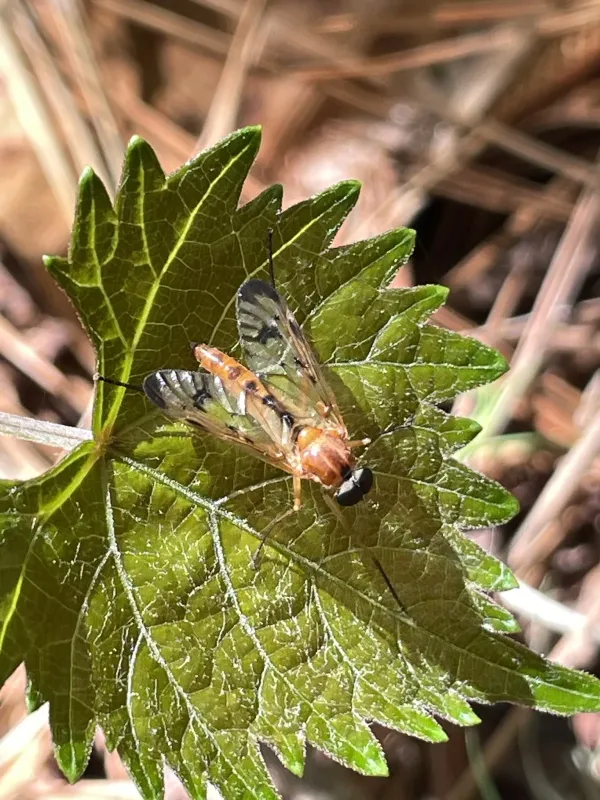
The Snipe fly, belonging to the family Rhagionidae, is a dipteran insect. Adult individuals have a slender body, ranging from 5 to 15 mm in length, often featuring an elongated proboscis resembling a snipe's beak, which gives the genus its common name.
The coloration of adult flies typically ranges from brown to grayish-yellow, sometimes with dark spots on the wings. They possess long legs and are frequently seen resting on tree trunks, facing downward.
Snipe fly larvae are cylindrical, legless, and colored white or cream. The larval head capsule is highly reduced, a characteristic feature of many members of this family.
Adult flies are diurnal and are often found on forest edges, in gardens, and park areas, where they primarily act as predators of smaller insects.
They can be distinguished from other flies by their specific resting posture on vertical surfaces and the shape of their wings, which are often held horizontally at rest, not fully covering the abdomen.
What it damages
The primary damage is caused by the larvae, which inhabit the soil, leaf litter, or decaying wood. They prefer moist environments with a high content of organic matter.
Rhagio larvae are predominantly predatory, feeding on small soil invertebrates. However, in intensive farming conditions, they may occasionally damage the roots of young plants.
The greatest damage is observed in nurseries and during seedling cultivation, when larvae feed on the succulent tissues of young roots or underground parts of stems.
Weakened plants become more susceptible to secondary infections and fungal diseases, which indirectly increases the harmfulness of this insect.
Significant economic loss for large-scale crops is rare, as Snipe flies are more often part of the natural entomofauna that regulates populations of other minor soil pests.
When it appears
The life cycle of the Snipe fly usually lasts one year. Adult flies appear in the spring and the first half of summer, which coincides with the flowering period of many fruit crops.
Adult activity is focused on reproduction: females lay eggs in loose soil rich in humus or in moist forest litter, where conditions are suitable for offspring survival.
Larvae feed actively throughout the warm season, gradually increasing in mass. By autumn, larvae of most species move into deeper layers of the soil to overwinter.
Pupation occurs in early spring directly in the soil. The pupal stage lasts two to three weeks, after which the new generation of adults emerges.
The overall population dynamics depend heavily on soil moisture levels: in dry years, the population drops sharply due to high larval mortality.
Signs of infestation
Signs of Snipe fly larval presence include sudden wilting of seedlings or young saplings without visible causes on the aerial parts of the plant.
Upon inspection of the root system in the soil, characteristic whitish larvae can be found hiding near the roots. Plants often exhibit damaged or "eaten" root areas.
The presence of large numbers of Snipe flies on tree trunks in the garden can serve as a signal to monitor the soil condition in the root zones.
Stunted plant growth in areas with excessive moisture or high organic fertilization is also an indirect sign of larval activity.
In severe cases, yellowing of leaves occurs due to disrupted root nutrition, eventually leading to the death of the plant.
Control measures
The primary control strategy involves following agricultural practices aimed at improving aeration and reducing soil moisture around cultivated plants.
Regular cultivation of the soil in rows and root zones effectively destroys larval habitats and exposes them to the surface, where they succumb to sunlight.
Avoid excessive application of raw manure, as this creates a favorable environment for Snipe fly breeding and attracts adults for egg-laying.
In cases of massive infestation of seedlings, it is recommended to use soil-applied insecticides approved for the respective crops.
- Preventive soil drainage.
- Timely weeding of moisture-retaining weeds.
- Biological methods using entomopathogenic nematodes.
Taxonomy
- Latin name
- Rhagio
- Order
- Diptera (flies)
- Family
- Rhagionidae
- EPPO code
- RHGISP
Discussion
No discussions yet — be the first.