
New Guinea palm weevil
Rhabdoscelus similis
Description
How to identify
The New Guinea palm weevil (Rhabdoscelus similis) is a coleopteran pest belonging to the Curculionidae family. It is a specialized insect known for boring into the stems of monocotyledonous crops like palms and sugarcane.
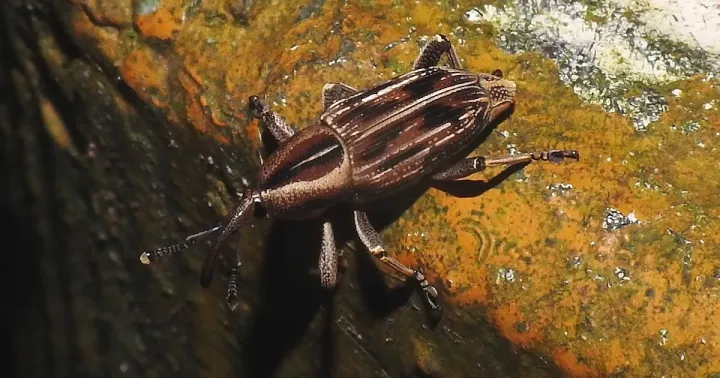
Adult beetles are robust, usually reddish-brown to black, with a long, curved snout. This snout is a critical tool for penetrating hard plant fibers to feed and oviposit eggs deep inside the host tissue.
Larvae are cream-colored, fleshy, legless grubs with a heavily sclerotized head capsule. They reside entirely within the plant tissue, where they perform the bulk of the damage during their development.
The pupal stage occurs within a protected cocoon made of fibrous plant material. This cocoon ensures the insect's survival during its most vulnerable phase of metamorphosis, shielded from external predators.
The life cycle is continuous in tropical environments, meaning generations overlap throughout the year. This persistent presence makes the weevil a challenging pest to manage without a long-term strategy.
What it damages
This weevil primarily impacts various palm species, such as coconut and sago palms, as well as sugarcane crops. Economic damage stems from the degradation of the plant’s structural and nutritional integrity.
Feeding larvae tunnel through the soft internal tissues of the stem. These tunnels destroy the vascular bundles, significantly impairing the transport of water and nutrients throughout the plant.
Sugarcane crops suffer reduced yields and quality because the damaged stems become brittle. They are prone to lodging, which complicates harvesting and significantly lowers the sugar content of the stalks.
Secondary infections are a major concern. The tunnels created by the larvae serve as entry points for pathogens, leading to rapid decay of the plant tissue, which is often faster than the damage from the pest itself.
Young plants are particularly vulnerable, as they lack the thick bark or dense fiber required to withstand heavy larval infestation, often resulting in complete plant mortality.
Signs of infestation
External signs include small, circular entry or exit holes found on the stem. Frass, a mixture of excrement and chewed fiber, is often visible near these holes, indicating active larval feeding.
Wilting of the canopy or the central spindle leaf is a critical warning sign in palms. It indicates that the heart of the palm has been compromised, putting the entire tree at risk of death.
In sugarcane, erratic patches of yellowing or drying stalks are typical symptoms. If a stalk is broken, one can easily see the galleries and tunneling inside, frequently accompanied by the presence of larvae.
Audible evidence is sometimes possible; in quiet conditions, the sound of larvae chewing within the dense fibers can be detected using sensitive equipment or keen observation by experienced farmers.
Sap exuding from the stem is another common indicator. As the plant reacts to the tissue damage, it may produce fluid that leaks from the feeding sites, which can be spotted during field inspections.
Control measures
Integrated Pest Management (IPM) is essential. Sanitation, including the removal and destruction of infested plant materials, is the most effective way to reduce the local population of weevils.
Pheromone traps are highly effective for monitoring and mass-trapping adults. By reducing the number of breeding adults, growers can significantly delay or prevent the infestation of healthy stands.
Chemical control involves systemic insecticides that are absorbed by the plant. These are most effective when applied at the onset of adult activity to prevent egg-laying and minimize internal damage.
Biological control agents, such as entomopathogenic fungi (e.g., Beauveria bassiana) or parasitic nematodes, offer a sustainable alternative, especially in integrated management programs in humid regions.
Regulatory measures are crucial to prevent the accidental transport of infested material. Strict quarantine procedures for palm and sugarcane shipments are required to curb the pest’s spread to new areas.
Taxonomy
- Latin name
- Rhabdoscelus similis
- Order
- Coleoptera (beetles)
- Family
- Dryophthoridae
- EPPO code
- RHSCSI
Discussion
No discussions yet — be the first.