
Lesser bud moth
Recurvaria nanella
Description
How to identify
The lesser bud moth (Recurvaria nanella) is a small lepidopteran insect belonging to the family Gelechiidae. It is a common pest of deciduous fruit trees in temperate regions.
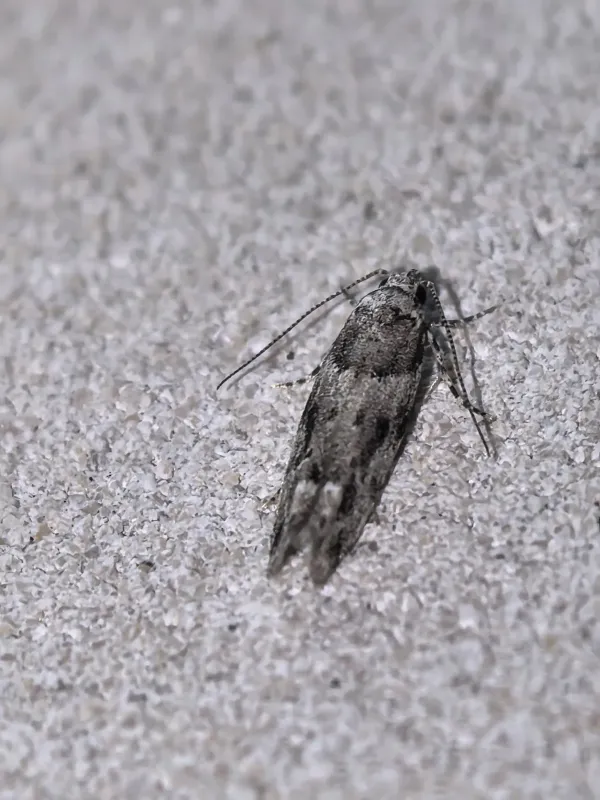
The adult moth has a wingspan of approximately 10–12 mm. The forewings are grey with dark spots and transverse lines, while the hindwings are pale grey with long fringes.
The larva, or caterpillar, starts off pale yellowish-white and turns reddish-brown with a shiny black head capsule as it matures throughout its development.
The pupa is about 5 mm long and is typically found inside a dense white silk cocoon constructed in crevices of the bark or near damaged buds.
Eggs are minute, oval, and creamy white. Females lay them individually on the underside of leaves or near the base of vegetative and flower buds.
What it damages
This pest affects a wide range of pome and stone fruit crops, including apple, pear, plum, cherry, apricot, and peach trees.
The primary damage occurs in early spring when overwintered larvae emerge and bore into swelling buds to feed on the developing tissues inside.
This feeding activity destroys the buds, preventing them from developing into leaves, flowers, or fruit, which can significantly reduce the overall yield.
In addition to bud damage, larvae may also skeletonize leaves in the summer, eating the soft tissues and leaving only the veins intact.
Severe infestations can lead to significant canopy damage, weakening the tree and making it more susceptible to other stressors or diseases.
When it appears
The lesser bud moth completes one generation per year. Larvae overwinter in the second instar inside small white cocoons located in bark fissures.
In spring, as temperatures rise, the larvae emerge and migrate to the buds, where they feed intensively for several weeks during the blooming period.
Pupation occurs in May or June, usually near the site of feeding or under the bark scales, with the pupal stage lasting about two weeks.
Adult moths emerge from mid-June to early August. During this period, mating and egg-laying occur, typically on the leaves of the host trees.
After hatching, the young larvae skeletonize the leaves before seeking out suitable overwintering sites as they enter the second instar stage.
Signs of infestation
Early spring signs include buds that fail to open, turn brown, and dry out, often held together by thin, silky webbing.
Summer symptoms are characterized by skeletonized leaves, where larvae have scraped away the leaf surface, leaving only thin, vein-like structures.
Rolled or curled young leaves, bound together by fine silk, serve as a clear indication of larval presence in the tree canopy.
- Frass and dark excrement near the base of damaged buds.
- Stunted development of leaf clusters on specific branches.
- Presence of small white cocoons tucked into rough bark crevices.
The damage is often localized initially, affecting only certain parts of the tree before potentially spreading to other branches.
Control measures
Effective management of the lesser bud moth requires a combination of cultural practices and targeted chemical treatments during critical phases.
Dormant or delayed-dormant oil sprays can be highly effective in suffocating overwintering larvae residing in bark crevices before they emerge in spring.
Systemic insecticides applied during the bud-burst stage can help control larvae that have already begun feeding inside the buds.
Maintaining orchard hygiene, such as removing dead bark and pruning infested branches, can significantly reduce the overwintering population.
Regular monitoring using pheromone traps can help track the adult flight period, allowing for precise timing of chemical applications if necessary.
Taxonomy
- Latin name
- Recurvaria nanella
- Order
- Lepidoptera (butterflies)
- Family
- Gelechiidae
- EPPO code
- RECUNA
Discussion
No discussions yet — be the first.