

Description
How to identify
The Viburnum leaf beetle (Pyrrhalta viburni) is a member of the Chrysomelidae family, known for its destructive impact on various Viburnum species.
Adult beetles are approximately 4.5–6.5 mm long, with a distinct yellow-brown coloration and a relatively uniform appearance throughout their life cycle.
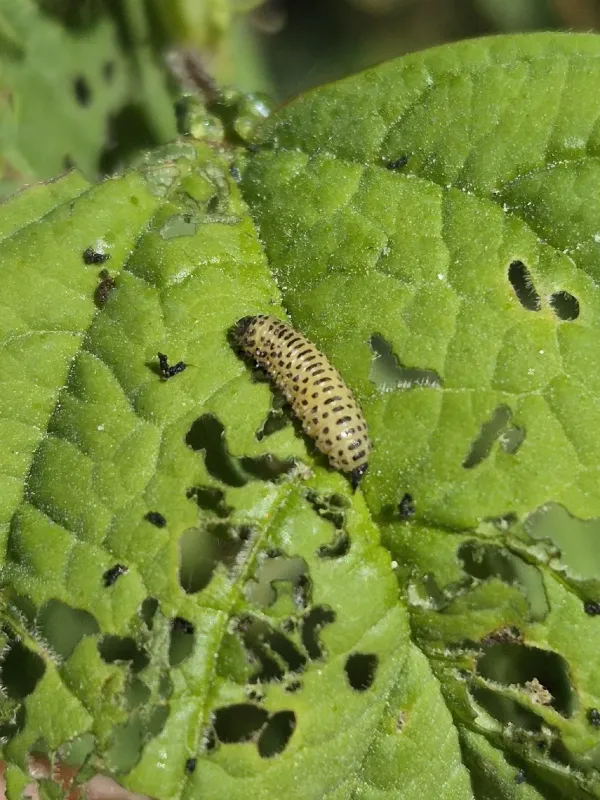
The larvae, which cause the most significant damage, are yellow-gray with a series of dark spots and hairs, making them easily identifiable on foliage.
The life cycle involves overwintering as eggs within cavities chewed into the new growth of Viburnum twigs by females during the autumn.
Development includes four larval instars followed by a pupal stage in the soil, emerging as adults in mid-summer to complete the cycle.
What it damages
This pest exclusively targets plants of the genus Viburnum, posing a severe threat to both native species and ornamental varieties used in landscaping.
Larvae feed in groups, causing extensive defoliation by consuming the leaf tissue between the veins, effectively skeletonizing the leaves.
Adult beetles continue the damage throughout the summer by feeding on the remaining foliage, leaving behind characteristic irregular holes.
Persistent infestations over consecutive years can lead to the death of the shrub due to stress and the loss of photosynthetic capability.
Heavy feeding also reduces the aesthetic value of ornamental shrubs, making them unsightly and prone to further attacks by opportunistic pathogens.
When it appears
Eggs hatch in early spring, typically around late April to mid-May, aligning with the emergence of the first new leaves of the host plant.
The larval stage lasts for about four to six weeks, during which the insects are highly active and voracious in their feeding patterns.
By late June or July, the larvae drop to the ground to pupate in the soil, remaining there for approximately two weeks before adult beetles emerge.
Adult activity peaks in late summer, with mating and egg-laying occurring from August through October as temperatures begin to cool.
The synchronization of the insect's life cycle with the host plant's phenology ensures a reliable and steady supply of food for the developing population.
Signs of infestation
Early symptoms include small circular holes in the emerging leaves, followed by rapid skeletonization as the larval population grows.
Inspection of the underside of the leaves in May often reveals clusters of small larvae feeding in parallel lines between the leaf veins.
The presence of adults in July and August, when they are frequently seen feeding on the upper surface of leaves, is another clear indicator of infestation.
Egg-laying sites on twigs appear as slightly raised, cap-like structures, often covered with a mixture of bark fragments and excrement.
A severely infested shrub will show signs of browning and early senescence of leaves by mid-summer, significantly reducing its foliage density.
Control measures
Effective management requires a combination of cultural practices and targeted chemical interventions to suppress the beetle population.
- Prune and destroy infested twig tips during winter to remove overwintering egg masses.
- Apply contact insecticides when larvae are small and actively feeding in spring.
- Use systemic insecticides if the infestation is heavy to provide longer-lasting protection.
- Encourage natural predators such as ladybugs and birds that feed on beetle larvae.
- Monitor the shrubs regularly throughout the growing season to ensure early detection.
Timely application of treatments is critical, especially when the larvae are at their most vulnerable stage during the early spring months.
Content graph
Connections · Viburnum leaf beetle
Most often together:
Marketplace
Products · 2

Biology
Taxonomy
- Latin name
- Pyrrhalta viburni
- Order
- Coleoptera (beetles)
- Family
- Chrysomelidae
- EPPO code
- GALEVI
Community
Discussion
No discussions yet — be the first.