

Description
How to identify
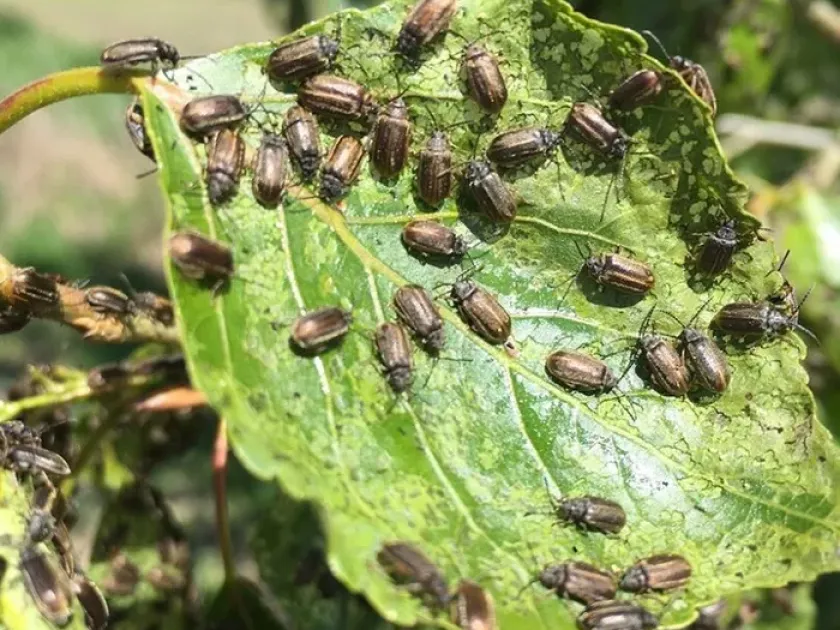
The willow leaf beetle (Pyrrhalta decora) belongs to the order Coleoptera and the family Chrysomelidae. This small insect is generally brown with characteristic dark markings on its wing covers (elytra).
The larvae are distinct in their elongated shape and black or dark gray coloration, adorned with rows of light-colored tubercles. Their bodies are covered in short, stiff hairs, which is a common trait among many species of the leaf beetle family.
The life cycle of this beetle includes complete metamorphosis: egg, larva, pupa, and adult. Adult beetles typically reach a length of 5 to 8 millimeters and possess strong mandibles adapted for active feeding on plant tissues.
Visually, adults can be recognized by their convex body shape and a characteristic sheen on their wing covers, which may vary from light to dark brown depending on the subspecies and geographical location.
Pupation generally occurs in the soil or within crevices of tree bark, where the insect constructs a protective chamber. This is a critical developmental stage that determines the population's survival through winter or harsh dry periods.
What it damages
The primary food source for this species includes various trees of the genus Salix (willow), though the pest frequently spreads to Populus (poplar) and Alnus (alder) species as well.
Adult beetles chew numerous irregular holes in the leaf blades, often leaving only the larger veins untouched. In severe cases, this feeding behavior leads to significant skeletonization of the foliage.
Larvae are considerably more voracious than adults, feeding primarily on the underside of the leaf tissues. During periods of high population density, they can completely defoliate a tree within a very short timeframe.
Damage to the photosynthetic apparatus causes plant stress, reduces annual wood growth, and renders trees more susceptible to secondary pests and various fungal infections.
In cases of massive outbreaks, the willow leaf beetle can induce premature leaf drop, which severely depletes the tree's energy reserves and lowers its overall cold hardiness.
When it appears
Adult activity begins in early spring, immediately following bud break, as insects emerge from hibernation to feed on young, succulent shoots.
Mass egg-laying typically occurs in late spring when average daily temperatures remain consistently above 15 degrees Celsius. Females deposit eggs on the undersides of leaves, preferring healthy foliage for larval development.
Larvae emerge roughly 10–14 days after oviposition and immediately begin aggressive feeding, progressing through several larval instars.
Peak larval activity is usually observed by mid-summer, after which they migrate into the soil to pupate. In most regions, there is one generation per year, though warmer climates may support a partial second generation.
Adults of the new generation appear by late summer or early autumn, undergo a short feeding period, and then seek shelter in leaf litter or topsoil to survive the winter months.
Signs of infestation
The first sign of an infestation includes small pinholes on young foliage and the presence of bright yellow or orange egg clusters on the undersides of leaves.
The second stage of damage is characterized by the appearance of larvae that feed in groups, quickly destroying the leaf surface and leaving only a skeleton of veins behind.
Accumulated black fecal matter on the leaves beneath feeding sites is a direct indicator of active beetle presence and feeding activity.
A color shift of the canopy to brown or yellow by mid-summer, in the absence of other stressors, indicates critical damage to the foliage caused by the beetle.
- Presence of adult beetles on branches and trunks.
- Grouped larval clusters on the underside of leaves.
- Massive shothole defoliation.
- Skeletonized leaf veins.
- Premature yellowing and shedding of leaves.
Control measures
Cultural control measures involve the timely removal of leaf litter and cultivation of the soil around the base of trees in autumn to disrupt the pest's overwintering sites.
The application of biological insecticides based on Bacillus thuringiensis is highly effective against young larvae while minimizing chemical impact on the surrounding ecosystem.
In nurseries or park landscapes with high infestation levels, the use of contact-stomach insecticides, such as pyrethroids or neonicotinoids, is justified to prevent severe damage.
Spraying must be timed carefully to coincide with the period of active larval feeding, as this is when the insects are most susceptible to chemical control agents.
Monitoring populations using pheromone or light traps allows for the early detection of mass beetle flights, enabling preemptive measures before significant injury is inflicted on the trees.
Content graph
Connections · Willow leaf beetle
Most often together:
Marketplace
Products · 1
Biology
Taxonomy
- Latin name
- Pyrrhalta decora
- Order
- Coleoptera (beetles)
- Family
- Chrysomelidae
- EPPO code
- GALEDE
Community
Discussion
No discussions yet — be the first.