
European fruit lecanium
Pulvinaria vitis
Description
How to identify
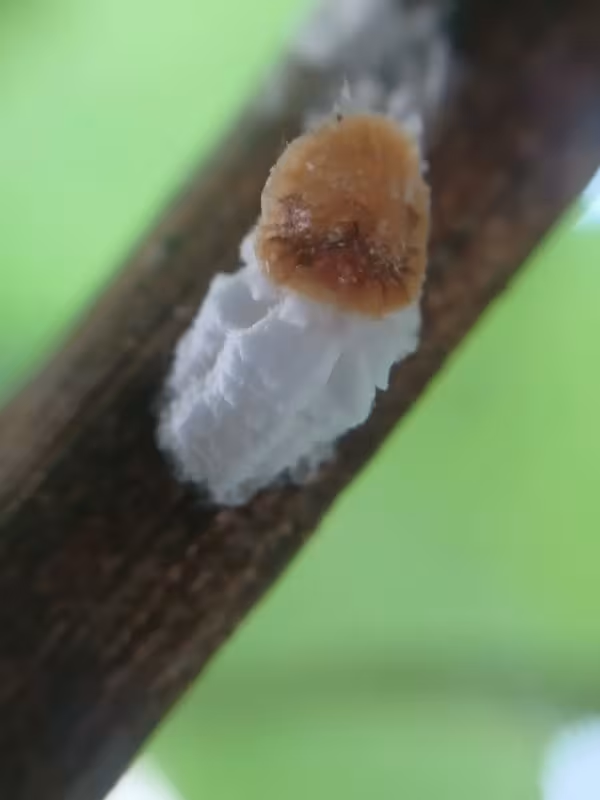
The European fruit lecanium (Pulvinaria vitis) belongs to the family Coccidae. The adult female has a convex, brown body that becomes nearly spherical when it begins egg-laying.
A distinctive feature of this pest is the production of white, fluffy, wax-like egg sacs (ovisacs) which make the pest highly visible on the vine bark.
The young nymphs, known as crawlers, are very small, yellow, and highly mobile, allowing them to spread across the plant quickly.
Reproduction is largely parthenogenetic, meaning females can produce viable eggs without mating, which enables rapid population growth in vineyards.
They overwinter as second-instar nymphs, typically tucked into cracks and crevices of the old bark on woody stems, where they remain until early spring.
What it damages
This pest affects not only grapevines but also various fruit trees such as peach, plum, and cherry, as well as several ornamental shrubs.
Damage is caused by nymphs and females sucking sap from young shoots, leaves, and petioles, which severely weakens the plant and stunts its growth.
Heavy infestations lead to leaf drop, drying of fruit buds, and a significant reduction in overall yield and vine vigor.
The pests excrete large amounts of honeydew, which serves as a substrate for sooty mold, coating the leaves in a black, sticky film.
This black sooty mold inhibits photosynthesis, directly impacting the sugar accumulation in grapes and degrading the quality of the harvest.
When it appears
In spring, as temperatures rise above +10°C, overwintered nymphs move from their wintering sites on the bark to the developing green shoots.
Adult females mature during the bloom period of the vine, making the late spring a crucial time for vineyard monitoring and management.
Egg-laying typically occurs in late spring or early summer, marked by the appearance of the white, waxy sacs on the woody parts of the vine.
The summer generation of crawlers emerges in mid-summer and actively migrates to the undersides of leaves and along the veins to feed.
By autumn, the nymphs complete their feeding stage and migrate back to the old wood to find suitable crevices for overwintering.
Signs of infestation
The most obvious sign is the presence of white, cottony egg sacs on the old wood or cordons of the grapevines in late spring and early summer.
A black, sooty mold covering the leaves and stems is a strong indicator of scale insect activity and associated honeydew production.
Distorted, curled, or stunted shoots, combined with sticky leaves, are classic symptoms of a severe infestation of European fruit lecanium.
Persistent presence of ants on the vines is a reliable sign, as ants are often attracted to the honeydew and protect the scale insects from predators.
Overall decline in plant health, yellowing leaves, and poor shoot development compared to neighboring vines suggest a localized scale problem.
Control measures
Mechanical control involves removing loose, old bark from the vine cordons during the dormant season to eliminate overwintering sites for the nymphs.
Controlling ant populations is vital, as ants actively interfere with natural biological control agents like ladybird beetles and parasitic wasps.
Chemical applications should be timed to coincide with the emergence of the crawler stage, which is the most vulnerable point in the life cycle.
Systemic insecticides are generally effective because they are absorbed into the plant sap, providing a lethal dose to the sucking insects.
- Pruning to improve canopy airflow and light penetration.
- Applying sticky bands to trunks to prevent ant traffic.
- Encouraging natural predators such as ladybugs and lacewings.
Taxonomy
- Latin name
- Pulvinaria vitis
- Order
- Hemiptera (bugs, aphids, leafhoppers)
- Family
- Coccidae
- EPPO code
- PULVVI
Discussion
No discussions yet — be the first.