
Publilia reticulata
Publilia reticulata
Description
How to identify
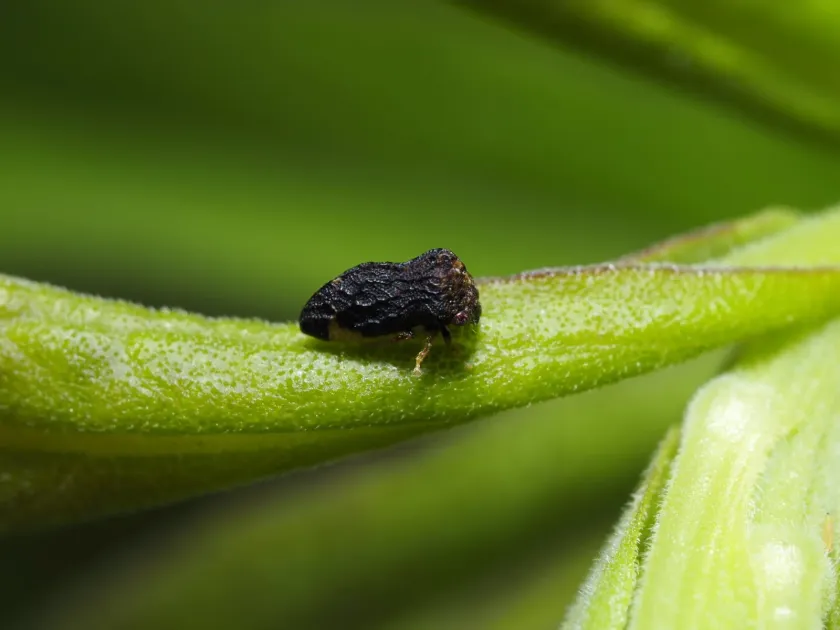
Publilia reticulata is a species of treehopper belonging to the family Membracidae. These insects are easily recognized by their unique thoracic pronotum, which is often elongated into a hump-like structure.
Adults typically measure between 5 and 7 millimeters in length. Their coloration ranges from brown to gray with a reticulated, net-like pattern, serving as effective camouflage against bark and plant stems.
The nymphs lack the prominent hump of the adults and often appear spiky or flattened. They are sedentary and are almost always tended by ants, which protect them from predators.
The life cycle involves oviposition into the tissues of host plants. Females use a sharp ovipositor to cut into stems, where they lay their eggs, which can cause localized tissue damage.
These treehoppers rely on mutualistic relationships with ants. The ants provide protection to the nymphs in exchange for honeydew, a sugary substance secreted by the insects.
What it damages
Publilia reticulata primarily damages woody plants and shrubs. They are commonly found on species within the Asteraceae and Rosaceae families, as well as various ornamental trees.
By piercing and sucking phloem sap from young shoots and leaf petioles, these insects cause stunted growth and severe deformation of new foliage.
Repeated feeding sessions weaken the host plant, making it more susceptible to environmental stressors such as drought and winter cold.
The honeydew produced by these insects accumulates on leaves, facilitating the growth of sooty mold, which blocks sunlight and hinders the plant's photosynthetic ability.
In nurseries and orchards, heavy infestations can lead to significant biomass loss and reduce the overall aesthetic and economic value of the plants.
Signs of infestation
One of the most obvious signs is the presence of insect clusters on succulent young shoots. These insects are skittish and will jump or fly away when disturbed.
The constant traffic of ants on young branches is a strong indicator of an active treehopper colony, as the ants are attracted to the honeydew secretion.
Sticky, shiny residues on the foliage indicate that sucking insects are active in the canopy. This often leads to the later development of black, dusty-looking sooty mold.
Curled, twisted, or yellowing leaves on terminal shoots are common symptoms of localized feeding damage caused by the treehoppers.
Premature leaf drop or the dieback of tender tips in the middle of the growing season is a clear sign that the plant is under sustained attack.
Control measures
Effective management of Publilia reticulata involves combining chemical control with methods that disrupt their relationship with tending ants.
Systemic insecticides are generally the most effective method, as they are absorbed into the plant vascular system and poison the treehoppers during their sap-feeding process.
Manual removal of infested terminal shoots is recommended for small-scale infestations or early-season outbreaks to curb the population growth.
Applying sticky bands to tree trunks is a vital cultural control method. By preventing ants from reaching the treehoppers, the nymphs lose their protection and become vulnerable to natural predators.
- Application of systemic insecticides during the peak nymph stage.
- Use of trunk sticky barriers to exclude ants.
- Encouraging biological control by protecting natural predators like lady beetles and lacewings.
Taxonomy
- Latin name
- Publilia reticulata
- Order
- Hemiptera (bugs, aphids, leafhoppers)
- Family
- Membracidae
- EPPO code
- PUBLRE
Discussion
No discussions yet — be the first.