
Publilia
Publilia
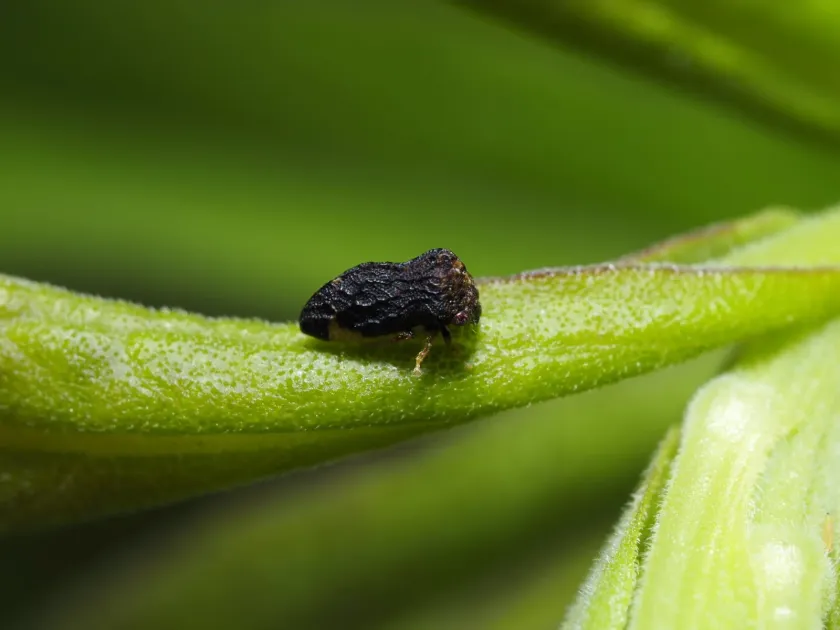
Description
How to identify
Publilia is a genus of insects belonging to the family Membracidae, commonly known as treehoppers, within the order Hemiptera. These insects are easily recognized by the enlarged and specialized pronotum that often covers the entire body, creating a hump-like or helmet-shaped appearance.
Adult specimens typically range from 4 to 8 mm in length. Their coloration is usually camouflaged in earthy tones, such as brown, gray, or olive, which allows them to blend seamlessly with the bark and foliage of their host plants.
The body is robust and well-armored, adapted for a life on stems and herbaceous vegetation. Like other members of the Hemiptera order, they possess specialized piercing-sucking mouthparts designed for feeding on plant phloem sap.
Nymphs differ significantly from the adults; they lack the fully developed pronotum "hump" and are often covered in specialized wax filaments or fine hairs for protection. The life cycle involves incomplete metamorphosis, passing through several nymphal instars.
These insects often exhibit a symbiotic relationship with ants. The ants protect the treehoppers from predators in exchange for the honeydew, a sugary byproduct excreted by the nymphs and adults as they feed.
What it damages
Publilia species are known to attack a wide range of host plants, including various herbaceous weeds, legumes, and certain woody ornamentals or fruit trees. They primarily congregate on young, succulent shoots where the sap is easiest to reach.
The primary damage is caused by the extraction of large amounts of plant sap. This nutrient loss results in overall stunting, chlorosis, and the general weakening of the host plant, which reduces total yield and biomass production.
Beyond direct sap-feeding, these insects often act as vectors or entry points for secondary pathogens. The mechanical damage caused by their mouthparts can facilitate the entry of various fungi and bacteria into the plant's vascular system.
Young seedlings are particularly vulnerable to infestation. In heavy cases, constant feeding can lead to the wilting and eventual death of young plant tissues, significantly disrupting the development of the crop.
The accumulation of honeydew on the leaves is a major concern as it serves as a substrate for sooty mold. This black fungal growth inhibits photosynthesis, further starving the plant and reducing its vigor.
When it appears
The activity of Publilia typically begins in early spring as temperatures rise, allowing overwintering eggs or nymphs to resume feeding and development. Their life cycle is heavily synchronized with the growth stages of their host plants.
Population peaks are generally observed in mid-summer, as multiple generations may occur in a single season depending on the climate and host availability. Late summer and early autumn are critical periods for egg-laying.
As temperatures drop in the autumn, the adults prepare for dormancy. Eggs are typically laid within plant tissues, such as cracks in the bark or near bud scales, ensuring their survival throughout the winter months.
Environmental factors significantly impact their population dynamics. Extended periods of extreme heat or excessive rainfall can naturally reduce colony size, while moderate, warm weather provides optimal conditions for rapid multiplication.
Scouting for this pest should be prioritized during the peak vegetative growth period, specifically checking the undersides of young leaves and the stems of succulent shoots where they tend to hide.
Signs of infestation
Visible signs of infestation include stunted growth, leaf curling, and the appearance of chlorotic or yellowing spots at the feeding sites. In severe cases, premature leaf senescence and abscission may occur.
A glossy, sticky residue known as honeydew on the leaves and stems is a classic indicator of treehopper activity. The presence of ant trails moving up and down the plant is a strong secondary signal that Publilia colonies are active.
Upon closer inspection, the insects themselves may be spotted. While they are quick to flee or jump when disturbed, they are often found in groups, clustered together in the leaf axils or along the underside of stems.
The development of sooty mold, appearing as a dark or black powder on the foliage, is a clear visual cue that the plant has been struggling with a sap-sucking pest infestation for some time.
Stem deformation or the development of localized galls can also occur, particularly on woody plants where the insects have repeatedly fed or deposited eggs over an extended period.
Control measures
Integrated pest management starts with good cultural practices, including the regular removal of nearby weeds that might serve as alternative hosts for the Publilia populations during the off-season.
Biological control is highly effective when local predator populations are encouraged. Generalist predators such as lady beetles, lacewings, and assassin bugs are major natural enemies that can significantly limit treehopper outbreaks.
If population thresholds are exceeded, chemical control using systemic insecticides is recommended. Products containing neonicotinoids or pyrethroids are typically effective at eliminating colonies and preventing further plant damage.
Applications should be timed correctly, targeting the active feeding stages during the cooler parts of the day. Using spreaders or stickers with the insecticide is advised to ensure better coverage on the waxy surfaces of the insects.
- Regular monitoring of crop development and pest presence.
- Pruning and destroying heavily infested twigs or branches.
- Installation of yellow sticky traps to capture adult insects.
- Crop rotation to reduce the overwintering success of the pest in the field.
Taxonomy
- Latin name
- Publilia
- Order
- Hemiptera (bugs, aphids, leafhoppers)
- Family
- Membracidae
- EPPO code
- PUBLSP
Discussion
No discussions yet — be the first.