
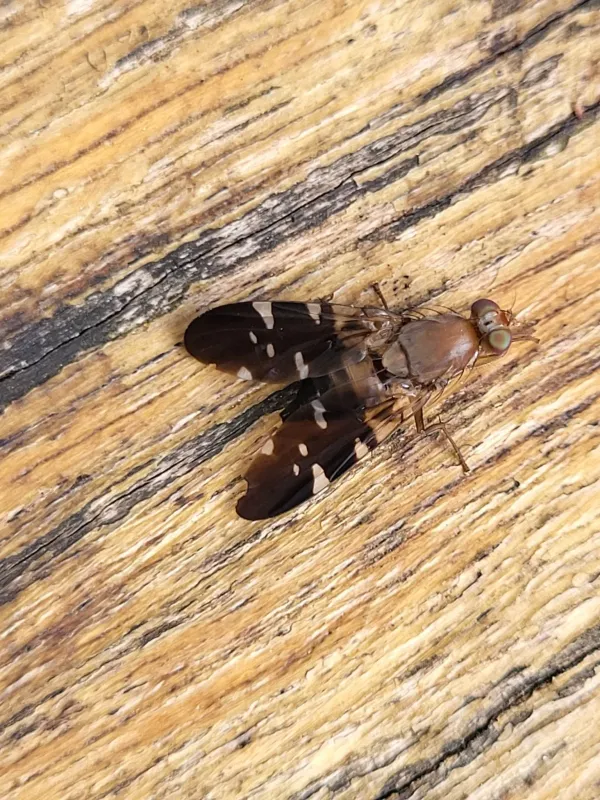
Fruit fly Ptilona confinis
Ptilona confinis
Description
How to identify
Ptilona confinis is a member of the Tephritidae family, also known as fruit flies or picture-winged flies. These insects are distinguished by the unique, elaborate patterns on their wings, which are typically used for mating displays.
The adult fly has a robust body and specialized mouthparts for feeding on plant secretions. Females possess a sharp, sclerotized ovipositor used to pierce the skin of fruits to lay eggs deep within the pulp.
Morphologically, they are small, often blending into their environment due to cryptic coloration. Their eyes are frequently iridescent, providing them with excellent vision to locate suitable host plants.
Larvae of this species are typical dipteran maggots, appearing whitish or yellowish, and are legless. They are highly specialized for an endophagous lifestyle, meaning they develop entirely within the fruit tissue.
Scientific identification usually requires the examination of wing venation patterns and male genitalia, as many species within the Tephritidae family look remarkably similar at first glance.
What it damages
The primary damage caused by Ptilona confinis occurs during the larval stage. As larvae consume the internal tissues of the fruit, they create intricate tunnels that degrade the structure of the fruit.
This feeding activity often introduces fungi, bacteria, and yeasts into the fruit, which leads to rapid decay. Consequently, the affected fruit becomes soft, discolored, and loses its marketability.
In addition to quality loss, the physical damage often triggers an ethylene response in the host fruit, leading to premature ripening and subsequent fruit drop from the tree.
In cases of high infestation, significant portions of the crop can be destroyed, causing severe economic losses for growers. The damage is often internal and not immediately visible until the fruit begins to rot.
The presence of larvae also renders the fruit unappealing for fresh consumption and unsuitable for many industrial processing applications, reducing the overall value of the harvest.
When it appears
The seasonal activity of Ptilona confinis is heavily dependent on temperature and the phenology of its host fruits. They are most active when temperatures allow for rapid development and reproduction.
Adult flies emerge from pupae in the soil when environmental conditions reach a threshold. The timing of mating and egg-laying is synchronized with the fruit developmental stage suitable for larval growth.
Multiple generations can occur within a single growing season if conditions remain optimal. This continuous lifecycle makes the pest particularly difficult to manage during the summer months.
Pupation typically takes place in the soil under the host tree. This life stage is vital for the survival of the species during winter or dry spells, as the pupae remain dormant in the ground.
Monitoring the flight patterns of adult flies is essential for timing interventions effectively, as the window for successful control is narrow and tied to the female's egg-laying period.
Signs of infestation
The earliest signs of infestation include small, localized sting marks on the fruit skin, which are the entry points for the female's ovipositor. These marks may be surrounded by slight discoloration.
Premature color change of the fruit is a common indicator of internal damage. Often, a fruit that appears ripe ahead of others is a prime candidate for harboring larvae.
As the infestation progresses, the fruit may become soft or mushy in specific areas. Upon cutting the fruit open, you will find larval tunnels and frass, which are clear signs of internal feeding.
Premature fruit drop is a frequent consequence of infestation. Collecting this dropped fruit and inspecting it will often reveal the exit holes of fully developed larvae.
Visible decay patches that originate from the inside out are a hallmark of fruit fly activity, distinguishing it from superficial skin damage caused by other insects or physical impact.
Control measures
Effective management of Ptilona confinis requires an integrated pest management (IPM) approach that targets multiple life stages of the fly.
- Strict sanitation, including the regular removal and destruction of fallen or damaged fruit to break the lifecycle.
- Soil cultivation around the base of trees to expose pupae to natural predators and environmental stressors.
- Utilization of adult traps, such as those using protein baits or synthetic pheromones, for monitoring and population suppression.
- Application of selective insecticides at specific stages of the fly's development to prevent egg-laying.
- Implementation of bagging techniques for high-value fruits to physically exclude the flies from reaching the crop.
Taxonomy
- Latin name
- Ptilona confinis
- Order
- Diptera (flies)
- Family
- Tephritidae
- EPPO code
- PTIOCO
Discussion
No discussions yet — be the first.