
Raspberry cane fly
Pterandrus rubivorus
Description
How to identify
The raspberry cane fly Pegomya rubivora is a small dipteran insect belonging to the Anthomyiidae family. Adults are greyish-black, measuring approximately 5–7 millimeters in length with clear wings.
The larvae are cylindrical, legless, and reach about 5-8 millimeters in length. They are typically creamy-white or yellowish in color and specialized for feeding within the stems of plants.
The life cycle involves four stages: egg, larva, puparium, and adult. The insect typically overwinters in the pupal stage buried within the soil beneath the raspberry canopy.
The emergence of adults occurs in spring, coinciding with the rapid growth phase of young raspberry shoots. This timing makes them particularly dangerous to the development of new canes.
Identifying this pest in early stages is challenging due to the hidden internal feeding nature of the larvae, which necessitates vigilant monitoring of the plantation.
What it damages
The primary host for this pest is the cultivated raspberry, though it can also infest blackberries. The larvae cause direct damage by feeding on the internal tissues of developing stems.
By boring into the tender shoots, the larvae disrupt the vascular system, preventing nutrient flow to the upper parts of the plant. This leads to the characteristic wilting and eventual death of the shoot tip.
Damage is most prevalent on young replacement canes when they reach a height of 15–30 centimeters. If left unmanaged, this damage significantly reduces the yield potential for the following season.
High-density plantings create ideal humidity conditions for the proliferation of this fly, often leading to severe localized outbreaks that can devastate young plantation sections.
In cases of heavy infestation, a large percentage of new canes can be affected, weakening the structural integrity of the plant and predisposing it to secondary diseases.
When it appears
Seasonal activity begins in spring when soil temperatures reach approximately 12-15 degrees Celsius. This triggers the emergence of the first generation of adult flies from their overwintering sites.
Females lay eggs singly or in groups near the leaf axils of the youngest shoot tips. After about 7 to 10 days, the larvae hatch and immediately bore into the stem.
The larval feeding period lasts for approximately 2 to 3 weeks. Once fully developed, the larvae exit the stems and move into the soil to pupate and begin their next cycle.
The flight period can be staggered throughout the spring season, making it necessary to inspect the tips of new canes consistently to catch early signs of infestation.
By mid-June, the cycle of the first generation generally concludes, and the risk of new damage to current season shoots decreases significantly as the stems harden.
Signs of infestation
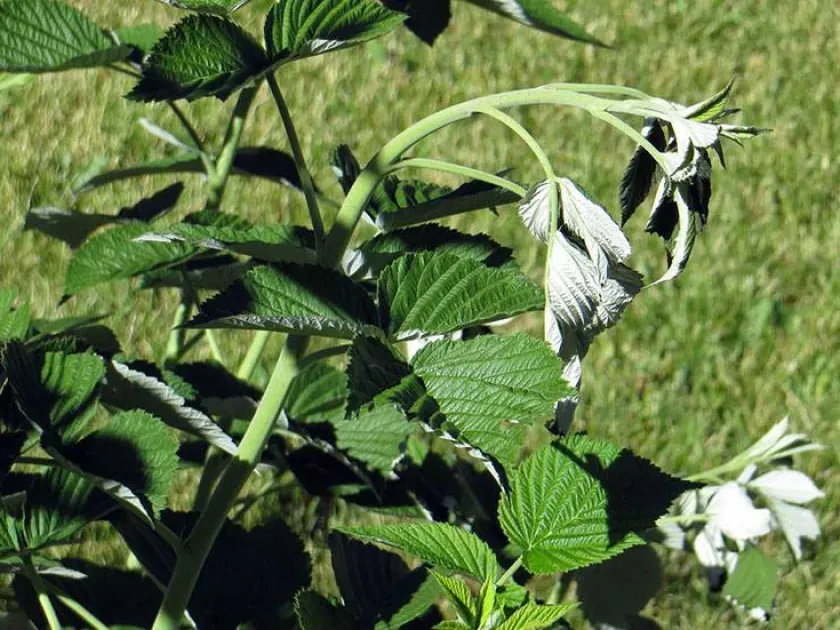
The most prominent sign of infestation is the sudden wilting and drooping of the shoot tip. The affected part often turns black and begins to shrivel or dry up entirely.
Close inspection will reveal an entry hole on the stem below the wilted section, often accompanied by a darkened ring or track where the larva has tunneled.
Splitting the stem vertically will reveal a spiral-shaped channel created by the larva, and often the white larva itself, which confirms the diagnosis of raspberry cane fly damage.
The loss of the terminal bud triggers the growth of lateral side shoots, which can lead to excessive and structurally weak branching patterns on the affected canes.
These damaged stems lose their vitality, become brittle, and are significantly more susceptible to environmental stressors and further pathogenic infection.
Control measures
The most reliable control method is the immediate mechanical removal and destruction of wilted shoot tips before the larvae finish feeding and drop into the soil.
- Cultivating the soil around the base of the bushes in autumn to disrupt overwintering pupae.
- Regular pruning of all dead and damaged canes to eliminate reservoir sites for the pest.
- Maintaining proper spacing between plants to improve airflow and reduce humidity levels.
- Applying systemic insecticides during the peak flight period of adult flies to prevent egg-laying.
Chemical control measures are only effective during the short window when adults are active and before the larvae have successfully penetrated the interior of the shoots.
Integrated pest management strategies, including the use of biological control agents and pheromone traps, can help manage populations without leaving residues on the harvested berries.
Taxonomy
- Latin name
- Pterandrus rubivorus
- Order
- Diptera (flies)
- Family
- Tephritidae
- EPPO code
- CERTVO
Discussion
No discussions yet — be the first.