
Drain fly
Psychoda alternata
Description
How to identify
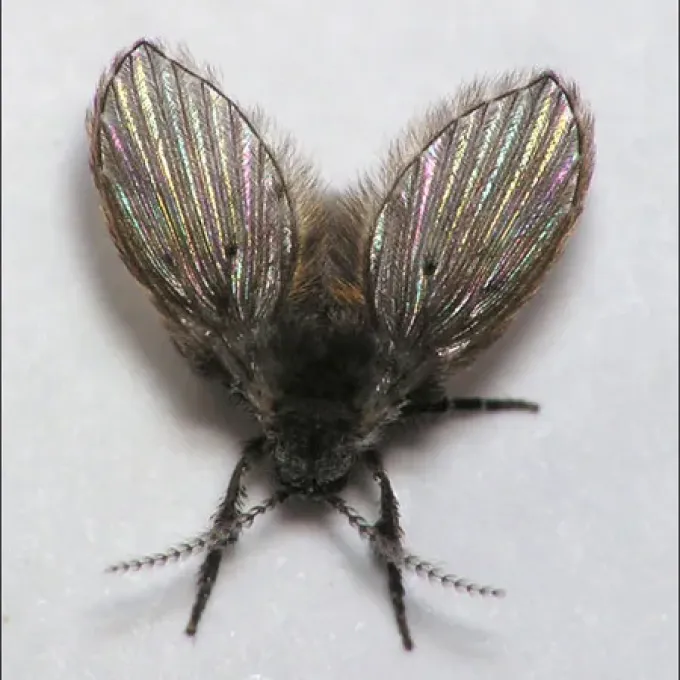
The drain fly (Psychoda alternata) is a small dipteran insect in the Psychodidae family, often referred to as a moth fly due to its fuzzy, moth-like appearance.
Adults are tiny, measuring about 2 to 3 mm in length, with broad, hairy wings that are held roof-like over the body when the insect is at rest.
The larvae are legless, pale to brown in color, and possess a distinct breathing siphon, allowing them to survive in oxygen-poor, semi-aquatic environments.
They are poor fliers and typically move by making short, darting flights or by crawling across surfaces, especially near water sources.
The entire lifecycle is rapid, often taking less than two weeks in warm, humid conditions, which leads to sudden and massive population outbreaks.
What it damages
Drain flies are primarily nuisance pests rather than direct plant pathogens, but they pose significant risks in greenhouses and hydroponic systems.
The larvae feed on organic matter and bacteria accumulating in drainage pipes, clogged gutters, and growing media, leading to unhygienic conditions.
In hydroponic setups, high populations of larvae can cluster around plant roots, damaging delicate root hairs and causing stress to the plant.
Their presence is a strong indicator of overwatering, poor drainage, or the buildup of decaying plant material, which are favorable conditions for root rot pathogens.
While they do not consume leaves or stems, the resulting root damage and the spread of opportunistic fungal pathogens can lead to stunted plant growth.
When it appears
In greenhouses and indoor environments, drain flies can reproduce throughout the year, provided that moisture and warmth are consistently maintained.
Population peaks are typically observed during the summer months when ambient temperatures optimize the insect's reproductive cycle and metabolic rate.
Optimal development occurs between 20°C and 25°C, though they can persist at wider temperature ranges if moisture remains abundant.
Cooler temperatures significantly slow down the life cycle, but the pest can overwinter in sheltered, damp areas such as drain lines or moist soil pockets.
Seasonal surges are most common after periods of heavy irrigation where excessive water pools in trays or unventilated areas of the greenhouse.
Signs of infestation
The most prominent sign is the sighting of adult flies gathering near water outlets, drains, or moist growing media surfaces.
An unpleasant, musty odor emanating from drainage systems or potting soil often accompanies an infestation, indicating the breakdown of organic matter.
Yellowing leaves and a lack of vigor in plants despite proper fertilization may suggest root system damage or poor root oxygenation caused by larval activity.
Visual inspection of drainage trays or hydroponic channels may reveal small, worm-like larvae moving through the sludge or debris.
Sudden swarming of tiny, moth-like insects upon disturbing plants or irrigation equipment is a clear indication of an established infestation.
Control measures
The most effective strategy for managing drain flies is rigorous sanitation, focusing on the removal of organic buildup in all drainage areas.
Improving greenhouse ventilation and allowing the growing medium to dry out slightly between waterings can prevent larval survival and development.
Biological control agents, such as microbial larvicides containing specific bacteria, are effective at reducing populations without harmful chemical residues.
Sticky traps can be used to monitor and reduce the number of adult flies, although they do not address the source of the infestation.
- Clear all clogged gutters and drain pipes regularly.
- Remove rotting plant debris from the floor and benches.
- Avoid overwatering and ensure proper sub-irrigation drainage.
Taxonomy
- Latin name
- Psychoda alternata
- Order
- Diptera (flies)
- Family
- Psychodidae
- EPPO code
- PSYCAL
Discussion
No discussions yet — be the first.