
Psyche casta
Psyche
Description
How to identify
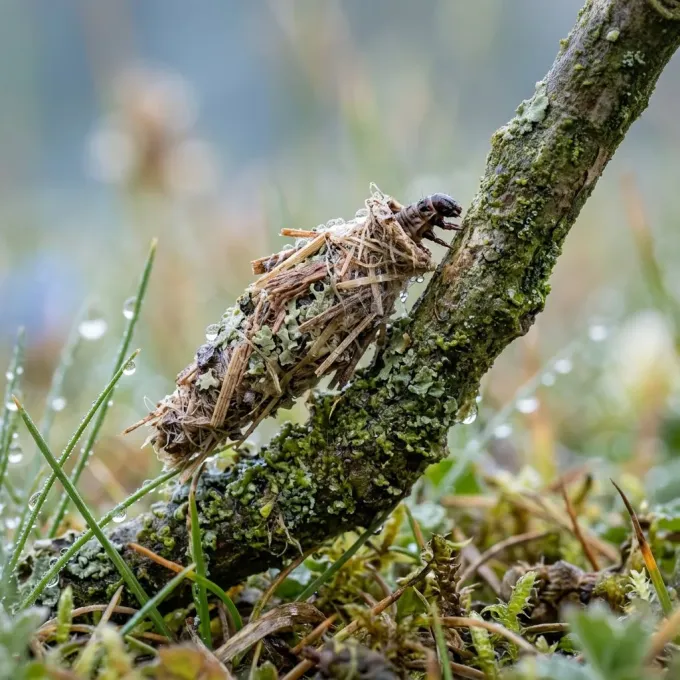
Psyche casta, commonly known as a bagworm moth, belongs to the Psychidae family within the order Lepidoptera. Adult males are small moths with a wingspan of about 12–15 mm and dark brownish coloration.
Females are biologically distinct, as they are wingless, legless, and have a worm-like appearance. They spend their entire adult life within a protective case made of silk and plant debris.
The larvae, or caterpillars, have a dark head and thoracic shield, with a pale whitish-yellow body. Their most notable feature is the mobile case they construct and carry with them throughout their development.
The life cycle involves complete metamorphosis. The larvae overwinter inside these protective cases, which are securely attached to branches or tree trunks, making them difficult to spot during the dormant season.
In spring, larvae emerge and resume feeding. As they grow, they enlarge their cases, incorporating fresh bits of leaves and twigs. Toward the end of the larval stage, they anchor the case firmly before pupating.
What it damages
This pest is a polyphage, meaning it infests a wide range of woody plants, shrubs, and trees. It is particularly known for causing damage to fruit trees such as apple, pear, plum, and cherry.
In addition to orchard crops, Psyche casta often feeds on deciduous forest trees like birch, willow, and alder. Ornamental shrubs in gardens can also suffer from heavy feeding pressure.
During outbreaks, large numbers of caterpillars can significantly defoliate plants. This reduction in leaf surface area impairs photosynthesis, leading to stunted growth and reduced fruit yield.
Damage appears as irregular holes in leaves or complete skeletonization of the leaf blades. Severely infested trees may show signs of stress, making them more susceptible to secondary pests and diseases.
The economic impact depends on the pest density. While individual larvae cause negligible harm, a high population can severely weaken the tree's immune system and reduce overall harvest quality.
Signs of infestation
The primary sign of infestation is the presence of small, cone-shaped cases, 10-15 mm long, hanging from leaves, twigs, or bark. These look like small bits of organic litter or debris.
Upon closer inspection, one can observe these cases moving slowly along the plant surface. If disturbed, the caterpillar retreats inside its case and remains motionless, mimicking inanimate debris.
Leaf damage starts with minor abrasions and progresses to larger holes. Fine silken threads, used by the larvae to anchor their cases, are often visible around the feeding sites on twigs and stems.
During the pupation phase, the cases are firmly attached to the substrate. Finding a cluster of such cases on a single branch is a clear indicator of a pest population that requires intervention.
Early spring scouting may reveal damage to young developing buds and emerging leaves. This indicates the larvae have finished their winter diapause and are actively feeding on the host plant.
Control measures
The most effective mechanical control is the manual removal and destruction of cases during the autumn and winter months. Pruning infested branches can significantly reduce the overwintering population.
During the growing season, biological insecticides containing Bacillus thuringiensis are effective against young larvae. These products are environmentally friendly and safe for beneficial predatory insects.
Chemical control involving systemic or contact insecticides may be necessary during heavy infestations. It is crucial to apply these treatments when larvae are actively feeding and before they pupate.
Cultural practices, such as maintaining healthy tree vigor and cleaning bark surfaces, help reduce the success rate of the pest. A well-nourished plant is better equipped to withstand and recover from light damage.
Consistency is key to managing this pest. Regular monitoring of the garden throughout the spring and early summer allows for early detection, preventing the moth population from reaching damaging levels.
Taxonomy
- Latin name
- Psyche
- Order
- Lepidoptera (butterflies)
- Family
- Psychidae
- EPPO code
- PSCHSP
Discussion
No discussions yet — be the first.