
Pseudodacus pallens
Pseudodacus pallens
Description
How to identify
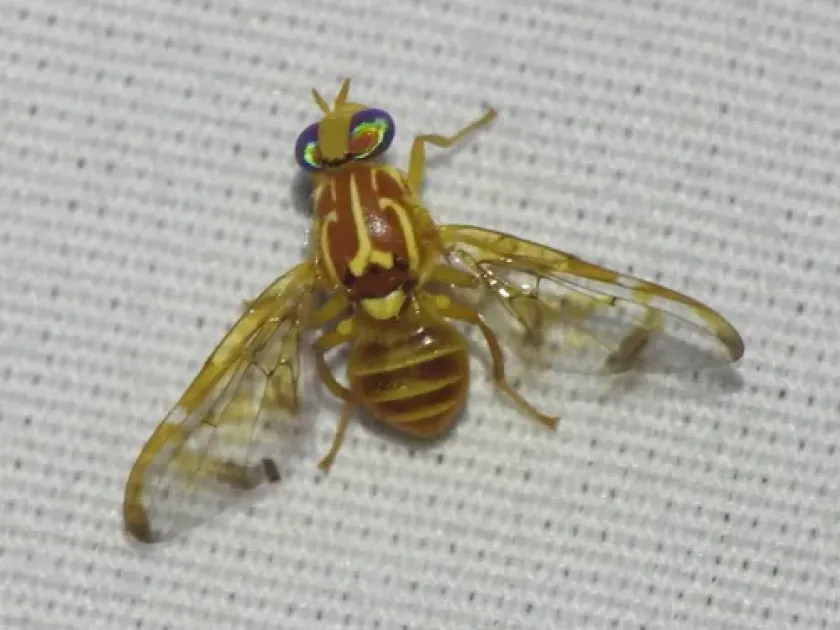
Pseudodacus pallens is a specialized insect from the order Diptera, belonging to the fruit fly family Tephritidae. As an adult, this small insect is characterized by wing patterns that are typical for the family, often featuring brownish or dusky markings.
The body of the pest generally displays a yellowish-brown or light coloration, which is reflected in its specific epithet. Morphologically, it is closely related to other species in its group, and precise identification often requires microscopic examination of genitalia or wing venation by a professional entomologist.
The life cycle includes four distinct stages: egg, larva, pupa, and adult. The adults lead a secretive life, preferring areas with dense vegetation where they find sustenance and mating partners.
Larval development occurs exclusively inside the host plant tissues, making them highly protected from many predators and parasites. Pupation usually takes place in the soil or within dry plant debris, where the pupa is shielded from harsh external conditions.
While the species occupies a specific niche related to wild flora in its natural habitat, it is capable of significantly increasing its population density when it shifts to cultivated crops.
What it damages
The primary damage is caused to plant parts where larvae can complete their feeding cycle. In most cases, these are fruits or seed pods, inside which the larvae feed and grow.
Larvae create tunnels within the fruit, feeding on the pulp or seeds. This compromises the integrity of the plant structure and promotes secondary bacterial and fungal infections, which lead to tissue decay.
Damaged fruits lose their commercial value and, in cases of severe infestation, become completely unsuitable for human consumption or processing. The reduction in yield quality is the main economic impact caused by this pest.
In some instances, damage may extend to young shoots or buds if the host plant provides a suitable structure for larval feeding. Such injuries lead to deformation and premature abscission of reproductive organs.
Mass reproduction of this pest in orchards or fields can result in significant yield losses if timely monitoring and control measures are not implemented at the beginning of the season.
When it appears
The activity of Pseudodacus pallens adults is directly dependent on temperature and humidity. The emergence of adults typically coincides with the flowering period or the early stages of fruit setting in sensitive host plants.
Depending on the climatic zone, the pest may produce one or several generations per year. Warm and humid conditions facilitate faster larval development and subsequent adult emergence.
The second half of the growing season is characterized by a peak in larval population density within fruits, as this is the period when the plant accumulates the nutrients necessary for the insect's growth.
Overwintering occurs at the pupal stage in the topsoil layer. This provides protection against winter frosts and allows the pest to rapidly activate upon the arrival of spring warmth.
Monitoring the adult emergence season is crucial for organizing protection measures, as the main control efforts must be directed toward interrupting the development cycle before egg-laying occurs.
Signs of infestation
The first visual sign of the pest's presence is the appearance of puncture points on the fruit skin, left by females during oviposition. Color changes or small indentations are often observed around these punctures.
Accelerated ripening or "false" coloring of fruits is another characteristic sign. The infested fruit may appear ripe prematurely, but internally it is filled with larval frass and decomposing tissue.
The presence of specific exit holes, through which mature larvae leave the fruit to pupate in the soil, clearly indicates the final stage of infestation.
When cutting open a fruit, one can find characteristic larvae—legless, whitish, or cream-colored, actively moving within the tunnels.
A secondary sign is the appearance of rot spots that spread rapidly across the fruit. The development of these rot centers is often triggered by the feeding activity of Pseudodacus pallens larvae.
Control measures
The foundation of protection against this pest is an agrotechnical method: gathering and destroying fallen fruit. Removing infested fruits before larvae can leave them for pupation in the soil drastically reduces the future population.
Tilling the soil around tree bases or between rows during autumn helps destroy overwintering pupae by bringing them to the surface, where they perish from frost or are consumed by birds.
The use of pheromone traps allows for precise tracking of adult flight, enabling timely insecticide applications during the mass emergence period to prevent egg-laying.
In large-scale farming, systemic or contact-stomach insecticides approved for use on specific crops are applied, with strict adherence to pre-harvest intervals.
- Usage of biological control agents (entomophagous insects).
- Implementation of crop rotation and spatial isolation of plantings.
- Installation of sticky traps and nets to protect individual fruits.
- Regular phytosanitary cleaning of the area from plant debris.
Taxonomy
- Latin name
- Pseudodacus pallens
- Order
- Diptera (flies)
- Family
- Tephritidae
- EPPO code
- PSEOPA
Discussion
No discussions yet — be the first.