
Three-spotted grain beetle
Psammoecus trimaculatus
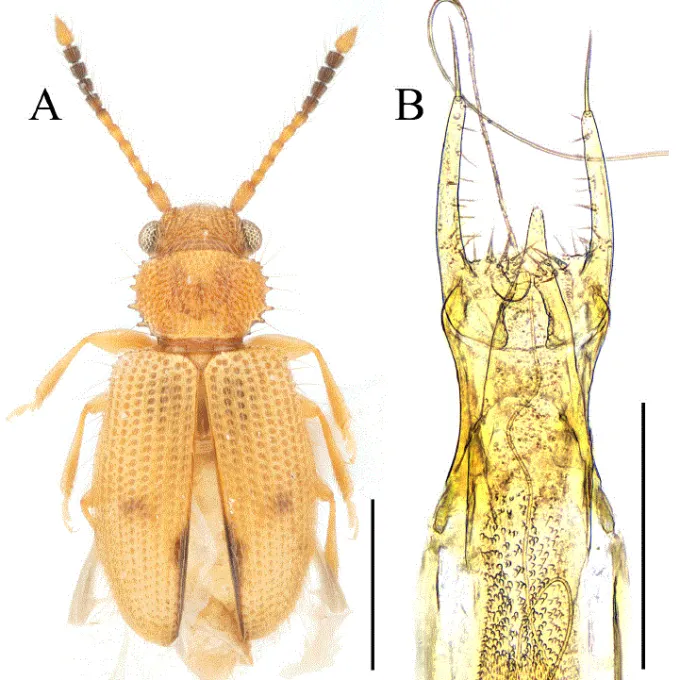
Description
How to identify
The three-spotted grain beetle (Psammoecus trimaculatus) is a small insect belonging to the Silvanidae family. Adult beetles typically measure between 2 to 3 millimeters in length, requiring close inspection for identification.
The body is elongated and ranges in color from reddish-brown to dark chestnut. As the common name suggests, it is distinguished by three dark spots on its elytra, which serve as a primary diagnostic feature.
The antennae are club-shaped, a characteristic that aids entomologists in distinguishing this species from other related grain beetles. Larvae are slender, pale in color, and primarily thrive in hidden, moist environments.
These beetles are strongly associated with high-humidity conditions. In the field, they are frequently found in debris or decaying plant matter, while in storage, they prefer areas where moisture creates damp pockets in the grain.
Accurate identification usually involves the use of a magnifying glass or a stereomicroscope to examine the morphological features, especially the specific pattern of the spots and the structure of the antennae.
What it damages
The three-spotted grain beetle primarily acts as a pest of stored grain, although it can also affect cereal crops in the field under specific conditions. It feeds on both whole and damaged grain particles.
In field settings, the beetles are often found on unharvested crops where moisture has accumulated. In silos or storage facilities, they consume grain dust, cracked seeds, and organic residues present in the storage bins.
The damage caused by this insect extends beyond physical consumption. They facilitate the spread of molds and fungi, which can lead to significant contamination and a decrease in the quality of the harvested grain.
Seeds infested with this pest often show reduced germination rates, making them unsuitable for agricultural use. The metabolic activity of the insects can also cause localized heating, which accelerates degradation.
Losses are often exacerbated by the beetle's ability to thrive in damp conditions, which further encourages the development of secondary fungal pathogens that damage the entire storage lot.
When it appears
The activity of Psammoecus trimaculatus is highly dependent on environmental factors, particularly moisture and temperature. They are most active during warm months when grain maturation occurs in the fields.
During the harvest period, these beetles are frequently transported from the field into storage facilities along with the harvested produce. This is the peak time for initial contamination of storage sites.
In climate-controlled storage, they can reproduce throughout the year. However, their development speed is directly correlated with the ambient temperature and the moisture content of the stored commodities.
Winter months generally slow down their life cycle, causing the insects to enter a period of reduced activity. However, they remain alive and can resume rapid reproduction as soon as temperatures rise in the spring.
Continuous monitoring throughout the storage period is essential, especially following the harvest, to prevent a small population from exploding into a major infestation during the warmer months.
Signs of infestation
The presence of this beetle is often indicated by the accumulation of fine dust (frass) within the grain pile, which is a byproduct of the insects' feeding and movement through the grain mass.
A musty or sour odor emanating from the grain indicates that the beetle population has created conditions suitable for fungal growth. This is a critical warning sign that immediate action is required.
Beetles can often be observed on the surface of grain or within the corners of bins, particularly when the grain is disturbed. They are agile and tend to move away from direct light sources.
Localized patches of moldy or damp grain are common indicators of a beetle infestation. This occurs because the insects create heat and humidity pockets, which in turn support fungal colonization.
- Presence of grain dust and organic debris in the pile.
- Musty odor from the stored grain.
- Visible adult beetles on the grain surface.
- Detection of increased temperature in grain hotspots.
Control measures
Sanitation is the first line of defense. Thoroughly cleaning bins and surrounding areas to remove old grain dust and organic waste prevents the buildup of beetle populations before new grain is added.
Drying grain to a moisture level below 12-13% is the most effective way to prevent Psammoecus trimaculatus from thriving. The beetle cannot complete its life cycle effectively in dry environments.
If an infestation is detected, fumigation with approved phosphine-based products is the standard approach to eliminate all life stages of the insect within the stored commodity.
Field management, such as the efficient removal of crop residue and timely harvesting, reduces the number of beetles that migrate from the field into the storage facility.
Regular inspection and the use of pheromone traps provide early detection of adult beetles, allowing for targeted interventions before the pest can cause significant economic loss.
Taxonomy
- Latin name
- Psammoecus trimaculatus
- Order
- Coleoptera (beetles)
- Family
- Silvanidae
- EPPO code
- PSMETR
Discussion
No discussions yet — be the first.