
Psammoecus bipunctatus
Psammoecus bipunctatus
Description
How to identify
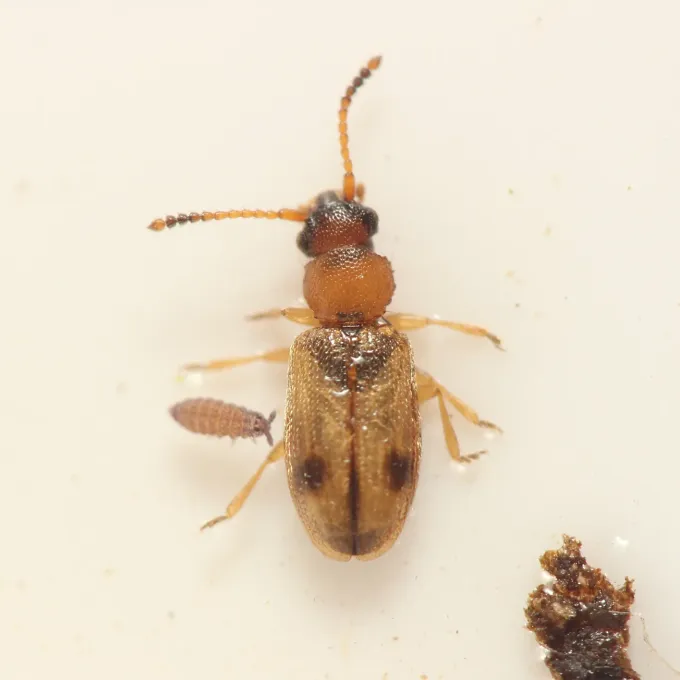
Psammoecus bipunctatus is a small beetle belonging to the Silvanidae family within the order Coleoptera. Adult specimens measure approximately 2–3 mm in length and exhibit an elongated body shape with a brownish-red coloration.
A distinctive feature of this insect is the presence of two clear, dark spots on the elytra located in the posterior region. The beetle's body is covered with fine setae, giving it a dull texture when viewed under magnification.
The head and pronotum feature characteristic lateral projections, and the antennae terminate in a weakly developed club. The larvae are small, agile, typically white or yellowish, and undergo several developmental stages within their habitat.
This pest prefers humid conditions and is often found near water bodies or in areas with dense vegetation. The beetles are capable of flight, which ensures their active spread across agricultural fields and storage facilities.
Taxonomically, this species is classified as a cryptic pest, often remaining unnoticed until mass reproduction occurs, as it prefers secluded areas for feeding and breeding.
What it damages
Psammoecus bipunctatus is most commonly found in grain stocks, stored grain products, and in field conditions on cereals and some vegetable crops. The pest damages both growing plants and harvested crops during storage.
In the field, the beetles may feed on soft plant tissues, damaging inflorescences and young grains, which reduces the quality and marketable weight of the yield. However, they pose the primary threat as secondary stored-product pests.
Once inside storage facilities, the pest prefers damp or fungus-damaged grain. The feeding activity of beetles and larvae in storage leads to significant contamination of grain mass with metabolic waste products.
In addition to direct consumption, the pest contributes to the spread of fungal spores and microorganisms that trigger grain spoilage. Affected products lose germination potential and become unsuitable for food processing.
The pest is often found in plant debris in fields and near warehouses, from where it migrates into buildings under favorable conditions, using cracks and ventilation shafts as entry points.
When it appears
The activity of the insect is directly dependent on temperature and ambient humidity levels. In field conditions, mass emergence of adults is observed during the summer period, when conditions are optimal for breeding.
In closed environments with a constant food source and stable temperatures above 15–18°C, Psammoecus can develop year-round, as it lacks a strict seasonal diapause.
The peak of damage often coincides with the harvest season when beetles migrate from fields to temporary storage sites or threshing floors. During this time, mass movement occurs in search of moist plant residues.
Spring warming activates overwintered individuals, which emerge from shelters to seek foraging grounds. The speed of generation development depends on the humidity of the substrate inhabited by the larvae.
The development cycle includes the egg, larva, pupa, and adult beetle stages. Under favorable conditions, the pest is capable of producing multiple generations within a single growing season.
Signs of infestation
The first sign of infestation in grain storage is the detection of live beetles on the surface of the grain pile. A specific musty odor often accompanies the infestation, indicating the development of microflora associated with the pest.
The presence of tiny holes in grains or damaged seed coatings is an indirect sign of larval activity, as they gnaw on the grain surface. Excrement and molted insect skins may also be found in the produce.
- Increased temperature in grain storage spots ("self-heating").
- Appearance of webbing or mold on grain transported by the pest.
- Reduced flowability of grain mass in areas of insect aggregation.
- Detection of adults in monitoring traps and on building walls.
In fields, identifying an infestation visually is difficult due to the beetle's cryptic behavior. Signs manifest as plant stunting and damage to apical parts if the pest population reaches critical levels.
Laboratory analysis of grain samples allows for accurate identification of the pest by sifting or examining samples under magnification tools.
Control measures
The cornerstone of control is strict adherence to sanitary standards in storage facilities. Regular wet cleaning and aerosol disinfestation of warehouses must be performed before storing new harvests.
Cleaning grain to remove impurities and weed seeds significantly reduces the product's attractiveness to the pest. Drying grain to critical moisture levels makes insect reproduction impossible.
In the fields, it is necessary to carry out effective weed control, as weeds serve as reservoirs for Psammoecus during the off-season. Agrotechnical practices, such as deep autumn plowing, help destroy overwintering sites.
If infestation clusters are detected in warehouses, fumigation with authorized insecticides is employed. Cooling the grain mass is also an effective method that inhibits life processes and slows down the reproduction rate of the pest.
Monitoring population levels using sticky and light traps allows for timely chemical or biological control interventions before the population reaches the economic injury level.
Taxonomy
- Latin name
- Psammoecus bipunctatus
- Order
- Coleoptera (beetles)
- Family
- Silvanidae
- EPPO code
- PSMEBI
Discussion
No discussions yet — be the first.