
Psammoecus
Psammoecus
Description
How to identify
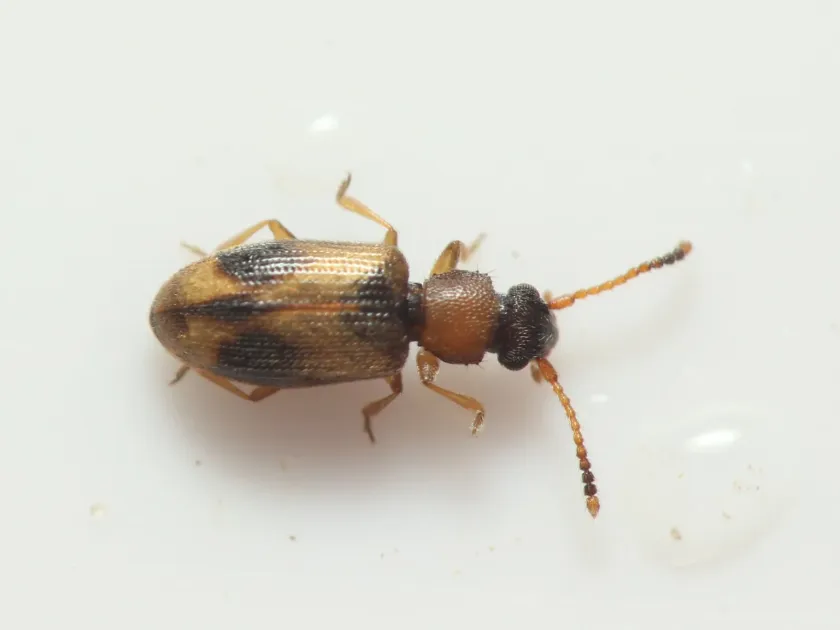
Beetles of the genus Psammoecus belong to the family Silvanidae (silvanid beetles) within the order Coleoptera. These are small insects, typically ranging from 2.5 to 3.5 mm in length.
The body of the beetle is elongated and slightly flattened, with a color profile ranging from reddish-brown to dark brown. Key morphological characteristics include serrated edges of the pronotum and clubbed antennae.
Larvae appear whitish or yellowish, with an elongated body and well-developed thoracic legs. They lead a cryptic, secretive lifestyle, preferring dark, moderately humid environments.
The insect undergoes a complete metamorphosis: egg, larva, pupa, and adult. Adult beetles are capable of flight, facilitating their rapid spread throughout storage facilities or agricultural fields.
This pest is frequently found in high-humidity conditions where mold fungi develop, which can serve as a supplementary food source alongside primary grain products.
What it damages
Psammoecus is primarily classified as a stored-product pest, infesting grains, flour, feed, oilseeds, and dried fruits. It acts as a secondary pest, thriving in products with elevated moisture levels.
In field conditions, these beetles may be found on various grain crops, especially if the plants have been weakened by fungal diseases, environmental stress, or mechanical damage.
The direct damage involves feeding on the endosperm of seeds, leading to significant mass loss and reduced seed viability or commercial quality.
Secondary damage is caused by contamination with excrement, cast larval skins, and metabolic waste, which promotes the growth of secondary microflora and mold.
Infested grain develops an unpleasant odor and a bitter taste, making it unsuitable for human consumption or high-quality processing.
When it appears
Within warehouse environments, Psammoecus is capable of reproducing year-round, provided that temperature and humidity levels remain within favorable ranges.
Peak activity occurs during the spring and summer months, when ambient temperatures in storage facilities rise to between 20°C and 28°C.
In natural habitats, the emergence of adults from overwintering sites correlates with the arrival of consistently warm temperatures in the spring.
Overwintering adults find refuge in plant debris, structural cracks in warehouses, beneath tree bark, or within the top layer of soil.
The developmental cycle from egg to adult takes approximately 30 to 50 days, allowing for several generations to emerge annually under optimal conditions.
Signs of infestation
The first indicator of an infestation is a distinctive musty or "grain storage" smell, which intensifies as the insect population grows within the bulk storage.
Visual inspection often reveals small entry holes in grains and the presence of fine dust, composed of excrement and pulverized grain particles.
Clusters of live beetles can often be spotted on the surface of grain piles or in warehouse corners, particularly in areas with high humidity or condensation.
Sieving grain samples through fine-mesh screens will easily reveal both adult beetles and larvae, which might otherwise be missed during simple visual scans.
The presence of surface mold on grain stocks is frequently associated with concurrent Psammoecus infestation, as the beetles prefer these moist environments.
Control measures
The primary control method is strictly maintaining moisture and temperature limits: drying grain to 12-14% moisture significantly inhibits population growth.
Before loading new harvests, it is mandatory to thoroughly clean and disinfect storage facilities to remove old grain residues that harbor pest breeding grounds.
Fumigation of storage areas using phosphine-based agents remains the most effective and radical method for eliminating large infestations of stored-product pests.
In agricultural fields, maintaining good agronomic practices, including effective weed control and timely harvesting, helps minimize the risk of initial contamination.
Systematic monitoring using pheromone or sticky traps allows for early detection, enabling farmers to contain infestations before they spread throughout the entire facility.
Taxonomy
- Latin name
- Psammoecus
- Order
- Coleoptera (beetles)
- Family
- Silvanidae
- EPPO code
- PSMESP
Discussion
No discussions yet — be the first.